














































































.png)









![[HOONIGAN] Ken Block's GYMKHANA NINE](https://img.youtube.com/vi/_bkX5VkZg8U/maxresdefault.jpg)






































































![[HOONIGAN] KEN BLOCK'S GYMKHANA SEVEN: WILD IN THE STREETS OF LOS ANGELES](https://cdn.motor1.com/images/mgl/2KlO4/s1/ken-block-london-tour-directors-cut.jpg)




































How to Corner Balance Your Car: Complete Track Setup Guide
Professional corner balancing guide for track cars. Equipment, process, adjustment, and performance gains explained.
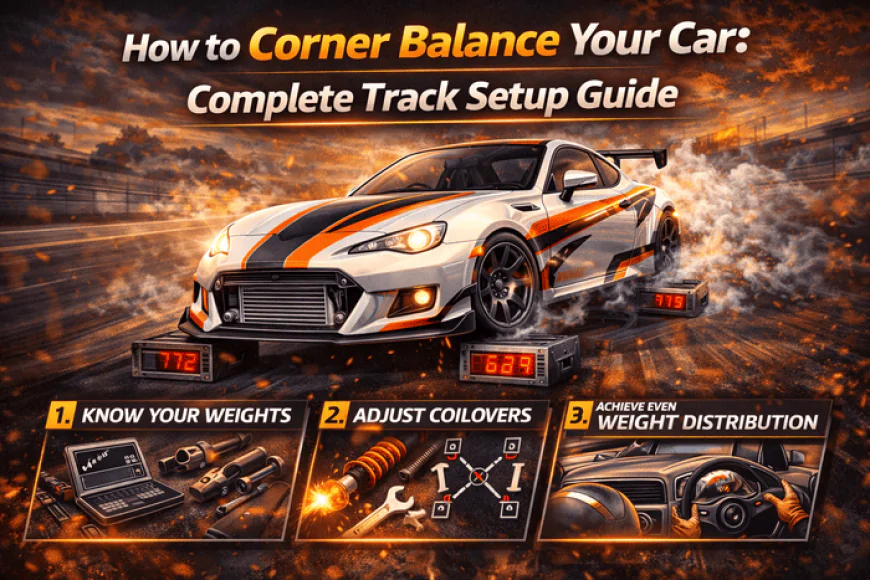
What is Corner Balancing?
Corner balancing (also called corner weighting) is the process of adjusting your car's weight distribution to optimize handling. The goal is to equalize diagonal weight pairs so the car handles consistently in left and right corners. A properly corner-balanced car has better turn-in, more predictable handling at the limit, and improved lap times.
Most production cars aren't corner-balanced from the factory. They're designed for comfort and cost, not ultimate handling. A stock car might have 51% weight on the front left, 49% on front right, 48% on rear left, and 52% on rear right. These imbalances cause inconsistent handling — the car might understeer left but feel neutral right, or vice versa.
Corner balancing fixes this by adjusting spring perch heights (on coilovers) to redistribute weight. Done properly, you achieve equal diagonal weights: if front-left + rear-right = 50%, then front-right + rear-left should also = 50%. This creates balanced, predictable handling.
This complete guide walks through the equipment needed, the step-by-step process, how to make adjustments, and the performance gains you can expect.
As covered in our MX-5 coilovers guide, suspension setup is fundamental to track performance. Corner balancing takes that to the next level.
What You'll Learn:
- Equipment required
- Step-by-step process
- How to make adjustments
- Target weight distributions
- Expected performance gains
- When professional help is needed

Equipment Required
Essential Equipment
Corner weight scales (4):
- Cost: £1,200-3,000 for set of 4
- OR: Borrow/rent from track or specialist (£50-150/day)
- Capacity: 1,000kg+ per scale
- Accuracy: ±0.5kg
Tools:
- Coilover adjustment spanners
- Torque wrench
- Jack and axle stands
- Level surface
- Tape measure
- Calculator or spreadsheet
Driver weight ballast:
- Equivalent to driver weight
- Placed in driver's seat during process
- Essential for accuracy
Understanding Weight Distribution
Target Distributions
Front/Rear split:
- FWD: 60-65% front
- RWD: 50-55% front
- AWD: 55-60% front
Left/Right balance:
-
Target: 50/50 (within 0.5%)
Diagonal (cross-weight):
- Target: 50/50 (within 1%)
- Formula: (FL + RR) ÷ total weight = 50%
Why Diagonals Matter
Diagonal weight affects how car transitions between corners. If front-left + rear-right = 52%, car will turn-in better going left than right. The goal is equal diagonal weights for consistent handling both directions.

The Corner Balancing Process
Step 1: Prepare the Car (1 hour)
- Fuel: Half tank (consistent weight)
- Remove: Everything not used on track (spare tire, tools, junk)
- Install: All track equipment (fire extinguisher, camera, etc.)
- Driver weight: Place ballast in driver's seat
- Tire pressure: Set to track pressures (hot)
- Alignment: Set camber/toe before corner balancing
Step 2: Initial Weighing (30 minutes)
-
Park car on level surface
-
Roll onto scales (one per wheel)
-
Settle suspension (push down on corners)
-
Record weights:
- Front left (FL)
- Front right (FR)
- Rear left (RL)
- Rear right (RR)
-
Calculate:
- Total weight
- Front %
- Left-right split
- Diagonal %
Example initial readings:
- FL: 375kg, FR: 365kg
- RL: 335kg, RR: 345kg
- Total: 1,420kg
- Front: 52.1%
- Cross-weight: 50.7%
Step 3: Adjust Ride Height (2-4 hours)
Goal: Equalize diagonal weights while maintaining ride height.
Basic principle:
- Raising a corner adds weight there, removes from diagonal opposite
- Lowering a corner removes weight there, adds to diagonal opposite
Adjustment process:
If FL + RR too heavy (>50%):
- Lower FL or RR (or both)
- Raise FR or RL (or both)
- Recheck weights
- Iterate
Critical: Make small adjustments (2-3mm per iteration). Large changes require starting over.
Maintain ride height: When raising one corner, lower opposite corner same amount.
Step 4: Fine Tuning (1-2 hours)
- Get diagonals within 0.5%
- Verify left-right within 1%
- Check ride height consistency
- Final torque check on perch locks
Step 5: Test and Verify (Track day)
- Drive car on track
- Note handling balance
- Adjust if needed
- Re-corner-balance after any suspension changes
Total time: 4-8 hours first time, 2-4 hours subsequently
For detailed suspension setup, see our track day cars guide.
Common Adjustments
Car Understeers
Try:
- Remove weight from front or add to rear
- Soften front or stiffen rear damping
- Check: May be alignment issue, not corner balance
Car Oversteers
Try:
- Add weight to front or remove from rear
- Stiffen front or soften rear damping
- Check: May be too much rear toe-out
- Inconsistent Left/Right
Fix:
Adjust cross-weight
This is exactly what corner balancing fixes
Professional vs DIY
DIY Corner Balancing
Feasible if:
- You have scales or can rent them
- You have adjustable coilovers
- You understand the process
- You're patient (takes time)
Cost: £50-200 (scale rental)
Professional Corner Balancing
When to use:
- First time (learn from pro)
- Don't have equipment
- Want perfect results
- Preparing for competition
Cost: £200-400 Time: 2-3 hours typically Includes: Usually alignment check too
Expected Performance Gains
Lap times: 0.2-0.5 seconds per lap (on 60-90 second circuits)
Handling improvements:
- More consistent turn-in
- Predictable behavior both directions
- Better traction out of corners
- Increased confidence at limit
- Easier to drive consistently
Not a magic bullet: Won't fix fundamental chassis issues, but maximizes what you have.
Maintenance
Re-check after:
- Any suspension changes
- Spring changes
- Ride height adjustments
- Major crash/impact
- Beginning of each season
Frequency: Annually minimum for tracked cars.

Frequently Asked Questions
Can I balance a corner without scales?
Not accurately. Rough estimates using bathroom scales don't work well enough.
Do I need adjustable coilovers?
Yes. Can't adjust corner weights without height-adjustable suspension.
Will this void my suspension warranty?
Possibly. Check with the manufacturer. Most track-focused brands expect this.
How much does cross-weight matter?
Significantly. 2-3% imbalance is very noticeable on track.
Can I daily drive a corner-balanced car?
Yes. Doesn't affect comfort or daily drivability.
What if my car has a fixed ride height?
Can't corner balance properly. Need coilovers with adjustable perches.
 Like
0
Like
0
 Dislike
0
Dislike
0
 Love
0
Love
0
 Funny
0
Funny
0
 Angry
0
Angry
0
 Sad
0
Sad
0
 Wow
0
Wow
0