




























































































.png)












![[HOONIGAN] Ken Block's GYMKHANA NINE](https://img.youtube.com/vi/_bkX5VkZg8U/maxresdefault.jpg)








































































![[HOONIGAN] KEN BLOCK'S GYMKHANA SEVEN: WILD IN THE STREETS OF LOS ANGELES](https://cdn.motor1.com/images/mgl/2KlO4/s1/ken-block-london-tour-directors-cut.jpg)




































ECU Remap vs Piggyback Tuner: Which Should You Choose in 2026?
Compare ECU remapping and piggyback tuners. Power gains, costs, pros/cons, and which tuning method suits your modified car.

The Tuning Decision That Every Modified Car Owner Faces
You've done the bolt-ons. Intake, exhaust, maybe an intercooler upgrade. Your turbo car is breathing better than it ever has from the factory — but you know there's power being left on the table. The engine management system is still running the factory map, still holding back ignition timing, still limiting boost to the conservative levels Nissan, Toyota, or Honda programmed in for warranty, emissions, and fuel quality reasons.
To unlock that power properly, you need a tune. But which kind?
The choice between an ECU remap and a piggyback tuner is one of the most debated topics in the modified car community, and the right answer genuinely depends on your car, your goals, your budget, and how deep you want to go. Both approaches work. Both have their place. But they work very differently, offer different levels of control and power, and suit different types of builds.
Want to see more affordable project cars? If you are planning your own custom build layout, check out our comprehensive guide to thebest JDM cars under £15k in 2026 to find a high-value performance platform before prices jump.
In this complete guide, we break down exactly what each system does, what it costs, how much power each can unlock, and — most importantly — which one is right for you. As we've covered in our complete engine tuning guide over at Stance Auto Magazine, the tuning decision is one that has long-term consequences for your build. Get it right and you unlock performance you didn't know was possible. Get it wrong and you're chasing your tail.
What You'll Learn:
- Exactly how ECU remapping and piggyback tuners work
- Power gains and limitations of each approach
- Real-world costs including hardware and dyno time
- Which system suits which type of build
- Common mistakes to avoid with both approaches

Understanding Your Car's Engine Management System
Before comparing the two tuning approaches, it helps to understand what we're dealing with. Your car's ECU (Engine Control Unit) is essentially the brain of the engine. It controls:
- Fuel injection timing and duration — how much fuel to inject and when
- Ignition timing — exactly when to fire the spark plug
- Boost pressure — how much turbo boost to allow (on turbocharged cars)
- Variable valve timing — when to open and close the valves (on VTEC, VVTI, etc.)
- Rev limiter and speed limiter — the hard limits programmed by the manufacturer
- Fuelling maps — how fuelling changes across the RPM and load range
The factory ECU is programmed conservatively. Manufacturers tune for emissions compliance, fuel economy, reliability across a wide range of conditions and fuel qualities, and warranty concerns. This means there's always power available that the factory deliberately leaves unclaimed.
Both remapping and piggyback tuning are methods of overriding or replacing these conservative factory settings. They just do it in very different ways.
ECU Remapping: What It Is and How It Works
The Basics
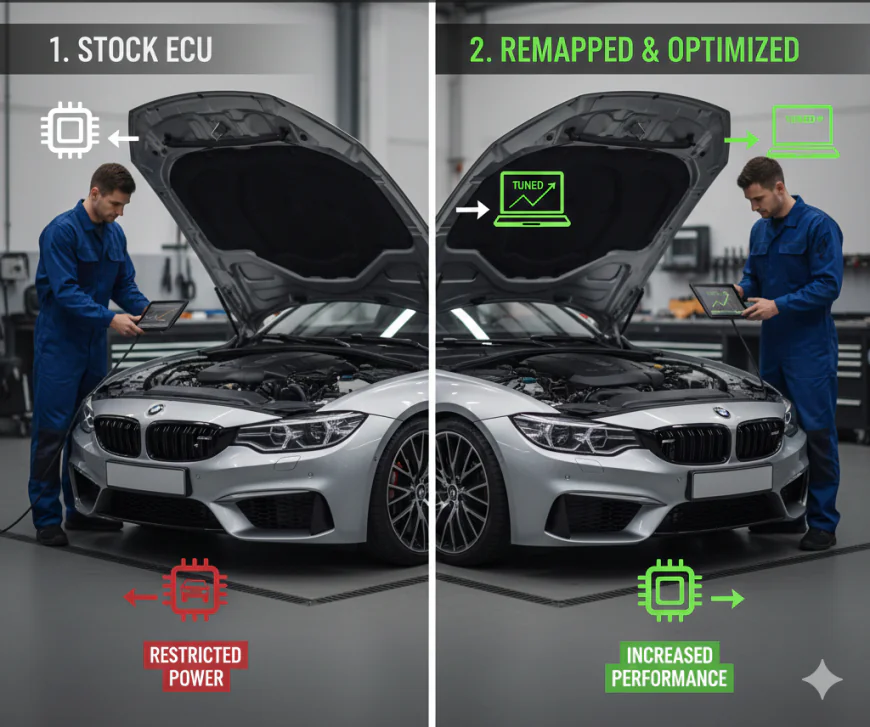
An ECU remap (also called a flash tune, ECU tune, or chip tune) involves directly modifying the software inside your car's existing ECU. A specialist connects to your ECU via the OBD port (or sometimes by physically removing the ECU), reads the existing data, modifies the relevant maps, and writes the new data back.
The modified maps tell your engine to use more boost, advance ignition timing, inject more fuel, raise the rev limit, and generally operate in a way the manufacturer never allowed. Because you're working directly within the ECU, you have access to every parameter — nothing is being intercepted, tricked, or approximated.
How the Process Works
- Baseline dyno run — Establishes current power output and identifies any issues
- ECU read — The tuner reads your ECU's current software
- Map modification — The tuner modifies boost maps, fuelling maps, timing maps, and any relevant parameters
- ECU write — New maps are written back to the ECU
- Dyno testing — Car is run on the dyno to verify power, check AFR (air/fuel ratio), and fine-tune
- Road testing — Final verification under real-world conditions
A quality remap is an iterative process, not a one-shot event. Good tuners make multiple passes on the dyno, adjusting maps based on measured results. This takes time — expect 4-6 hours of dyno time for a proper tune.
What You Can Change With a Remap
- Boost pressure (turbo cars)
- Ignition timing advance/retard
- Fuelling across the entire RPM/load map
- Rev limiter (raise or adjust)
- Speed limiter (remove or adjust)
- Launch control and flat shift (on supported ECUs)
- Variable valve timing maps
- Idle speed and behaviour
- Throttle response
The depth of access depends on how well-understood your specific ECU is. Popular platforms (Golf GTI, Focus ST, WRX, Civic Type R) have incredibly well-developed remap support. Less common cars may have limited tuning options.
Power Gains From Remapping
Power gains vary enormously by platform and supporting modifications, but realistic expectations:
|
Car Type |
Supporting Mods |
Expected Gain |
|
Stock turbocharged car |
None (remap only) |
15-30% |
|
Turbocharged + exhaust/intake |
Stage 1 mods |
25-40% |
|
Turbocharged + intercooler/turbo |
Stage 2 mods |
40-60%+ |
|
Naturally aspirated |
Remap only |
5-10% |
|
NA + cams/ITBs |
Full NA build |
15-25% |
As we've documented in our turbo car modification guides, remapping is nearly always the final step that ties a build together — you do your hardware modifications first, then tune the ECU to match.
Piggyback Tuners: What They Are and How They Work
The Basics
A piggyback tuner (also called a signal interceptor, power module, or boost controller with fuel management) is a secondary device that intercepts the signals between your sensors and the ECU, modifying them before the ECU sees them.
Rather than changing the ECU's programming, a piggyback works by tricking the ECU. For example, if a piggyback wants to run more boost than the ECU allows, it intercepts the MAP sensor signal and tells the ECU that boost is lower than it actually is. The ECU responds by allowing more boost. The piggyback manages the additional fuel required to prevent the engine running lean.
Types of Piggyback Devices
Simple boost controllers: Bleed valves or electronic solenoids that increase boost by bypassing the factory boost control system. These are the simplest and cheapest option but offer very limited control.
Fuel piggybacks: Devices like the Apexi S-AFC or HKS VPC that intercept and modify injector signals, allowing additional fuel to be added across the RPM range. Common on NA builds where slightly more fuel is needed.
Comprehensive piggybacks: More sophisticated units like the GReddy e-manage Ultimate or AEM FIC (Fuel/Ignition Controller) that intercept and modify multiple signals simultaneously — MAP sensor, injector signals, and sometimes ignition timing. These are the most capable piggyback devices.
Plug-and-play power modules: Pre-programmed devices specific to one car model — popular examples include the JB4 for various turbocharged BMWs and Volkswagens. These are essentially piggybacks with pre-developed maps for specific platforms.
How the Process Works
Installation varies by device:
- Purchase an appropriate piggyback for your car
- Connect to relevant sensor wiring (injectors, MAP sensor, etc.)
- Configure base settings (via laptop software, phone app, or onboard dials)
- Initial road testing and adjustment
- Optional dyno session to properly calibrate (recommended for comprehensive devices)
Power Gains From Piggyback Tuners
|
Device Type |
Expected Power Gain |
Reliability |
|
Simple boost controller |
5-15% |
Good if done carefully |
|
Fuel piggyback |
5-10% |
Good |
|
Comprehensive piggyback |
15-30% |
Moderate (depends on setup) |
|
Plug-and-play module (e.g. JB4) |
20-40% |
Good on supported platforms |
Head-to-Head Comparison
Power Potential
Winner: ECU Remap
A proper ECU remap will always extract more power than a piggyback tuner. Because the remap works directly within the ECU, the tuner has access to every parameter simultaneously and can optimise them as a complete system. Piggybacks work by tricking the ECU — an approach that inherently involves compromises.
On a Stage 2 turbocharged build (upgraded turbo, intercooler, exhaust), a remap might deliver 400bhp. The same hardware with a piggyback might deliver 340-360bhp — because the piggyback can't fully optimise the relationship between boost, fuel, and ignition timing across the entire map.
Cost
Winner: Piggyback (initially)
|
Item |
Piggyback |
ECU Remap |
|
Hardware |
£150-600 |
£0-200 (cable/software) |
|
Dyno time |
£0-300 (optional) |
£400-900 (essential) |
|
Tuner fee |
£0-200 |
£200-500 |
|
Total |
£150-1,100 |
£400-1,400 |
However, this initial cost saving is often misleading. A piggyback that's not properly calibrated can damage engines just as easily as a bad remap — and the cost of engine damage dwarfs any saving on tuning costs. We've seen this documented repeatedly in builds featured on Stance Auto Magazine — the cost of cutting corners on tuning is always higher than the cost of doing it properly.
Reversibility
Winner: Piggyback
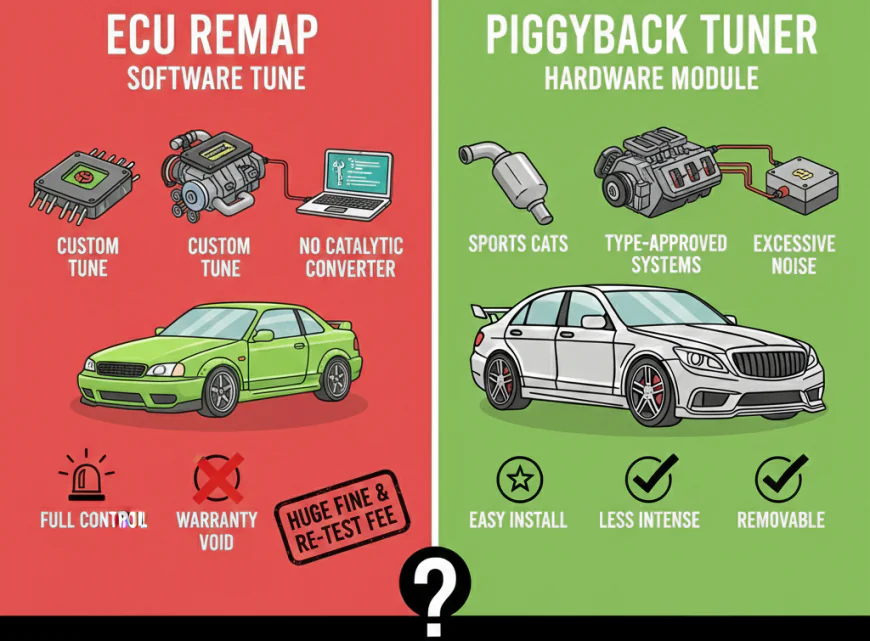
Piggybacks are completely reversible — unplug and remove, and the car is completely standard. ECU remaps can usually be returned to stock with a re-flash, but this depends on the tuning method and whether the original data was saved. For lease cars or warranty concerns, piggybacks are clearly better.
Reliability
Winner: ECU Remap (when done properly)
A properly calibrated ECU remap is more reliable than a piggyback. Because the entire engine management system is working as a coordinated unit (not fighting between factory ECU logic and external signal manipulation), the result is cleaner, more consistent power delivery.
Poorly done remaps are extremely damaging. Cheap online "generic" remaps that aren't dyno-tuned to your specific car are genuinely dangerous. This is why choosing an experienced tuner is so critical — a good remap from a reputable shop is safe and reliable, while a bad remap can destroy an engine.
Flexibility for Future Modifications
Winner: ECU Remap
Every time you add a hardware modification — larger injectors, bigger turbo, upgraded intercooler — a piggyback needs to be reconfigured or replaced. An ECU remap can be updated on a dyno to account for new hardware. On popular platforms, stage-based remapping (Stage 1, Stage 2, Stage 3) is well-established, and upgrading your tune as you upgrade your hardware is straightforward.
Compatibility
Winner: Piggyback
Piggybacks are more universally compatible — if a device intercepts the right signals, it can work on almost any car. ECU remaps require specialist knowledge of your specific ECU, and on less common cars, remap support may be limited or non-existent. If you're running an obscure JDM import with limited tuner support, a piggyback may be your only option.
For guidance on which cars have the best remap support in the UK, our modified car tuning guide breaks down the most popular platforms in detail.
Which Should You Choose?
Choose an ECU Remap if:
- You're on a popular platform with well-developed remap support (Golf GTI, Focus ST, WRX, Civic Type R, BRZ/86, etc.)
- You're building for maximum power and want to extract every bhp from your setup
- You're doing a staged build and want tuning that grows with your hardware upgrades
- Long-term reliability is a priority and you're not concerned about reversibility
- You have a specific tuner you trust and can access for dyno work
- Your car is staying modified rather than needing to return to stock
Choose a Piggyback if:
- Your ECU isn't well-supported for remapping (rare imports, unusual platforms)
- You need reversibility (lease car, warranty concerns, future resale)
- Budget is genuinely tight and a remap isn't financially viable right now
- You want a temporary solution while planning a more comprehensive build
- You're running a plug-and-play module on a supported platform (JB4 on N54/N55 BMW, for example) where the platform-specific calibration is excellent
The Third Option: Standalone ECU
For serious builds — big power turbocharged cars, engine swaps, heavily modified platforms — neither a remap nor a piggyback is ideal. A standalone ECU (Link G4X, Haltech Elite, Motec M series) replaces the factory ECU entirely, giving the tuner complete freedom to build maps from scratch.
Standalone ECUs are more expensive (£800-3,500 for the hardware) and require full custom wiring, but they're the only correct choice for builds that push beyond what the factory ECU architecture can handle. If you're building a 500bhp+ turbo car from scratch, budget for a standalone from day one.
The Importance of a Good Tuner
Whichever route you choose, the quality of your tuner matters more than the hardware itself. A mediocre remap from an incompetent tuner will underperform a well-calibrated piggyback. A brilliant tuner can extract maximum power from almost any system.
What to look for in a tuner:
- Proven experience with your specific platform
- Dyno capability (no dyno = no way to measure results)
- References and examples of previous work
- Transparent about what they're doing and why
- Uses quality monitoring equipment (wideband O2, data logging)
- Doesn't rush the session
Red flags:
- "Generic" maps emailed to you without dyno time
- No wideband O2 monitoring during the tune
- Extremely cheap pricing (good dyno time costs money)
- Reluctance to show you measured AFR and power figures
- No logged data from the session
Real-World Costs: What to Budget
ECU Remap — Complete Costs
|
Item |
Cost |
|
Initial consultation |
Usually free |
|
Dyno hire (if separate from tuner) |
£100-200/hour |
|
Tuner fee |
£200-500 |
|
Hardware (if required) |
£0-200 |
|
Stage 1 remap total |
£400-800 |
|
Stage 2 remap total |
£600-1,200 |
|
Full custom build tune |
£800-1,800 |
Piggyback — Complete Costs
|
Item |
Cost |
|
Simple boost controller |
£50-150 |
|
Fuel piggyback (Apexi S-AFC etc.) |
£150-300 |
|
Comprehensive piggyback (GReddy e-manage etc.) |
£300-600 |
|
Plug-and-play module (JB4 etc.) |
£400-700 |
|
Optional dyno calibration |
£200-500 |
|
Total (basic setup) |
£50-300 |
|
Total (properly calibrated) |
£500-1,100 |
Final Verdict
For the vast majority of modified car owners on popular platforms, an ECU remap from a reputable specialist is the right choice. It's cleaner, more powerful, more reliable, and gives you a foundation to build on. Yes, it costs more upfront. But the results are better, and done properly, it's the last tuning decision you'll need to make until you change hardware.
Piggybacks have their place — for reversibility, for obscure platforms without remap support, and as a temporary solution. Plug-and-play modules on supported platforms (particularly the JB4 on BMW N-series engines) can be genuinely excellent. But as a general rule, if your car is well-supported for remapping, remap it.
And whatever you do — don't skimp on the tuner. The hardware is only as good as the person programming it.

Frequently Asked Questions
Will remapping void my warranty?
In theory, yes — any modification can void relevant warranty sections. In practice, manufacturers need to prove the modification caused the fault. Some tuners offer "stealth" remaps that are harder to detect. For cars still under warranty, consider a piggyback for reversibility, or accept that modifying voids warranty and proceed accordingly.
Can a remap damage my engine?
A poor remap absolutely can. Running lean (insufficient fuel), over-advancing ignition timing, or running excessive boost beyond component limits can all cause serious damage. This is why choosing an experienced, reputable tuner and insisting on dyno validation is so critical.
How long does a remap last?
Indefinitely, unless you change hardware or someone overwrites it. Quality remaps don't "fade" or need updating. However, if you add more modifications, an updated tune will extract more power from the new setup.
Do I need a remap after adding an exhaust?
It helps but isn't always essential for a cat-back exhaust. For a full turbo-back system, decat, or larger turbo, a remap is strongly recommended to safely extract the full benefit of the modifications.
What's the difference between a Stage 1 and Stage 2 remap?
Stage 1 is a remap on an otherwise stock car — or with minor bolt-ons (intake, exhaust). Stage 2 requires hardware modifications (typically a larger intercooler and downpipe) to support higher boost and fuelling levels. Stage 3 usually involves hardware modifications that push beyond stock internal limits.
Can I remap a naturally aspirated car?
Yes, but gains are more modest — typically 5-15%. NA remaps focus on ignition timing optimisation, throttle response improvement, and variable valve timing — there's no boost to increase. For significant NA power gains, hardware modifications (cams, ITBs, head work) are needed.
 Like
0
Like
0
 Dislike
0
Dislike
0
 Love
0
Love
0
 Funny
0
Funny
0
 Angry
0
Angry
0
 Sad
0
Sad
0
 Wow
0
Wow
0