








































.png)








![[HOONIGAN] Ken Block's GYMKHANA NINE](https://img.youtube.com/vi/_bkX5VkZg8U/maxresdefault.jpg)





















































![[HOONIGAN] KEN BLOCK'S GYMKHANA SEVEN: WILD IN THE STREETS OF LOS ANGELES](https://cdn.motor1.com/images/mgl/2KlO4/s1/ken-block-london-tour-directors-cut.jpg)
































Subaru WRX vs STI: Which to Modify in 2026?
Compare WRX and STI for modification projects. EJ engine differences, transmission strength, and build potential.
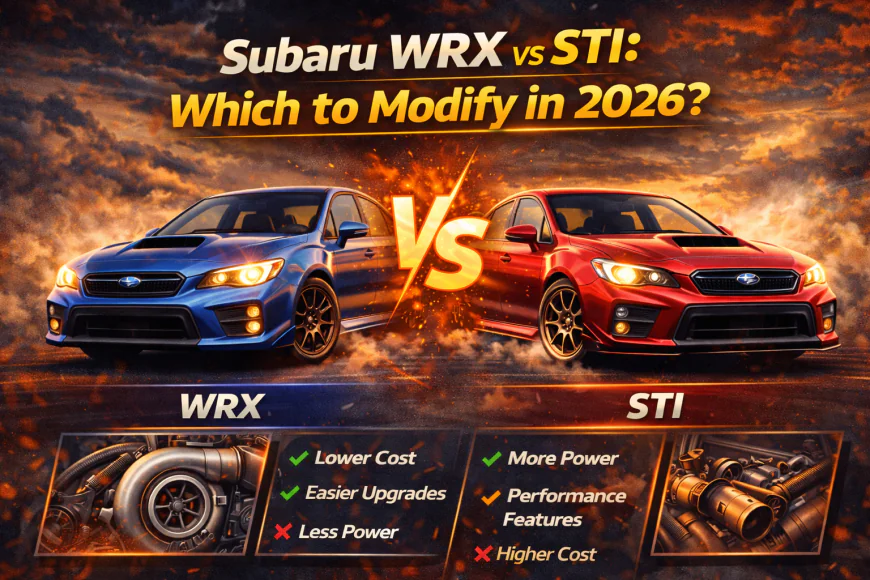
The Subaru Dilemma: WRX or STI?
If you're in the market for a turbocharged AWD performance car with a flat-four soundtrack and rally heritage, the choice inevitably comes down to Subaru WRX or STI. Both are legendary. Both have massive modification potential. Both deliver that distinctive boxer rumble and all-weather traction. But which one should you actually buy if you're planning to modify?
The answer isn't as simple as "STI is better because more power." The WRX and STI use different engines (EJ255 vs EJ257), different transmissions (5-speed vs 6-speed), and have different modification characteristics. The WRX is cheaper to buy (£12,000-18,000 vs £18,000-28,000 for STI), but the STI has stronger internals and better transmissions. The WRX makes 265bhp stock; the STI makes 300bhp. But both can be modified to 400+ bhp with proper builds.
In this comprehensive comparison, we break down everything that matters for modification: engine strength and tuning potential, transmission capabilities, cost to achieve different power levels, reliability considerations, and running costs. Whether you're building a 350bhp daily driver or a 500bhp track weapon, we'll help you choose the right platform.
As we've covered in other comparisons like our AE86 vs S13 Drift Car Comparison, understanding platform differences before committing is essential for successful builds.
What You'll Learn:
- EJ255 vs EJ257 engine differences
- Transmission strength and limitations
- Modification costs by power level
- Reliability and maintenance differences
- Which platform suits different builds
- Running costs comparison
Quick Specifications Comparison
|
Specification |
WRX (2002-2007) |
STI (2004-2007) |
|
Engine |
EJ255 2.5L turbo |
EJ257 2.5L turbo |
|
Power |
224-265bhp |
276-300bhp |
|
Torque |
226-244 lb-ft |
289-300 lb-ft |
|
Compression |
8.0:1 (early) / 8.4:1 (late) |
8.0:1 |
|
Turbo |
TD04 |
IHI VF series (larger) |
|
Transmission |
5-speed manual |
6-speed manual |
|
Differential |
Open (rear) / Viscous LSD |
Mechanical LSD (center + rear) |
|
Brakes |
294mm front |
326mm Brembo 4-pot front |
|
Weight |
1,495kg |
1,515kg |
|
0-60 mph |
5.5-6.0 sec |
4.7-5.2 sec |
|
Current Price |
£8,000-16,000 |
£15,000-28,000 |
Note: Specifications vary by year and market. US/UK/Japan specs differ.
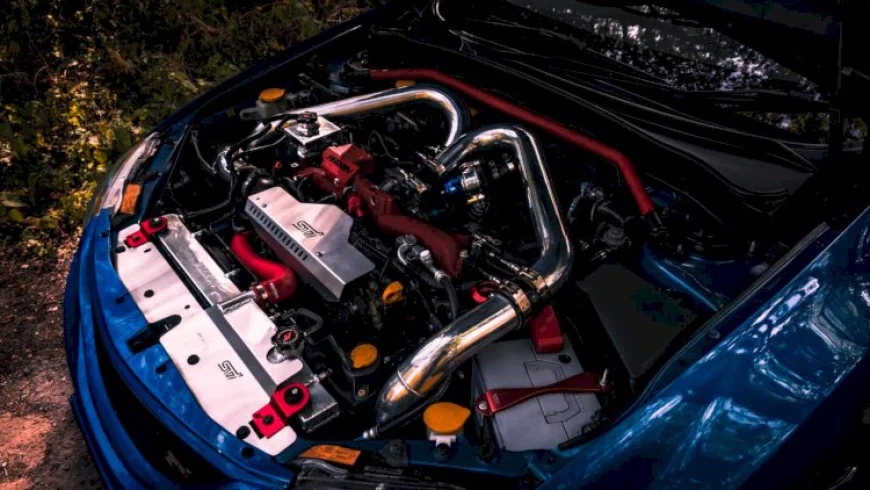
Engine Deep Dive: EJ255 vs EJ257
EJ255 (WRX Engine)
Configuration:
- 2.5L turbocharged boxer
- TD04 turbo (smaller, quicker spool)
- Cast pistons
- Semi-closed deck block
Stock power: 224-265bhp depending on year
Strengths:
- Quicker spool than STI turbo
- More responsive low-end
- Good daily driver characteristics
- Slightly better fuel economy
Weaknesses:
- Semi-closed deck (ringland failure above 350bhp)
- Weaker pistons (prone to cracking)
- Smaller turbo limits top-end
- Head gasket issues (2006-2014 models especially)
Safe power limit (stock internals): 300-320bhp
EJ257 (STI Engine)
Configuration:
- 2.5L turbocharged boxer
- IHI VF series turbo (larger)
- Forged pistons (most years)
- Closed deck block (stronger)
Stock power: 276-300bhp
Strengths:
- Closed deck block (stronger)
- Forged pistons (most years)
- Larger turbo (more top-end power)
- Better oil cooling from factory
Weaknesses:
- More lag than WRX turbo
- Still suffers ringland failure
- Head gasket issues (less common than WRX)
- More expensive to repair
Safe power limit (stock internals): 350-380bhp
Key difference: The STI's closed deck and forged pistons give it about 50-80bhp more headroom before requiring built bottom end.
Transmission Comparison
5-Speed (WRX)
Characteristics:
- Gear ratios: 3.166, 1.882, 1.296, 0.972, 0.738
- Final drive: 3.90:1 (varies by year)
- Max torque rating: ~350 lb-ft
Strengths:
- Adequate for stock to 350bhp
- Parts more readily available
- Cheaper to rebuild
Weaknesses:
- 2nd gear synchros wear easily
- Known weak point at 350+ lb-ft
- Gear ratios not optimal for track
Upgrade path:
- OEM replacement: £1,500-2,500
- Built 5-speed: £3,000-5,000
- Swap to 6-speed: £3,000-6,000
6-Speed (STI)
Characteristics:
- Gear ratios: 3.636, 2.375, 1.761, 1.368, 1.063, 0.842
- Final drive: 3.90:1 (varies)
- Max torque rating: ~400 lb-ft
Strengths:
- Stronger than 5-speed
- Better gear ratios
- Handles 400+ bhp stock
- More engaging to drive
Weaknesses:
- 1st and 2nd gear synchros still wear
- Expensive to rebuild (£4,000-7,000)
- Some model years have glass 5th gear
Upgrade path:
- OEM replacement: £3,000-5,000
- Built 6-speed: £6,000-10,000
Verdict: The STI's 6-speed is significantly stronger and has better ratios. Worth the premium for serious builds.
Modification Costs by Power Level
350bhp Build
WRX path (£4,000-7,000):
- Turbo upgrade (VF39 or similar): £800-1,500
- 3" turbo-back exhaust: £600-1,000
- FMIC upgrade: £600-1,000
- Fuel pump + injectors: £500-800
- Accessport or ECU tune: £400-800
- Supporting mods: £500-1,000
Result: 330-360bhp, close to WRX stock transmission limit
STI path (£3,500-6,000):
- 3" turbo-back exhaust: £600-1,000
- FMIC upgrade: £600-1,000
- Fuel pump + injectors: £500-800
- Accessport or ECU tune: £400-800
- Supporting mods: £500-1,500
Result: 340-370bhp, well within STI transmission capability
Verdict: Both reach 350bhp similarly, but STI does it with less stress on components.
400bhp Build
WRX path (£8,000-15,000):
- Built bottom end (forged pistons, rods): £4,000-7,000
- Larger turbo (GT3076R or similar): £1,200-2,000
- Fuel system upgrade: £800-1,500
- FMIC: £800-1,500
- Clutch upgrade: £600-1,200
- ECU (Haltech, Link): £1,500-2,500
- 6-speed transmission swap: £3,000-5,000
Result: 380-420bhp, requires transmission upgrade
STI path (£6,000-12,000):
- Built bottom end: £4,000-7,000 (recommended but not mandatory)
- Larger turbo: £1,200-2,000
- Fuel system: £800-1,500
- FMIC: £800-1,500
- Clutch: £600-1,200
- ECU: £1,500-2,500
Result: 380-420bhp, stock transmission handles it
Verdict: STI is £2-3k cheaper at this power level due to not needing transmission swap.
For detailed guidance on turbo selection at different power levels, see our Best 2JZ Turbos — principles apply across platforms.
500bhp Build
Both require:
- Fully built engine (pistons, rods, studs): £6,000-10,000
- Large turbo (GTX3076R, EFR 7163): £1,500-2,500
- Full fuel system: £1,500-2,500
- Upgraded FMIC: £1,000-2,000
- Standalone ECU: £2,000-3,500
- Twin-disc clutch: £1,500-2,500
- Built transmission: £4,000-8,000
- Supporting mods: £2,000-4,000
Total: £18,000-33,000+
Verdict: At 500bhp, both platforms cost similar amounts. Both require full builds.
Reliability and Common Problems
WRX Reliability Issues
Ringland failure:
- Most common WRX killer
- Piston ringland cracks, loses compression
- Caused by detonation, cheap fuel, aggressive tuning
- Symptoms: Misfires, loss of power, smoke
- Fix: Engine rebuild (£4,000-8,000)
Head gasket failure:
- 2006-2014 models especially prone
- External coolant leaks
- Fix: £1,000-2,000
Turbo failure:
- TD04 turbos fail around 100,000-150,000 miles
- Symptoms: Blue smoke, whining, loss of boost
- Fix: £600-1,500
Transmission synchros:
- 2nd gear most common
- Symptoms: Crunching shifts, hard to engage
- Fix: £1,500-3,000 (rebuild)
STI Reliability Issues
Ringland failure:
- Still occurs but less common than WRX
- Forged pistons help but don't eliminate risk
- Same causes: detonation, bad fuel, poor tuning
Transmission:
- 1st/2nd gear synchros wear
- Some years have weak 5th gear
- Fix: £4,000-7,000 (rebuild)
Turbo:
- VF turbos generally more robust than TD04
- Still fail eventually (120,000-180,000 miles)
- Fix: £800-2,000
Head gaskets:
- Less common than WRX
- Still occur, especially on abused examples
- Fix: £1,000-2,000
Daily Drivability
WRX
Pros:
- More comfortable ride (softer suspension)
- Better fuel economy (23-27 MPG highway)
- Less aggressive power delivery (easier in traffic)
- Lower insurance costs
Cons:
- Less special feeling
- Smaller brakes fade faster
- Open rear diff (less engaging)
Verdict: Better daily driver for most people.
STI
Pros:
- More engaging to drive
- Better brakes (critical for daily)
- Mechanical LSD makes it more fun
- Better resale value
Cons:
- Firmer ride (less comfortable)
- Worse fuel economy (20-24 MPG highway)
- More expensive insurance
- More expensive maintenance
Verdict: Better if you prioritize driving engagement over comfort.
Track Day Capability
WRX
Stock: Adequate for beginners. Brakes fade, suspension soft.
Modified: With coilovers, brake upgrade, and tune — very capable.
Weak points:
- Brakes (upgrade essential)
- Soft suspension (coilovers mandatory)
- Open rear diff (LSD swap recommended)
Cost to make track-ready: £3,000-6,000
STI
Stock: Excellent. Brembo brakes, mechanical LSD, stiffer suspension.
Modified: With basic suspension and brake pads — genuinely fast.
Weak points:
- Stock suspension OK but could be better
- Brake fluid boils under sustained use
Cost to make track-ready: £1,500-3,000
Verdict: STI is better track car out of the box.
Running Costs Comparison
|
Expense |
WRX (Annual) |
STI (Annual) |
|
Insurance (30+) |
£800-1,200 |
£1,000-1,500 |
|
Fuel (10k miles) |
£1,600-2,000 |
£1,800-2,200 |
|
Servicing |
£500-800 |
£600-1,000 |
|
Tires |
£500-800 |
£600-900 |
|
Brakes |
£300-500 |
£400-700 |
|
Repairs (average) |
£800-1,500 |
£1,000-2,000 |
|
Total |
£4,500-6,800 |
£5,400-8,300 |
STI costs 15-20% more to run annually.
For insurance strategies on modified Subarus, see our Modified Car Insurance Tips.
Which Should You Buy?
Buy WRX If:
- Budget is limited (£10-16k vs £18-28k)
- You want better daily comfort
- You're targeting 300-350bhp maximum
- Lower running costs matter
- This is your first Subaru
Buy STI If:
- You can afford the premium
- You're planning serious modifications
- You want 380bhp+ without transmission swap
- Better factory brakes matter
- You prioritize driving engagement
- You track the car regularly
The Ugly Truth:
At stock or mild modification (up to 350bhp), the WRX offers better value. Beyond that, the STI's stronger internals and transmission make it the smarter choice — the money saved on not needing transmission swaps and built motors offsets the higher purchase price.
Alternative: Buy WRX, Build Properly
Strategy: Buy cheaper WRX (£12k), then:
- 6-speed transmission swap: £3-5k
- Built engine (if going past 350bhp): £6-8k
- Big brake kit: £1-2k
Total: £22-27k for equivalent of modified STI
Advantage: You control quality and spec of every component
Disadvantage: Higher total investment than buying STI initially

Frequently Asked Questions
Which is more reliable?
Both have similar reliability. STI has slightly stronger internals but costs more to fix when problems occur. Reliability depends more on maintenance and tuning quality than model choice.
Can I daily drive a modified WRX/STI?
Absolutely. Both make excellent daily drivers even with 350-400bhp, provided tuning is conservative and parts quality is good.
How much power can stock EJ255/EJ257 handle?
EJ255 (WRX): 300-320bhp safely. Beyond that, ringland failure risk increases dramatically. EJ257 (STI): 350-380bhp safely. Still risks ringland failure but at higher power levels.
Is the STI worth £8-10k more?
If you're keeping it stock or mildly modified: No, WRX is better value. If you're building to 400bhp+: Yes, the stronger internals and transmission save money long-term.
Which has better resale value?
STI holds value better. Well-maintained examples barely depreciate. WRXs drop faster.
Can I swap STI parts onto WRX?
Many parts swap: turbo, brakes, suspension, transmission. Creates "hybrid" builds that offer best of both worlds. Popular approach.
What about newer models (2015+)?
2015+ WRX has FA20DIT engine (different platform). 2015+ STI still uses EJ257. This comparison focuses on 2002-2007 "blobeye/hawkeye" generations where most affordable examples exist.
 Like
0
Like
0
 Dislike
0
Dislike
0
 Love
0
Love
0
 Funny
0
Funny
0
 Angry
0
Angry
0
 Sad
0
Sad
0
 Wow
0
Wow
0