








































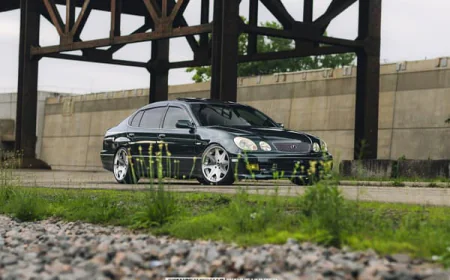

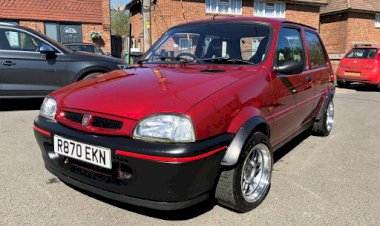




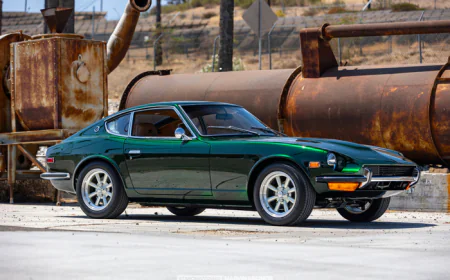



















.png)










![[HOONIGAN] Ken Block's GYMKHANA NINE](https://img.youtube.com/vi/_bkX5VkZg8U/maxresdefault.jpg)
















































![[HOONIGAN] KEN BLOCK'S GYMKHANA SEVEN: WILD IN THE STREETS OF LOS ANGELES](https://cdn.motor1.com/images/mgl/2KlO4/s1/ken-block-london-tour-directors-cut.jpg)






























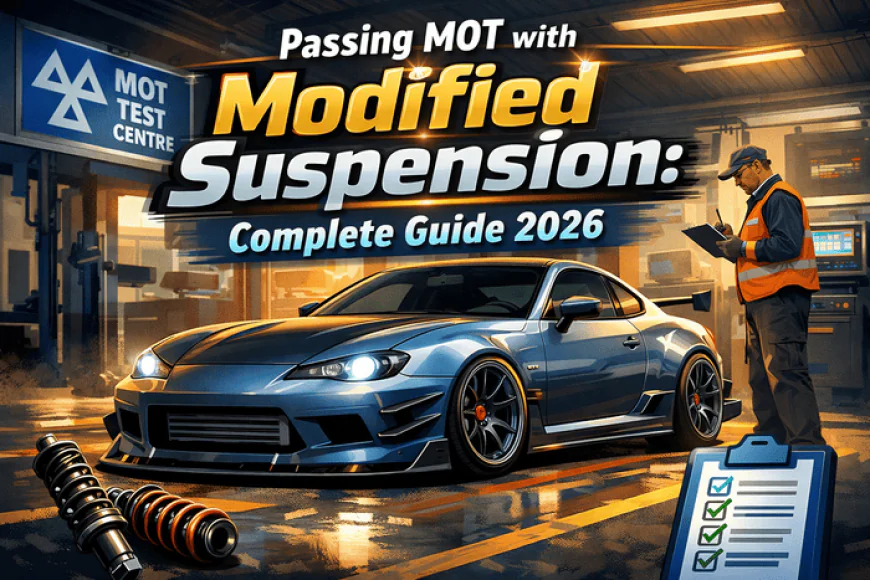
How To Pass MOT with Modified Suspension: Complete Guide 2026
Everything you need to pass MOT with lowered or modified suspension. Rules, testing points, and common failure reasons.
The Modified Suspension MOT Dilemma
You've spent hundreds or thousands on quality coilovers. Your car looks perfect, handles brilliantly, and the suspension setup is dialled in exactly how you want it. Then MOT season arrives and suddenly you're worried — will it pass? Should you raise it back to standard height? Are your modifications even legal?
The good news is that modified suspension, even significantly lowered cars, can absolutely pass MOT if done properly. The bad news is that "properly" covers a lot of ground, and MOT testers have significant discretion in their judgements. What passes at one garage might fail at another, and the regulations themselves contain frustrating grey areas.
In this complete guide, we're breaking down everything you need to know about passing MOT with modified suspension in 2026. We cover the actual legal requirements, what MOT testers are looking for, the most common failure points, and how to ensure your lowered car sails through the test without compromise.
What You'll Learn:
- Exact MOT suspension testing requirements
- What MOT testers actually check
- Common failure reasons and how to avoid them
- How low you can go and still pass
- Pre-MOT checks you should perform
- What to do if you fail
Understanding the MOT Suspension Requirements
The MOT test for suspension focuses on safety, not aesthetics. The examiner doesn't care if your car is slammed or sits at 4x4 ride height — they care whether the suspension is secure, functional, and not dangerously worn or damaged.
What the Law Actually Says
According to the MOT testing manual, suspension must:
- Be secure — No loose, missing, or broken components
- Not be excessively corroded — Structural integrity must be maintained
- Have adequate damping — Shock absorbers must control spring oscillation
- Allow adequate suspension travel — Must move freely without binding
- Not foul bodywork or tyres — No rubbing or contact during full suspension travel
Nowhere in the MOT regulations does it say "must be at factory ride height" or "cannot be lowered." Modified suspension is legal. Poorly modified suspension that compromises safety is not.
The Grey Areas
The frustrating part of MOT suspension testing is the subjective nature of some checks:
"Excessive corrosion" — What counts as excessive? One tester's "surface rust" is another's "structural concern."
"Adequate damping" — The bounce test is subjective. A car on stiff coilovers behaves differently to one on soft standard dampers.
"Fouling" — Does the tyre touch the arch liner during the test? Under full lock? When suspension is compressed? The rules don't specify.
This subjectivity means building a good relationship with a knowledgeable MOT station is valuable. Find a garage that understands modified cars and stick with them.
What MOT Testers Actually Check
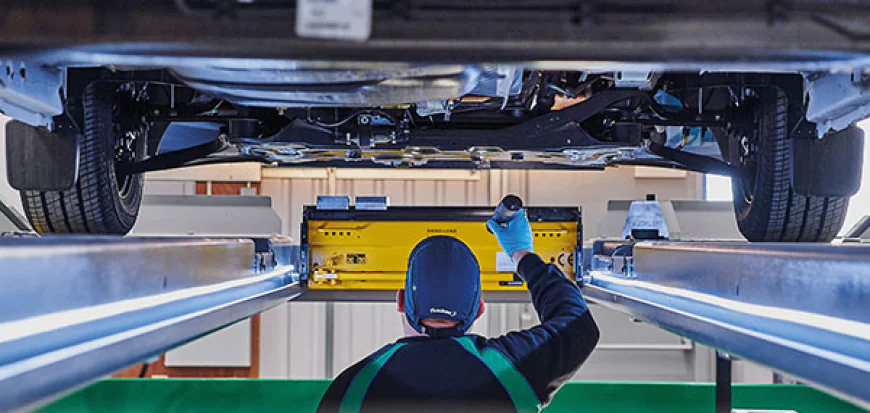
1. Visual Inspection
The tester looks for:
- Damaged or missing components — Springs, dampers, top mounts, wishbones, drop links
- Corrosion — Particularly on subframes, wishbones, and mounting points
- Leaking dampers — Oil seepage from shock bodies
- Cracked or broken springs — Visual inspection of coil springs
- Secure mounting — All bolts present and tight
- Modified components — Any non-standard parts are noted
Pass/Fail: Anything visibly damaged, severely corroded, or insecure is an immediate fail.
2. Suspension Articulation Check
The tester manually pushes down on each corner of the car and releases, observing how the suspension moves:
- Binding or catching — Suspension should move freely
- Noise — Clunking, knocking, or grinding indicates worn components
- Damping — Car should return to rest position without excessive bouncing
Pass/Fail: If suspension binds, makes concerning noises, or bounces more than 1.5 times, it's a fail.
3. Ball Joint and Bush Inspection
Using a lever, the tester checks for play in:
- Ball joints (upper and lower)
- Tie rod ends
- Control arm bushings
- Anti-roll bar links
Pass/Fail: Excessive play in any joint or bush is a fail. "Excessive" is defined as movement visible to the naked eye under load.
4. Shock Absorber Test
The bounce test checks damper function:
- Tester bounces each corner 3-4 times
- Releases and observes oscillation
- Car should settle within 1-1.5 bounces
Pass/Fail: More than 1.5 bounces indicates worn dampers — immediate fail.
5. Tyre to Bodywork Clearance
The tester checks for:
- Static clearance — Tyres must not touch bodywork when stationary
- Dynamic clearance — Tyres must not rub when steering is turned full lock
- Suspension travel — Adequate clearance during compression
Pass/Fail: Any contact between tyre and bodywork during the test is a fail.
6. Steering Geometry
While not strictly suspension, the tester checks:
- Excessive toe — Tyres pointing too far in or out
- Visible misalignment — One wheel clearly off-angle
- Steering wheel off-centre — When driving straight
Pass/Fail: Obvious misalignment is an advisory; severe cases can be a fail if deemed unsafe.

Common Failure Points and How to Avoid Them
1. Rubbing Tyres
Why it fails: Tyre contact with bodywork or suspension components.
How to avoid:
- Test full lock clearance before MOT (both directions)
- Check clearance with passenger weight in car
- Roll or trim arch liners if necessary
- Consider slightly narrower tyres or less aggressive offset
2. Worn Ball Joints or Bushings
Why it fails: Play in suspension joints compromises safety.
How to avoid:
- Replace worn components before MOT
- Budget for consumables — lowered cars wear these faster
- Polyurethane bushings last longer than rubber
- Check for play manually before booking MOT
3. Leaking Dampers
Why it fails: Oil leakage indicates damper failure.
How to avoid:
- Inspect dampers for oil seepage monthly
- Budget coilovers leak more than premium brands
- Replace worn dampers — they cannot be repaired
- Clean damper bodies before MOT so leaks are visible
4. Excessively Stiff Damping
Why it fails: Car bounces too much or doesn't settle after compression.
How to avoid:
- Set damping to softest setting for MOT if adjustable
- Quality coilovers with proper valving pass easily
- Cheap coilovers with harsh damping may struggle
- Test bounce behaviour yourself before MOT
5. Corroded Components
Why it fails: Structural corrosion compromises safety.
How to avoid:
- Underseal and rustproof regularly
- Inspect wishbones, subframes, and mounting points
- Replace corroded components before MOT
- Wire brush surface rust before test (clean metal passes more easily)
6. Damaged Springs
Why it fails: Cracked or broken springs are immediate fail.
How to avoid:
- Inspect coil springs for cracks before MOT
- Budget coilover springs can crack under stress
- Replace damaged springs immediately
- Never run with broken springs (dangerous)
7. Binding Suspension
Why it fails: Suspension must move freely through full travel.
How to avoid:
- Ensure coilovers aren't bottomed out or topped out
- Check bump stops aren't permanently compressed
- Verify suspension has adequate travel (2-3 inches minimum)
- Excessively low cars often bind at full compression
How Low Can You Go and Still Pass?
This is the question every lowered car owner asks. The answer: it depends.
Factors that determine minimum height:
- Tyre clearance — You need 10-15mm clearance at full compression
- Suspension travel — Minimum 50mm (2 inches) recommended
- Subframe clearance — Must not contact road surface or speed bumps
- Exhaust clearance — Must not scrape regularly
Realistic minimum heights:
- Street-driven daily: 30-40mm lower than standard
- Weekend/show car: 50-70mm lower than standard
- Track-only: As low as geometry allows (no MOT required)
Pro tip: If your car scrapes exhausts or sills regularly, it's too low for MOT. Raise it 10-20mm and it'll likely pass.
Pre-MOT Checklist for Modified Suspension
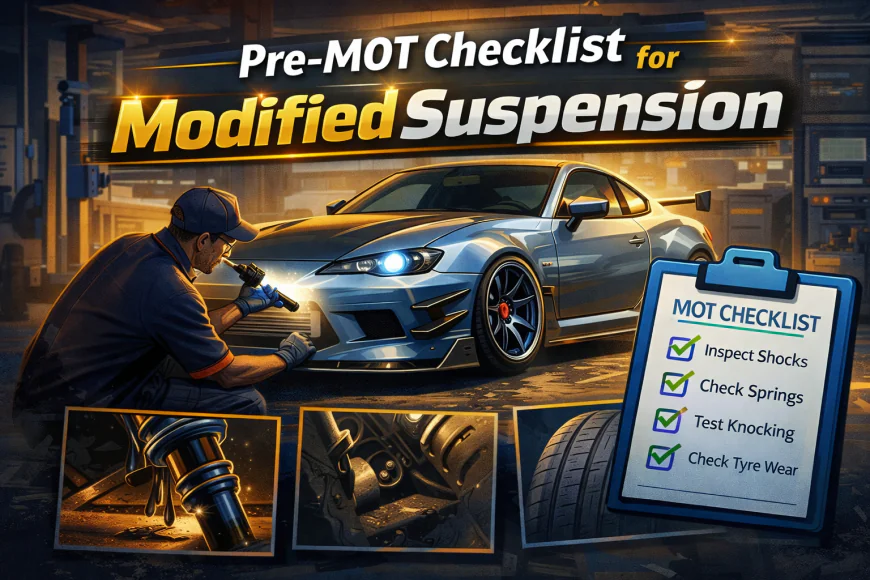
Perform these checks 1-2 weeks before your MOT:
Visual Checks
- ☐ Inspect all suspension components for damage or corrosion
- ☐ Check for oil leaks on damper bodies
- ☐ Verify all mounting bolts are tight
- ☐ Inspect springs for cracks or damage
- ☐ Check ball joints and bushings for play
Functional Checks
- ☐ Perform bounce test on each corner
- ☐ Check tyre clearance at full lock (both directions)
- ☐ Test clearance with passenger weight
- ☐ Verify suspension has adequate travel
- ☐ Check for binding or unusual noises
Adjustments
- ☐ Set damping to softest setting (if adjustable)
- ☐ Adjust ride height if too low (raise 10-20mm if concerned)
- ☐ Get alignment check if steering feels off
- ☐ Clean all suspension components (makes inspection easier)
Documentation
- ☐ Gather receipts for quality coilovers (helpful if questioned)
- ☐ Have alignment printout available (shows geometry is correct)
- ☐ Know brand and model of coilovers fitted
What to Do if You Fail
Advisory vs Failure
Advisory: Issue noted but not serious enough to fail. Car still gets MOT certificate. Address for next year.
Failure: Safety concern. Car cannot pass until fixed. Repair and retest required.
Common Advisories on Modified Cars
- "Non-standard suspension fitted"
- "Ride height lower than manufacturer specification"
- "Aftermarket suspension components fitted"
These advisories are noting modifications, not faults. They don't prevent passing.
If You Fail
- Understand exactly why — Ask tester to show you the specific issue
- Get a written report — MOT failure notice details every fault
- Assess if judgement was fair — Some testers are overly cautious with modified cars
- Fix legitimate issues — Worn components need replacement regardless of
- Consider second opinion — If failure seems questionable, try different garage
- Retest — Most garages offer free retest within 10 working days
Disputing an Unfair Fail
If you believe the failure was incorrect:
- Request manager review — Most garages will have senior tester double-check
- Contact DVSA — File complaint if failure was demonstrably wrong
- Provide evidence — Photos, measurements, manufacturer specs help your case
- Try different garage — Sometimes starting fresh is easier than fighting
Building a Good Relationship with Your MOT Station
Find a modified-car-friendly garage:
Ask at local car meets, check modified car forums, or simply call garages and ask "do you test many modified cars?" A garage that regularly handles modified vehicles understands the nuances better than one that only sees standard cars.
Benefits of a regular relationship:
- Tester understands your car and modifications
- Less likely to fail on questionable judgments
- More willing to explain advisories and suggest fixes
- May offer pre-MOT inspections or advice
Be honest with your tester:
- Explain modifications clearly
- Mention any concerns you have
- Ask questions before the test, not after
- Show you care about safety, not just passing

Frequently Asked Questions
Is lowering my car illegal?
No. Lowered suspension is legal provided it doesn't compromise safety. You must pass MOT and meet construction and use regulations (tyres not rubbing, lights at correct height, etc.).
Do I need to declare a modified suspension to insurance?
Yes. Undeclared modifications void your insurance. Declare everything, even if it seems minor.
Will coilovers fail the MOT?
No — quality coilovers from reputable brands pass MOT without issue. Cheap coilovers with poor damping or leaking seals may fail.
Can I fail the MOT for being too low?
Not specifically for ride height, no. You'll fail if being too low causes tyres to rub, suspension to bind, or inadequate travel. But "low" itself isn't a failure reason.
Should I raise my car for the MOT, then lower it again?
Only if genuinely necessary (rubbing, binding, etc.). If the car is functional and safe at its normal height, keep it there. Repeatedly adjusting height is an unnecessary hassle.
What if my coilovers don't have an MOT certificate?
Coilovers don't need certification. They need to work properly and be safe. Receipts showing you bought quality parts help if questioned, but aren't required.
Can I fit air suspension and pass the MOT?
Yes, provided the system works correctly, doesn't leak, and maintains safe ride height. Air suspension is becoming increasingly common and most testers are familiar with it.
 Like
0
Like
0
 Dislike
0
Dislike
0
 Love
0
Love
0
 Funny
0
Funny
0
 Angry
0
Angry
0
 Sad
0
Sad
0
 Wow
0
Wow
0