



























.png)






![[HOONIGAN] Ken Block's GYMKHANA NINE](https://img.youtube.com/vi/_bkX5VkZg8U/maxresdefault.jpg)






































![[HOONIGAN] KEN BLOCK'S GYMKHANA SEVEN: WILD IN THE STREETS OF LOS ANGELES](https://cdn.motor1.com/images/mgl/2KlO4/s1/ken-block-london-tour-directors-cut.jpg)



























Pedal Commander Review: Is It Actually Worth It?
Does the Pedal Commander throttle controller actually work, or is it a placebo. An honest look at what it does, what it doesn't, and who should buy one.
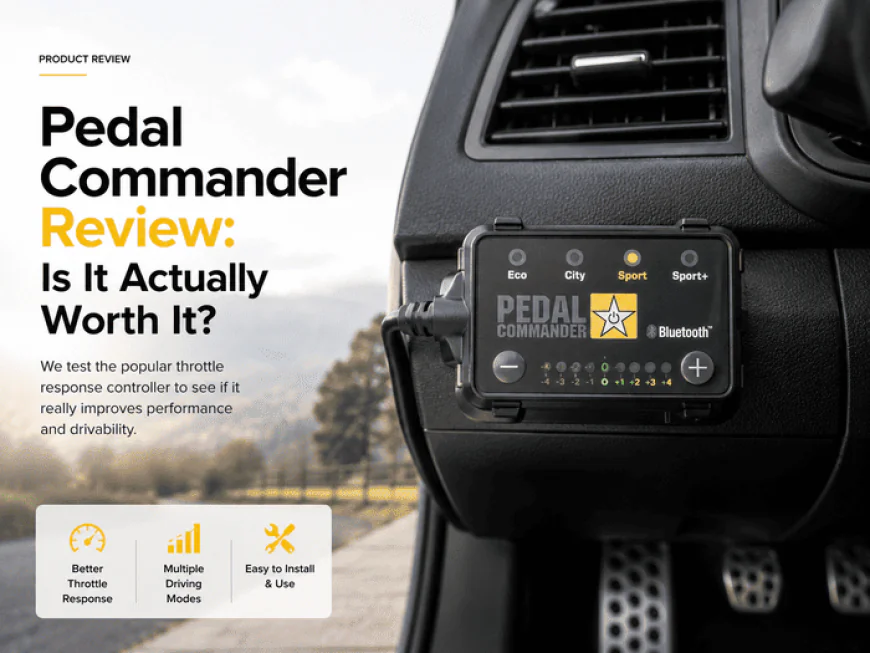
If you've spent any time in a car meet WhatsApp group or scrolling modified-car content online, you've almost certainly seen someone recommend a Pedal Commander as the first cheap upgrade to make a car "feel faster." It's one of the most talked-about bolt-ons going, sitting somewhere between a genuine driving improvement and a running joke depending on who you ask. So let's actually settle it.
In plain English: a Pedal Commander is a small plug-and-play device that sits between your accelerator pedal and your car's engine control unit, and it changes how much throttle the ECU thinks you're asking for at a given pedal position. It doesn't touch your engine, your fuelling, or your ignition timing in any way. Whether that's actually worth £200-plus depends entirely on what you're expecting it to do.
What Throttle Lag Actually Is
To understand whether this device is solving a real problem, you need to understand what "throttle lag" actually is on a modern car, because it's genuinely misunderstood. Almost every car built in the last fifteen-plus years uses drive-by-wire throttle, meaning there's no physical cable running from your pedal to the throttle body anymore. Instead, a sensor reads how far you've pressed the pedal, sends that as an electronic signal to the ECU, and the ECU decides how far to actually open the throttle. Manufacturers deliberately build a soft, non-linear curve into that mapping — light pedal input near the top of the travel does relatively little, and the response ramps up more aggressively further down. It's done for smooth around-town driving, fuel economy, and emissions compliance, not because the electronics are slow. The processing itself happens in single-digit milliseconds; there's no meaningful mechanical delay to eliminate.
What a Pedal Commander Actually Does
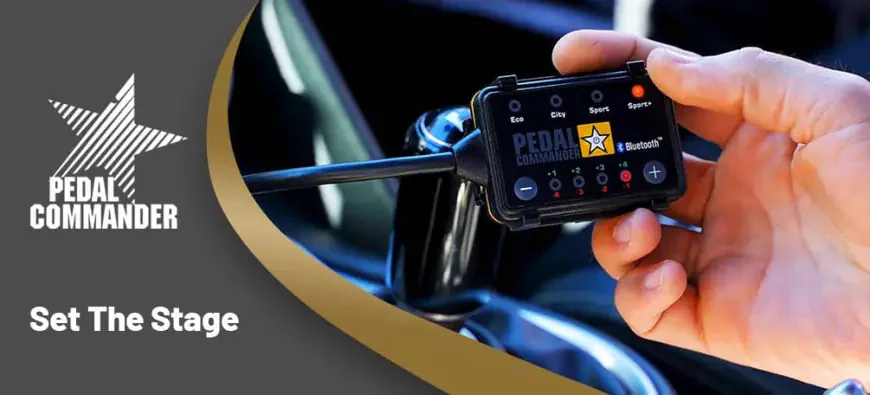
This is where it's worth being straight with you rather than just repeating the marketing. A Pedal Commander doesn't remove that delay because there mostly isn't one to remove — what it does is rescale the pedal-position signal before it reaches the ECU, so that, say, 25% of your actual pedal travel gets reported as 50%. You're not getting more power, more torque, or a genuinely quicker-reacting throttle body. You're getting the same throttle opening you'd have gotten anyway, just for less physical pedal movement. It doesn't touch your air-fuel ratio, your ignition timing, or your ECU's tune in any way, and it doesn't add a single horsepower — no reputable source, including the manufacturer itself, actually claims otherwise once you read past the headline marketing.
Key Facts
- What it is: A plug-and-play device that intercepts and rescales the accelerator pedal position signal before it reaches the ECU
- What it does: Makes the same throttle opening happen with less pedal travel — feels sharper, especially at low-to-mid pedal input
- What it doesn't do: Add horsepower, torque, reduce true system lag, or change fuelling/ignition
- Typical price: Around $300 in the US; UK pricing generally lands in a similar £200–£250 bracket depending on vehicle fitment and retailer
- Install time: Genuinely quick — most owners report 5–15 minutes, plug-and-play under the dash
- Warranty impact: Doesn't touch the ECU's tune or flags, so manufacturers state it doesn't void your factory warranty
- With a special £20 discount for Stance Auto Magazine readers: STANCE20 *:(go directly to the link or use the code ‘’STANCE20’’
So Does It Actually Feel Different?
Here's the part that's genuinely true and not just hype: it does feel different, and for a lot of drivers that difference is immediately noticeable. Because you're commanding more throttle opening for the same pedal travel, low-speed manoeuvres like pulling out of junctions, merging, or overtaking do feel snappier — you're simply asking for more, sooner, with your foot. Whether that translates into an actually faster car in a stopwatch sense is a different question, and independent forum discussion among tuners and enthusiasts is fairly consistent on this: any real-world time gain is marginal, limited mostly to situations where you weren't using full pedal travel anyway, since a WOT (wide open throttle) pull maxes out the throttle body regardless of what curve is feeding it.
Is It Worth Buying, Then?
That depends entirely on what result you're actually chasing. If what bothers you is the factory-soft, slightly numb feeling of a modern drive-by-wire pedal, and you want that fixed with zero risk to your warranty and a fifteen-minute install, a Pedal Commander does solve that specific complaint reasonably well, and the adjustability across driving modes means you can dial it back for wet weather or your daily commute and sharpen it up for a spirited backroad. If, on the other hand, what you're actually after is more power, quicker acceleration times, or a fix for genuine mechanical throttle response — the kind that comes from turbo lag, a lazy CVT, or an underpowered engine trying to do too much — this isn't the product for that job, and no amount of pedal remapping changes what the engine is physically capable of producing. For that, you're looking at a proper ECU tune, which changes actual fuelling and timing rather than just repainting the pedal curve, and typically costs considerably more than a Pedal Commander to do properly. If you're weighing that decision, our breakdown of ECU remaps versus piggyback tuners covers what each approach actually changes and what it costs — worth reading before you spend money on either.
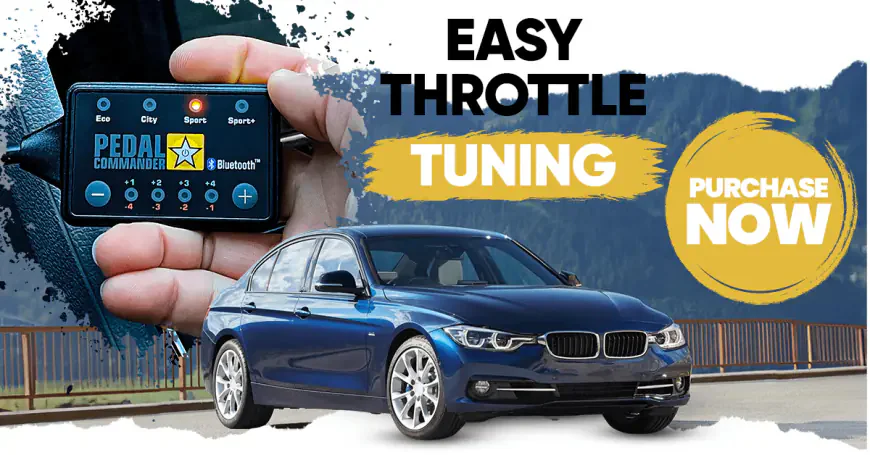
With a special £20 discount for Stance Auto Magazine readers: STANCE20 *:(go directly to the link or use the code ‘’STANCE20’’
What Does the UK Scene Actually Think?
Opinion in the wider community splits fairly predictably along the same line as the technical reality. Plenty of owners genuinely love the feel it gives their daily, particularly on cars known for a lazy factory throttle map — hybrids and diesel SUVs come up a lot in owner feedback for exactly this reason. On the more sceptical end, tuners and forum regulars who understand exactly what the device is doing tend to describe it as a placebo dressed up as a performance part, and a few go further, flagging mild discomfort at splicing an aftermarket connector into a safety-relevant pedal signal path, even though the device is FCC/CE/CARB tested and hasn't shown a pattern of causing real-world issues.
The Honest Verdict
If you're chasing a genuinely sharper-feeling pedal for a car with a soft factory map, low risk to warranty, and you go in understanding you're buying a feel upgrade rather than a power upgrade, it does what it says on the tin and plenty of owners are happy with it. If you're buying one hoping it'll make your build measurably quicker, save that money and put it toward a proper tune instead — the kind covered in our Ford Focus ST build guide, where an actual ECU remap forms part of a genuine power increase rather than just a feel change.
For more honest gear breakdowns like this one, alongside the builds and features you come here for, grab a copy of Stance Auto Magazine on Amazon.
 Like
0
Like
0
 Dislike
0
Dislike
0
 Love
0
Love
0
 Funny
0
Funny
0
 Angry
0
Angry
0
 Sad
0
Sad
0
 Wow
0
Wow
0