




















































.png)










![[HOONIGAN] Ken Block's GYMKHANA NINE](https://img.youtube.com/vi/_bkX5VkZg8U/maxresdefault.jpg)

































































![[HOONIGAN] KEN BLOCK'S GYMKHANA SEVEN: WILD IN THE STREETS OF LOS ANGELES](https://cdn.motor1.com/images/mgl/2KlO4/s1/ken-block-london-tour-directors-cut.jpg)

































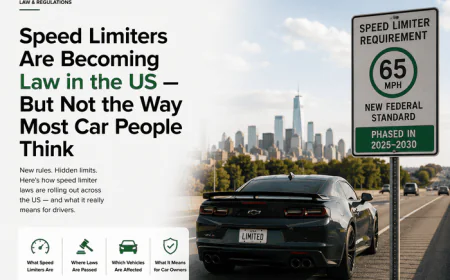
Speed Limiters Are Becoming Law in the US — But Not the Way Most Car People Think
Virginia, DC, and Washington now mandate speed limiters for repeat offenders — not all drivers. Here's how US Intelligent Speed Assistance laws actually work.
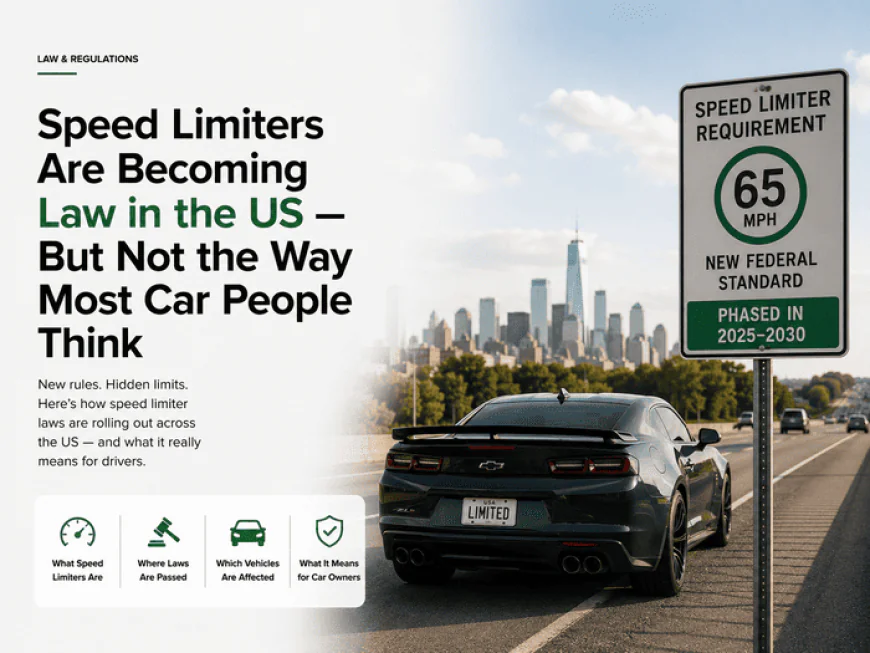
Speed Limiters Are Becoming Law in the US
Intelligent Speed Assistance, or ISA, is technology — usually GPS and mapping-based — that either warns a driver or physically caps a vehicle's speed relative to the posted limit, and contrary to a lot of the panic circulating in car forums, it's not currently a mandate for every car sold in America. It's being rolled out the same way ignition interlock devices were for DUI offenders: targeted at people who've already proven they can't be trusted with the privilege.
In plain English: if you get caught driving dangerously fast, several states can now order a physical speed limiter installed in your car as a condition of keeping your license — but if you're not that driver, nothing changes yet.
What's Actually Law Right Now
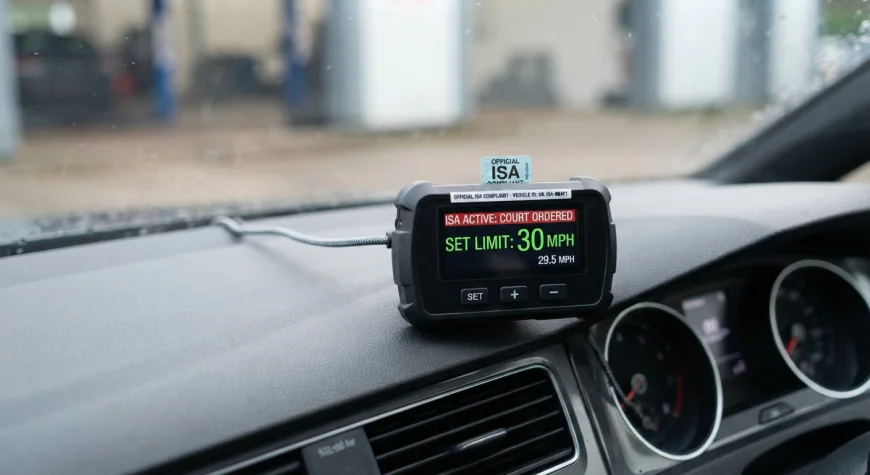
Virginia became the first state in the country to pass a full ISA law, and it takes effect in July 2026. It lets judges require drivers caught going over 100 mph to install speed-limiting technology as part of sentencing — essentially an alternative to a straight license suspension for the most extreme speeding cases. Washington, D.C. was actually first to implement the concept back in 2024, mandating ISA devices for drivers convicted of major speeding or aggravated reckless driving, on an escalating scale — a one-year program for a first conviction, up to four years for repeat offenses. Washington State followed with its own version, using a graduated definition of "excessive speeding" (20 mph over the limit above 40 mph zones, or 10 mph over in 40-and-under zones) to determine who qualifies, with the mandate beginning in 2029.
The States Still Debating It
New York's legislation is the one generating the most online alarm, and it's worth being precise about what it actually says. The primary Senate bill defines an ISA device as one that caps a vehicle's speed at roughly 5 mph above the posted limit and applies to drivers who've accumulated a serious violation record — eleven or more points in 24 months, or six camera-issued tickets in a year — not to every driver or every new car sold in the state. It passed the Senate in 2025 but has not cleared the Assembly or been signed into law. California, Maryland, Arizona, and Georgia all have similar bills moving through their legislatures as of 2026, and a California proposal that would have mandated passive speed assistance in all new cars sold in the state was actually vetoed, specifically over concerns it would conflict with federal vehicle regulation.
Why the "All New Cars" Fear Doesn't Match the Legislation
It's worth separating this clearly from Europe, where the EU now requires new cars to include a passive ISA warning system by default. Nothing comparable has passed in any US state — every enacted or seriously advancing American ISA law is structured as a targeted, court-ordered intervention for high-risk drivers, modeled explicitly on how ignition interlock programs work for DUI offenses. The "commonsense, targeted tool" framing that advocacy groups like Families for Safe Streets use isn't just messaging — it reflects how the actual bill text is written.
Does This Kill Driver Autonomy, or Save Lives?
The genuine tension here isn't really about whether every car will get a mandatory speed cap — it's about precedent and scope creep. Modified car owners and track-day drivers worry that a framework built for "super speeders" today becomes the foundation for broader mandates tomorrow, especially as more states copy the model and some proposals (like New York's) start tying eligibility to camera-issued tickets rather than just moving violations judged by an officer, which lowers the bar for who qualifies.
Advocates point to the numbers that got these bills moving in the first place: extreme speeding is disproportionately responsible for traffic fatalities relative to the small number of drivers who do it, and the ignition-interlock comparison isn't just rhetorical — DUI interlocks have a well-documented track record of reducing repeat offenses, and ISA proponents argue the same logic should apply to habitual extreme speeders.
For most enthusiasts and daily drivers, the realistic takeaway is that this legislation targets a genuinely narrow, high-risk group right now — but it's worth watching which way New York's and California's bills move, since they're the ones testing whether the eligibility criteria stay narrow or start expanding. It mirrors a debate we've already covered on the UK side — see our piece on UK speeding points and modified cars for how a similar points-based escalation plays out there.
If you're keeping an eye on where these laws are headed and want more car culture and legislation reading, the Mag store on Amazon is worth a browse.
Sources: Vision Zero Network state ISA tracking, Governors Highway Safety Association, NY Senate Bill S4045 and Assembly Bill A2299, Newsweek reporting on state ISA laws, American Bar Association Highway Justice program.
 Like
0
Like
0
 Dislike
0
Dislike
0
 Love
0
Love
0
 Funny
0
Funny
0
 Angry
0
Angry
0
 Sad
0
Sad
0
 Wow
0
Wow
0