








































































.png)












![[HOONIGAN] Ken Block's GYMKHANA NINE](https://img.youtube.com/vi/_bkX5VkZg8U/maxresdefault.jpg)





































































![[HOONIGAN] KEN BLOCK'S GYMKHANA SEVEN: WILD IN THE STREETS OF LOS ANGELES](https://cdn.motor1.com/images/mgl/2KlO4/s1/ken-block-london-tour-directors-cut.jpg)





































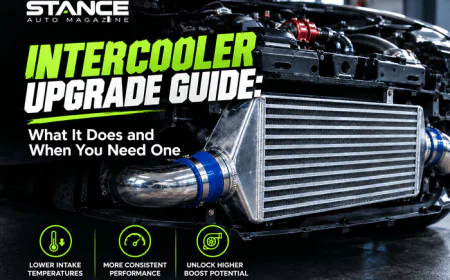
Intercooler Upgrade Guide: What It Does and When You Need One
An intercooler upgrade is one of the most effective mods on any turbocharged car here's exactly what it does, when you need one, and what to look for.
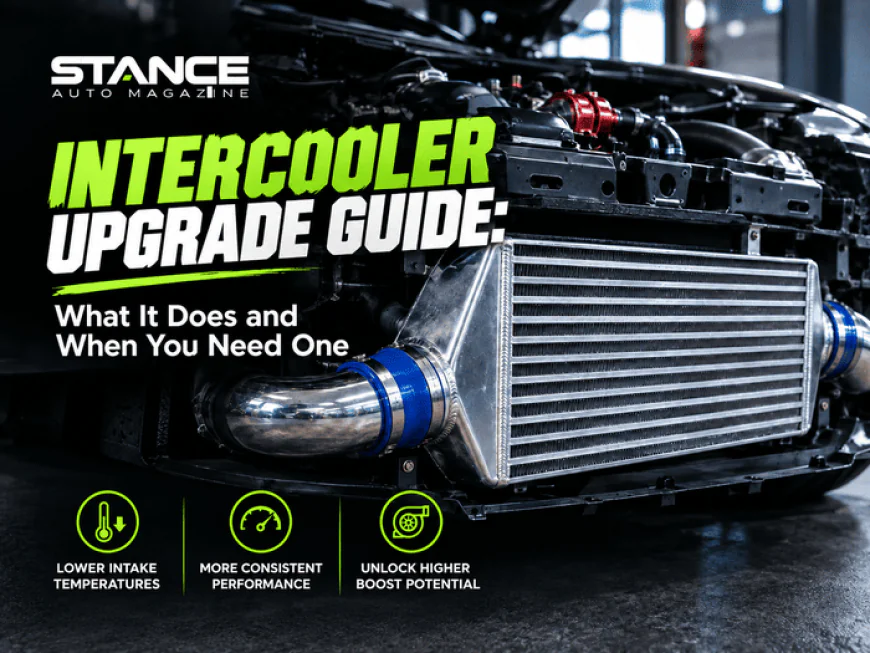
Why does cooling the air coming out of your turbo make such a big difference to power? An intercooler upgrade is one of the most genuinely effective, well-understood modifications on any turbocharged platform — and it's also one of the most commonly misunderstood in terms of when it actually becomes necessary versus when it's just expensive extra hardware.
What Does an Intercooler Actually Do?
A turbocharger compresses intake air, and compressed air gets hot. Hot air is less dense than cool air, meaning it carries less oxygen per unit of volume — which means less fuel can be burned efficiently, less power is made, and the risk of detonation increases. An intercooler sits between the turbocharger and the intake manifold, using ambient air passing through its core to cool that compressed charge back down before it enters the engine. Cooler charge air means denser air, more oxygen, more fuel, more power — and significantly better resistance to heat-related detonation under sustained boost.
When Does an Intercooler Upgrade Actually Become Necessary?
The factory intercooler on a turbocharged car is sized for the factory boost level and the factory power target, with a modest margin for normal operating conditions. Once you start pushing more boost, running a bigger turbo, or driving hard in warm weather for extended periods, the factory core starts to heat soak — the core itself gets so warm it can no longer cool the charge air effectively, and power drops progressively as the engine sees increasingly hot air. This is the moment an upgraded intercooler genuinely earns its place, not before.
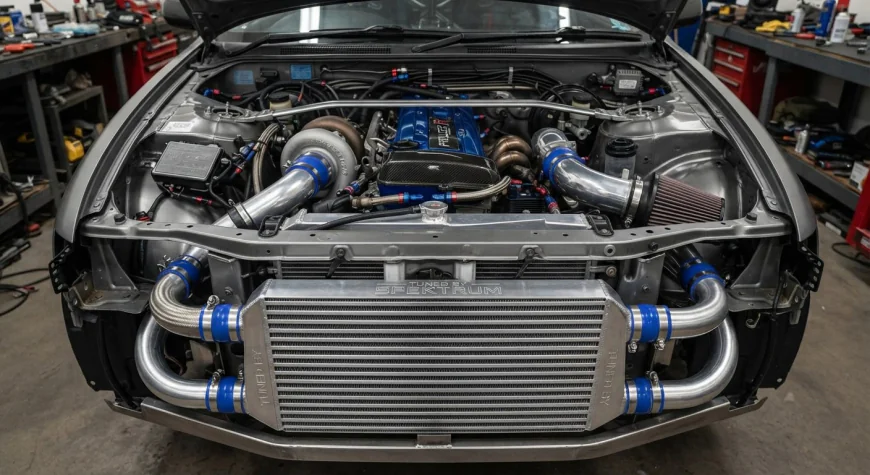
Front Mount vs Top Mount Intercoolers
Most factory turbocharged cars run a top-mount intercooler (TMIC), sitting directly on top of the engine close to the turbo outlet. Aftermarket upgrades typically involve either a larger top-mount core or a switch to a front-mount intercooler (FMIC) — mounted at the front of the car in the airflow path like a radiator. Front-mounts offer the most cooling potential since they're permanently in fresh ambient airflow, but they add intercooler piping length which can slightly increase turbo lag compared to a top-mount. For most street builds, a quality upgraded top-mount is often the more practical choice; for serious power builds, a front-mount is typically the better long-term investment.
How Do You Size an Intercooler Properly?
Intercooler sizing is a balance between cooling efficiency and flow restriction. An intercooler core that's too small for your power target will heat soak. One that's massively oversized will flow poorly and cause excessive lag. Core thickness, bar and plate vs tube and fin construction, and end tank design all affect how effectively an intercooler can cool charge air without killing flow. Reputable aftermarket manufacturers like Mishimoto and PWR publish flow and efficiency data for their cores, making it easier to match a core to a specific power target rather than guessing.
What Power Gains Can You Realistically Expect?
This depends almost entirely on how heat-soaked your factory intercooler was getting. On a car already running more boost than stock, switching to a quality front-mount can recover 20-40 horsepower that was being lost purely through charge air temperature, even before any other changes are made. On a car running exactly stock boost with a fully effective factory intercooler, an upgrade will make very little measurable difference — the gain comes from solving a problem that exists, not from the core itself being magic.
Does an Intercooler Upgrade Require Supporting Mods?
Not necessarily, but it works best as part of a properly sequenced build covered in our best mods for more horsepower guide. A bigger intercooler with more boost and a proper tune extracts far more benefit than the intercooler alone would suggest. Fitting an upgraded intercooler while staying at stock boost on a fully healthy factory core is money that could be more effectively spent elsewhere in the build order.
See It in Action: Real Intercooler Builds
Our 2JZ-GTE build guide covers intercooler selection as part of a complete build sequence, and the 1001HP Supra build features a Greddy FMIC as part of a properly sequenced supporting mod package that shows exactly what this hardware does at serious power levels.
For more build guides and everything else modified car culture, head back over to Stance Auto Mag. And if you're building a 90s JDM platform, our Stance Auto 90s JDM Classics magazine is the best-selling issue in our store and the most popular JDM magazine on Amazon right now — packed with the iconic builds from the era that defined this whole culture.
 Like
0
Like
0
 Dislike
0
Dislike
0
 Love
0
Love
0
 Funny
0
Funny
0
 Angry
0
Angry
0
 Sad
0
Sad
0
 Wow
0
Wow
0