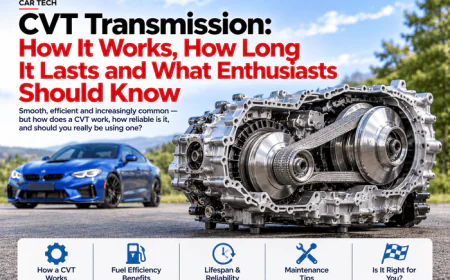























































































































































































































CVT Transmission: How It Works, How Long It Lasts and What Enthusiasts Should Know
A CVT transmission uses two pulleys and a steel belt instead of fixed gears. Here is how it works, how long it lasts, what fluid it needs and whether you can tune one.
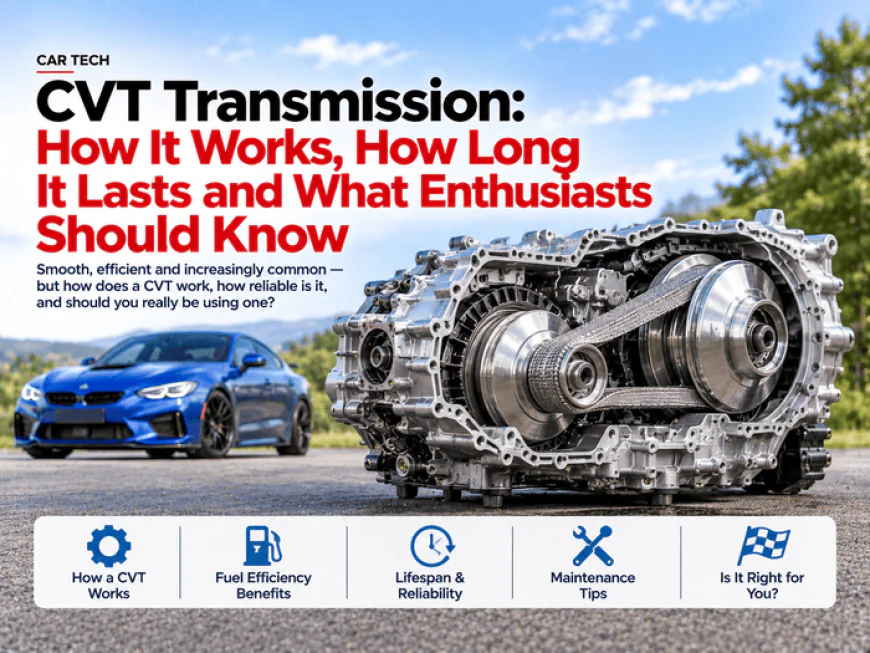
A CVT transmission, short for continuously variable transmission, is an automatic gearbox that uses two cone-shaped pulleys and a steel belt or chain to give an endless range of ratios instead of fixed gears. There are no shifts to feel, no gear hunting and no stepped power delivery. The engine just sits at whatever rpm suits the moment while the pulleys quietly change the ratio. It's clever engineering and it's incredibly common now, but among enthusiasts a CVT transmission still gets a bad name. Some of that's fair and some of it's a hangover from early units. Here's the real picture.
If you drive anything from a kei car to a family crossover, there's a good chance you already own one. And if you're thinking of buying a Japanese import, you'll run into a CVT sooner or later, so it's worth knowing what you're getting into.
What Is a CVT Transmission?
A CVT transmission is an automatic gearbox with no fixed gears, using variable-diameter pulleys to change the ratio smoothly. A conventional automatic has a set number of gears, say six or eight, and a torque converter or clutch packs shuffle between them. A CVT replaces all of that with two pulleys connected by a belt. One pulley is attached to the engine and the other to the wheels. Each pulley is made of two cones that slide together or apart. When the cones squeeze together, the belt rides higher on the pulley and acts like a larger gear. When they open, the belt rides lower and acts like a smaller one.
Because the pulleys can sit at any point along their range, the transmission can hold the engine at its most efficient or most powerful rpm and let the car's speed climb without the revs jumping around. That's why a CVT often feels like it's "stuck" at high revs under hard acceleration. It's not slipping in the usual sense, it's doing exactly what it was designed to do.
How Does a CVT Work in Everyday Driving?
A CVT works by constantly adjusting pulley width to keep the engine in its ideal rpm band for the speed and throttle you ask for. Pull away gently and the ratio starts low, a bit like first gear. As you speed up the pulleys shift smoothly toward a taller ratio. Floor the throttle and the CVT holds the engine near its power peak while the car catches up, which gives that rubber band feeling people either hate or ignore.
Modern units soften this with programmed "steps" that imitate gear changes and paddle shifters that give you fixed ratios. Toyota's Direct Shift-CVT adds a physical launch gear to improve takeoff. Honda and Subaru both use their own versions, and Subaru's Lineartronic unit uses a chain instead of a belt. Many Japanese-market cars rely on units from Jatco, the Nissan-affiliated supplier that builds CVTs for plenty of brands, so you'll find similar hardware in cars that look nothing alike.
What Are the Advantages of a CVT Transmission?
The main advantages of a CVT transmission are better fuel economy, smooth acceleration and a lighter, more compact package than a traditional automatic. Because the engine can sit at its efficient speed, the car uses less fuel in everyday driving and often beats a conventional automatic on the official test. There's no shift shock, which is why CVTs are so popular in small city cars, hybrids and kei cars where comfort and mpg matter more than driving excitement.
They're also cheaper to build in many applications and they pair well with small engines. That's part of the reason you'll see one in tiny Japanese runabouts. If you want to read more about that world, our kei cars explained piece covers why so many of these little legends exist and why they're so appealing.
What Are the Common CVT Transmission Problems?
The most common CVT transmission problems are overheating, belt or chain wear, shuddering, whining noises and slipping caused by old or wrong fluid. Early CVTs from several manufacturers earned a reputation for failing well before 100,000 miles, and some Nissan models in particular were the subject of extended warranty coverage and class actions. Newer designs are noticeably better, but the weak points are the same. Heat is the enemy because the belt relies on friction against the pulley, and friction makes heat.
Typical symptoms include a shudder when pulling away, a high-pitched whine, delayed engagement, revs flaring without the car speeding up and a warning light on the dash. If you notice any of those, stop thinking about it and get it looked at. A CVT that's caught early can sometimes be saved with a fluid service or a valve body repair, but a CVT that's been driven while slipping usually needs replacing. A replacement unit can run into thousands, which is more than many older cars are worth.
How Often Should You Change CVT Fluid?
Most specialists recommend changing CVT fluid every 30,000 to 60,000 miles, even when the manufacturer calls it a lifetime fill. The fluid does more than lubricate. It's what lets the belt grip the pulleys without damaging them, and it also carries heat away. Over time it breaks down and picks up fine metal particles from normal wear. That's why a CVT is much less forgiving of old fluid than a conventional automatic.
Crucially, you must use the exact fluid the car calls for. Nissan, Honda, Toyota and Subaru all use their own formulas and they aren't interchangeable. Putting in a generic ATF is a quick way to kill a CVT transmission. Check the handbook or the dealer part number and buy the right stuff from a trusted supplier like Motul or the manufacturer. Use a proper drain-and-fill rather than a high-pressure flush, and if the car has a history of overheating, a small external cooler can help a lot.
Can You Tune a Car With a CVT Transmission?
You can tune a car with a CVT, but there's very little headroom because most belts and chains are rated close to the engine's stock torque. That's the big reason you won't find many hardcore builds running one. Add boost or a big remap and the extra torque can make the belt slip, which damages the pulleys. Once that happens the transmission is usually finished.
If your plan is a stage one remap or light bolt-ons on something modest, you may get away with it as long as the fluid is fresh and you don't abuse launches. Beyond that you're better off looking at a manual or a conventional automatic swap. It's the same reason performance cars almost never use CVTs. For more on what's practical and what's wishful thinking, our guide on the best first car modifications under 5k is a good starting point before you start throwing money at something that can't take it.
Is a CVT Transmission Right for a JDM Import?
A CVT transmission is fine for a daily-driven JDM import if you buy carefully and keep the fluid fresh, but it's the wrong choice for a performance build. Plenty of Japanese cars that are popular in the UK and US, like the Nissan Cube, small Hondas and kei vehicles, come with a CVT. If you're buying one for style and fun rather than outright speed, a good one is easy to live with. The Cube is a great example, and you can see one done properly in our bagged Nissan Cube feature.
When you're shopping for an import, ask for service history, check for any shudder on a test drive and look at the fluid. If you're sourcing a car from Japan, our JDM import guide explains what to inspect, and if you enjoy the cars that came before the CVT era, the Stance Auto 90s JDM Classics issue is a good read at our magazine page.
Final Word on the CVT Transmission
A CVT transmission isn't the villain it's made out to be, but it needs fresh fluid and a gentle owner. Treat it right and it'll deliver smooth, efficient driving for years. Ignore it, tune it hard or fill it with the wrong oil, and it will cost you more than the engine ever did. Know which type you've got, keep a service record and walk away from any used car that shudders when it pulls off.
If you enjoy this kind of down-to-earth car advice, find Stance Auto Magazine on Amazon.
Related Reads
- Kei Cars Explained: The Tiny JDM Legends
- Clutch Slipping: Causes, Diagnosis and Solutions
- How to Import a JDM Car: The Complete Guide
- Bagged Nissan Cube by Alex Torres
Find more builds, guides and car culture at Stance Auto Magazine.
 Like
0
 Dislike
0
 Love
0
 Funny
0
 Angry
0
 Sad
0
 Wow
0