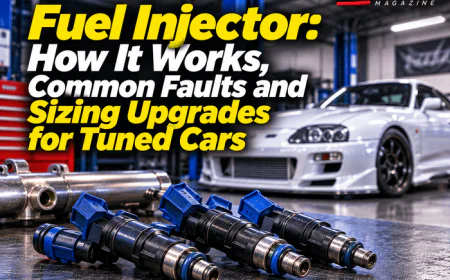

























































































































































































Fuel Injector: How It Works, Common Faults and Sizing Upgrades for Tuned Cars
A fuel injector sprays a precise mist of fuel into your engine. Learn the symptoms of a bad injector, cleaning and replacement costs, and how to size upgraded injectors for a tuned car.
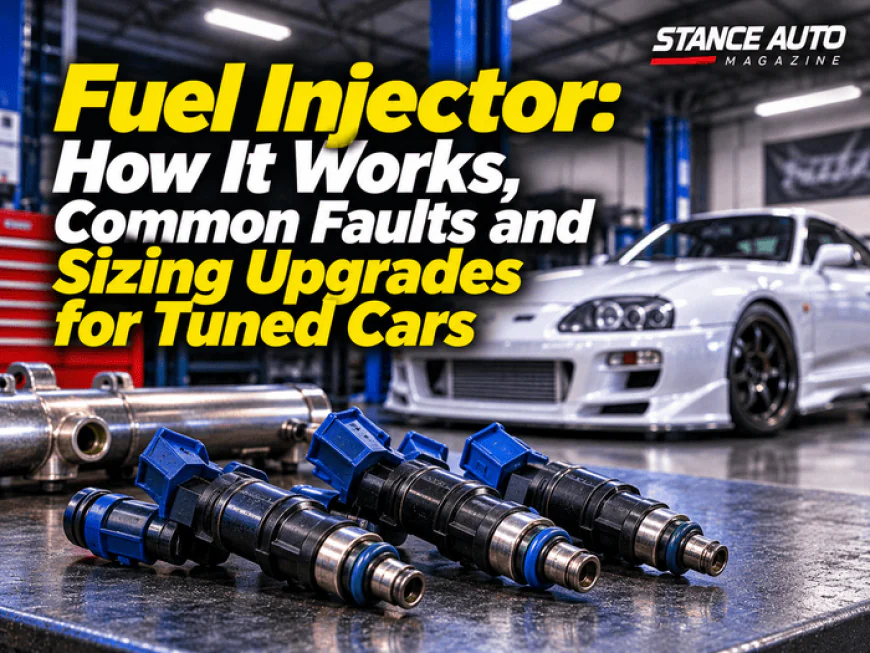
A fuel injector is an electronically controlled valve that sprays a fine, precisely metered mist of fuel into the engine so it can mix with air and burn efficiently. Every petrol engine on the road has one per cylinder, and each opens and closes thousands of times a minute on the instructions of the ECU. When they work, you never think about them. When one clogs or leaks, the engine runs rough, drinks fuel and sometimes goes lean enough to cause serious damage. And if you're chasing power, the injectors are one of the first things that run out of headroom.
This guide explains how a fuel injector works, how to spot a bad one, what cleaning and replacement cost and how to size new injectors if you're tuning.
What Does a Fuel Injector Do?
A fuel injector delivers a measured amount of fuel in a fine spray at the exact moment the engine needs it. The fuel pump sends pressurised fuel to the fuel rail, and each injector sits at the end of it. When the ECU sends an electrical pulse, a small solenoid lifts a pin or ball off its seat and fuel sprays out through tiny holes. The length of the pulse, called pulse width, decides how much fuel is delivered. A longer pulse means more fuel.
The quality of the spray matters as much as the amount. A good injector atomizes the fuel into a fine cone so it mixes properly with air and burns cleanly. A dirty one dribbles or squirts in a bad pattern, which leaves some fuel unburned and wastes power.
What Are the Different Types of Fuel Injector?
The main types are throttle body injection, port injection and direct injection, with modern cars mostly using port or direct, or both. Throttle body systems are old and simple, with one or two injectors above the throttle. Port injection puts an injector in each intake port, spraying fuel onto the back of the intake valve. Direct injection sprays fuel straight into the cylinder at very high pressure, which gives better efficiency and power, but also leaves the intake valves without a fuel wash and prone to carbon buildup.
Many newer engines use both port and direct injection to get the benefits of each. Most of the classic Japanese turbo engines that enthusiasts love, like the 2JZ and the RB26, use port injection, and that's part of why they're so easy to upgrade. Brands like Bosch have built the injectors for a huge range of cars, and plenty of aftermarket upgrades use Bosch-style bodies.
What Are the Symptoms of a Bad Fuel Injector?
The common symptoms of a bad fuel injector are a rough idle, misfires, hesitation under load, poor fuel economy, a fuel smell and a check engine light. A clogged injector delivers too little fuel, so that cylinder runs lean and misfires. A leaking injector delivers too much, which can wash oil off the cylinder wall, foul the plug and make the car hard to start when hot. You may see codes in the P0200 range, which point at injector circuits, or P0300 series misfire codes.
Other signs include a ticking that's louder than normal, a car that stumbles at idle and a fuel economy figure that quietly gets worse. A mechanic can test injectors by measuring resistance, listening with a stethoscope, or running a flow and spray pattern test on a bench. Don't keep driving with a lean misfire, because lean running raises combustion temperature and can melt a piston.
How Do You Clean a Fuel Injector?
You can clean a fuel injector using a fuel additive for light deposits or having a specialist ultrasonic clean and flow test them for heavy ones. Bottled injector cleaners are cheap and easy, and a good one used regularly helps stop deposits forming. They work best as prevention or on mild clogging. For a properly clogged set, an ultrasonic bench service removes the injectors, cleans them in a tank and tests the spray pattern and flow rate across the whole set, so you know they match.
On direct injection engines, carbon builds up on the intake valves and not on the injectors, so cleaners don't help much there. Walnut blasting or a manual clean is the fix. Using decent fuel and keeping the engine serviced also reduces deposits, and sticking to a quality oil helps too.
How Much Does Fuel Injector Replacement Cost?
Fuel injector replacement typically costs roughly £50 to £250 per injector in parts, with a full set and fitting usually landing between £300 and £1,000 or more depending on the car. A single failed injector on a simple engine is an easy job. A direct injection engine with high-pressure fuel needs more care and more cost, and some European engines hide the injectors under the intake manifold, which pushes up labor.
If one injector has failed on a high-mileage car, it's often worth replacing the set, because the others have the same wear and will start to go too. Always fit new seals and O-rings, and make sure the rail is depressurized before touching anything, since petrol under pressure is dangerous.
How Do You Size a Fuel Injector for a Tuned Car?
To size a fuel injector, divide your target horsepower times the fuel consumption rate by the number of injectors times a safe duty cycle, usually about 80 percent. The fuel consumption figure is called brake specific fuel consumption, or BSFC, and a common rule of thumb is about 0.5 lb/hp/hr for naturally aspirated engines and 0.6 for boosted ones. The result is in pounds per hour, which you multiply by 10.5 to get cubic centimeters per minute, the unit most injectors are sold in.
Here's an example. You're aiming for 500 hp on a six-cylinder turbo. Multiply 500 by 0.6 to get 300, then divide by six injectors at 0.8 duty, which is 4.8, and you get 62.5 lb/hr. That's about 656 cc per minute per injector. In practice you'd pick the next size up, around 700 to 750 cc, so you've got some headroom. These are rough numbers, so always confirm with a tuner, who will know your fuel, pressure and setup.
What Else Needs Upgrading with Bigger Fuel Injectors?
Bigger fuel injectors need a tune, and usually a stronger fuel pump, a suitable regulator and sometimes a larger fuel rail to keep up. An engine with larger injectors and no retune will run horribly rich and may not idle. The ECU needs the injector's data, including flow rate and latency, which is the tiny delay between the pulse and the fuel actually flowing. Specialist suppliers such as Injector Dynamics publish this data for their injectors, which is useful for a tuner.
Fueling is part of the whole package. If you're adding a turbo, a remap or a supercharger, our guides on the best mods for more horsepower and turbo conversion costs help you plan the supporting upgrades so you don't end up chasing problems one at a time. The ECU remap vs piggyback tuner comparison is worth reading before you decide how to handle the tuning side.
Do Classic JDM Turbo Engines Need Bigger Fuel Injectors?
Yes, most 90s Japanese turbo engines need larger injectors once you move beyond modest boost, because the stock injectors run out of headroom first. The 2JZ and RB series respond well to boost, and a bigger turbo, a retune and larger injectors is the classic path. It's one reason these engines became so popular with builders. Our 2JZ-GTE build guide and RB26DETT tuning guide go into what the rest of the build looks like.
If you love that era, the Stance Auto 90s JDM Classics issue is worth a read at our magazine page, and it covers the cars that made big injectors and bigger boost part of the culture.
What Should You Check Before Buying Used Injectors?
Before buying used or upgraded injectors, check the flow rate, the connector type, the impedance and whether the supplier provides data for your tuner. High impedance and low impedance injectors need different drivers, and plugging in the wrong type can damage the ECU. Make sure the body length and O-ring size match your rail, and avoid unbranded sets with no flow data. A cheap set of mismatched injectors is a very good way to destroy an engine.
If you're buying used, have them cleaned and flow-tested as a set. That costs a little, but it tells you whether they're matched and ready to use.
Final Word on the Fuel Injector
The fuel injector is a small part with a huge job, and whether you're fixing a rough idle or building a big power car, getting it right matters. Watch for the early warning signs, clean and service the system, and if you're chasing power, size your injectors properly and have the car tuned to suit. Do that and the engine will reward you with smooth running and reliable power.
For more practical guides and builds, find Stance Auto Magazine on Amazon.
Related Reads
- What Are the Best Mods for More Horsepower?
- Turbo Conversion Cost: Complete Breakdown
- ECU Remap vs Piggyback Tuner Comparison
- 2JZ-GTE Build Guide
Find more builds, guides and car culture at Stance Auto Magazine.
 Like
0
 Dislike
0
 Love
0
 Funny
0
 Angry
0
 Sad
0
 Wow
0