





























































































.png)












![[HOONIGAN] Ken Block's GYMKHANA NINE](https://img.youtube.com/vi/_bkX5VkZg8U/maxresdefault.jpg)













































































![[HOONIGAN] KEN BLOCK'S GYMKHANA SEVEN: WILD IN THE STREETS OF LOS ANGELES](https://cdn.motor1.com/images/mgl/2KlO4/s1/ken-block-london-tour-directors-cut.jpg)




































Front splitters on a lowered car: what actually happens to your ground clearance
A front splitter on a lowered car costs you approach angle, not static clearance. How to measure it, which mounting method survives kerbs, and why ABS and carbon suit different builds.

A front splitter on a lowered car costs you approach angle, not static ground clearance. Most bolt-on lip splitters sit level with, or a few millimetres below, the bottom edge of the standard bumper, because the part is cut to follow that line. What changes is how far the leading edge projects forward, which is what decides whether you clear a ramp. Measure the lowest point at driving height, work out the projection, and pick a mounting method with some give. The rest of this covers how to do each of those.
A splitter is measured from the ground, not from the bumper
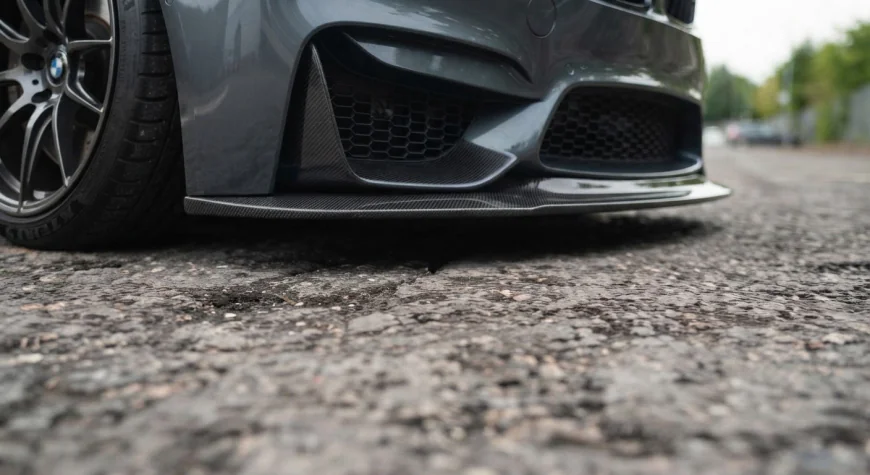
The common mistake is treating the splitter as if it hangs below the bumper by its own thickness. What actually matters is the lowest point of the whole assembly relative to the road, and on a lip splitter that point is usually within a few millimetres of where the bumper already sat.
So the splitter does not add its full depth to your clearance loss. It extends forward, and that changes your approach angle far more than it changes your static clearance.
The distinction matters more than it sounds. A car lowered 40mm running a splitter is not the same thing as a car lowered 60mm. The static number barely moves. The approach angle is where the change actually lands.
The three numbers that decide it
- Static clearance at the bumper's lowest point. Measure it with the car at driving height, do not estimate it.
- How far forward the splitter projects from that point.
- Your approach angle, which is what determines whether you clear a ramp.
A splitter projecting 60mm forward on a car sitting at 95mm will catch on a steep driveway before the bumper itself would. The failure mode is almost always a scrape on entry, not bottoming out on a flat road. Once you understand that, you stop measuring the wrong thing.
Mounting method changes the failure mode
There are two broad approaches, and they behave very differently when something goes wrong.
Bonded with automotive tape and supported with screws, the part has a small amount of give. When the leading edge catches a kerb at low speed it deflects and returns. The tape line takes the load first and the bumper skin is protected.
Mounted rigidly with brackets straight through the bumper, there is no give at all, so the impact goes into the mounting points and into the bumper itself.
For a car that lives on UK roads rather than a track day car, the flexible mount is the one that survives a supermarket car park.
Material: two tiers, not two qualities
ABS is the same family of plastic used for factory bumpers. It is impact resistant and it flexes, which on a lowered car is exactly the property you want. A leading edge that deflects over a speed bump and returns to shape is doing its job.
Prepreg carbon is stiffer and lighter, and the weave is part of the look rather than something hidden under paint. It is the right choice when the part itself is meant to be seen and the car is not being parked nose-in against high kerbs every day. Stiffer also means it does not deflect, and a part that does not deflect has to transmit the impact somewhere.
Neither is a compromise version of the other. They are different specifications for different uses. Most UK ranges, including the Maxton Design UK front splitters range, cover the same fitment tree in both materials, so the decision comes down to how the car is actually used rather than what is available for it.
Air ride changes the sums
On air, clearance is variable, which removes most of the risk but introduces a different one. The part still sits at its lowest when the car is aired out, and that is usually when the car is stationary and being photographed, not when it is moving.
The number to size the part around is ride height at driving level, not at parked level. The common error is working to the static drop used for shows and then finding the geometry is wrong at cruising height.
Practical technique
- Approach ramps at an angle, one wheel first. Lifting one corner buys clearance that a straight-on approach does not.
- Speed bumps: straddle them where it is legal and safe, or take them at a slight angle for the same reason.
- Concrete wheel stops in car parks are the single most common source of damage, because they sit at roughly splitter height and disappear under the bonnet as you approach.
- Check the mounting line after the first few weeks. Automotive tape bonds fully over time, and any lifting at the leading edge shows up early if you look for it.
Fitment: the part most people skip
Ground clearance is the question everyone asks. Fitment is the one that actually causes returns.
Manufacturers routinely change the front bumper between trim levels within the same generation, and again at facelift. A splitter follows the bumper's bottom edge across its full width, so a part cut for a sport bumper will not sit flush on a standard one, even on the same model year and the same engine.
Before ordering, four things need establishing: generation, trim level, pre-facelift or facelift, and body style. That takes two minutes with the car in front of you, and it saves a return in both directions.
In short
A splitter on a lowered car is a question of approach angle, not static clearance. Measure the lowest point at driving height, work out how far the part projects forward, pick a mounting method with some give, and choose the material based on how the car is genuinely used. Then check the fitment properly before anything goes in the basket.
 Like
0
Like
0
 Dislike
0
Dislike
0
 Love
0
Love
0
 Funny
0
Funny
0
 Angry
0
Angry
0
 Sad
0
Sad
0
 Wow
0
Wow
0