











































































































































































































ADAS Explained: What It Means for Lowered and Modified Cars
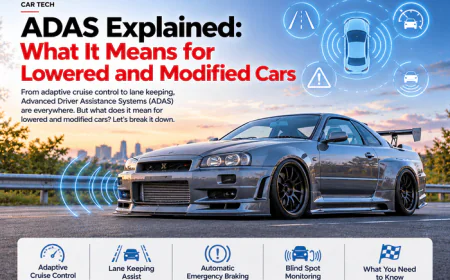
ADAS stands for advanced driver assistance systems, the cameras and radar behind lane assist and auto braking. Lowering or modifying a car can throw them off, here is how.
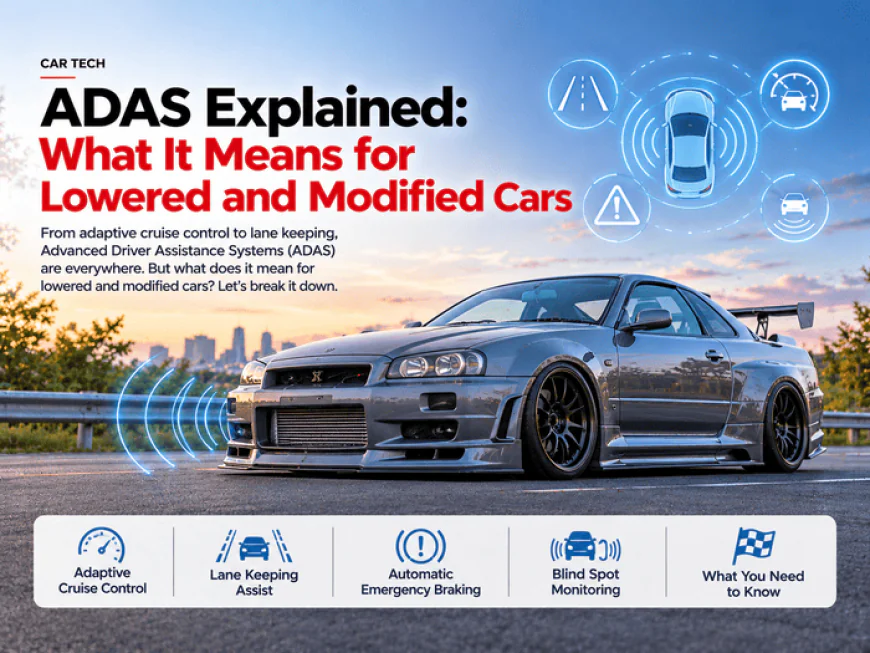
ADAS stands for advanced driver assistance systems, the cameras, radar and sensors that run features like lane keep assist, adaptive cruise control and automatic emergency braking. If your car was built in the last few years, it almost certainly has some of it. And if you're thinking of lowering it, fitting air suspension, changing wheel sizes or swapping a windscreen, ADAS is the thing that quietly gets forgotten. It's a big deal, because these systems rely on knowing exactly where the car is pointing and how high it sits.
Most modification guides still read like it's 2005. Springs, coilovers, bags, wheels, done. But the sensors on a modern car were calibrated for one specific ride height and one specific geometry, and change either and the system's view of the road changes with it. This guide explains what ADAS actually is, how modifications affect it and what you can do about it.
What Is ADAS?
ADAS is a group of electronic safety and convenience systems that use cameras, radar and ultrasonic sensors to help the driver and reduce crashes. The term covers a long list of features. Autonomous emergency braking, adaptive cruise control, lane departure warning, lane keep assist, blind spot monitoring, traffic sign recognition, rear cross traffic alert and parking sensors all count. Regulators like Euro NCAP now reward these systems in safety ratings, and in the US the NHTSA tracks them closely, which is why even small and cheap cars have them.
None of this is autonomous driving. It's assistance. The car still needs you to pay attention. But the systems make real decisions, like braking for you, so they need accurate data, and that's where modifying a car causes trouble.
How Do ADAS Sensors Work?
ADAS sensors work by measuring the road ahead and around the car with a camera behind the windscreen, radar in the bumper or grille, and ultrasonic sensors in the bumpers. The forward camera reads lane markings, signs and vehicles. The radar measures distance and speed of objects in front. Ultrasonic sensors handle close range parking. Some cars add surround cameras and rear radar for blind spot monitoring.
Every one of these sensors has a fixed idea of where it's aimed. The camera expects the horizon to be at a certain height in its image. The radar expects to look straight down the road at a set angle. If the car sits lower, the nose points slightly differently and the sensors see a different slice of the world. A tiny change in angle at the sensor becomes a big error at 100 meters. That's why a car that's been lowered can brake for things that aren't there, miss a stopped vehicle or drift out of its lane with the assist active.
Does Lowering a Car Affect ADAS?
Yes, lowering a car affects ADAS because it changes the sensor aim, the ride height and often the alignment, all of which the system was calibrated around. The radar behind the front bumper is often the most sensitive. Manufacturers specify its aim to a very small tolerance, and lowering a car by an inch or more can tilt it enough to push it out. The windscreen camera can also be affected, although it's mounted high and may tolerate a little more.
Cars on springs or coilovers are the usual case, but air suspension complicates things. A car on air ride has no single height, so the sensors are only correctly aimed at the height the car was calibrated at. If you drive around slammed with ADAS active, you're relying on sensors pointed at the sky or the tarmac. Our guide to lowering your car properly covers the basics of springs versus coilovers, but if the car has ADAS, add this to your checklist before you buy parts.
Why Does Wheel Alignment Matter for ADAS?
Wheel alignment matters for ADAS because the systems assume the car travels in a straight line, so a bad thrust angle makes the sensors point slightly off from where the car is actually going. Many manufacturers require a proper alignment before any camera or radar calibration, because there's no point aiming a sensor at a car that's crabbing sideways. Lowering a car changes camber and toe, so an alignment is already on your to-do list. Do it first, then calibrate.
We've covered the alignment side in detail in our wheel alignment after lowering guide, which explains what to ask for and what numbers to aim at. For a car with ADAS, tell the shop up front. A good one will either do the calibration or send you to someone who can.
What Is ADAS Calibration and How Much Does It Cost?
ADAS calibration is the process of re-aiming a camera or radar sensor to factory spec, using either target boards in a workshop or a guided road drive with a scan tool. Static calibration uses printed targets or reflectors placed at exact distances and heights in front of the car. Dynamic calibration needs the car to be driven at set speeds on well-marked roads while the diagnostic tool teaches the sensor where it's pointing. Some cars need both.
It's normally done after a windscreen replacement, a front bumper repair, a collision and a suspension or alignment change. Specialists like Autoglass offer it in the UK, and dealers and many independents do too. Prices vary with the car and the system, but you should expect a few hundred pounds or dollars per calibration, and more if the car needs both camera and radar. For a modified car it gets more complicated, because the shop will normally calibrate to the factory ride height. Ask them first whether they'll agree to do it on a lowered or air suspension car.
Can You Calibrate ADAS on an Air Suspension Car?
You can calibrate ADAS on an air suspension car by setting it to its factory ride height first, but you then have to drive at that height for the calibration to stay valid. This is the catch. It's tempting to calibrate at standard height and then lay frame at the show, and that does work as a one-off. But every time the car is at a different height, the sensors are aimed incorrectly. The honest answer is that a car lowered for daily use will never be perfectly calibrated unless the sensors are physically repositioned or the ECU is adjusted for the new height.
Some people accept that and turn the assists off. Others keep them on and accept the risk. Both are your call, but be aware that a system working from bad data can be more dangerous than one that's switched off. If the car brakes for no reason at motorway speed, that's a real hazard. The safest approach is to keep the car within a small drop of the calibrated height, or to choose a platform where the modification doesn't carry as much risk.
Do You See ADAS on Modified Builds?
ADAS is turning up on modified builds more and more as newer cars like the Honda Civic Type R and Tesla Model 3 become project cars. Honda's current Type R runs a camera and radar package, and it's one of the cars we've featured on air ride, as you can see in this Honda Civic FL5 Type R with custom air suspension. Teslas are another example. They're full of sensors and cameras, and builders have been bagging and widebodying them for years, like the bagged Tesla Model 3 by Khris Taylor.
As newer cars get cheaper on the used market, more people will modify them, and the ADAS conversation will only get louder. Builders who understand the sensors will end up with safer, better-driving cars than the ones who ignore them.
Will ADAS Modifications Affect Your Insurance and MOT?
Modifying a car with ADAS can affect your insurance, because a policy may not cover a crash caused or worsened by an uncalibrated or disabled safety system. Always declare suspension changes to your insurer, and if you've turned off a safety feature, think about whether that's something to mention too. Our modified car insurance explainer goes through how insurers treat different mods.
On the testing side, an MOT in the UK focuses on core safety items, and a warning light for something like ABS or airbags can matter. How a particular tester treats ADAS faults varies, so ask before you book. In the US, inspection rules depend on your state, and modifications that change ride height can run into state laws on bumper and headlight height regardless of ADAS.
Final Word on ADAS
ADAS is no longer optional equipment on most new cars, and modifying a car without thinking about it can make the car less safe, not more fun. Before you lower, bag or swap parts on anything with cameras or radar, find out what sensors it has, plan an alignment and calibration into your budget, and decide how much you're willing to rely on those systems once the car is changed. If you do it properly, you can have a car that looks the part and still drives like it should.
For more straight-talking guides, builds and car culture, find Stance Auto Magazine on Amazon.
Related Reads
- Wheel Alignment After Lowering: Complete Setup Guide
- How to Lower Your Car Properly: Springs vs Coilovers
- Air Suspension vs Coilovers: Pros, Cons and Costs
- Modified Car Insurance Explained: UK 2026
Find more builds, guides and car culture at Stance Auto Magazine.
 Like
0
 Dislike
0
 Love
0
 Funny
0
 Angry
0
 Sad
0
 Wow
0