




































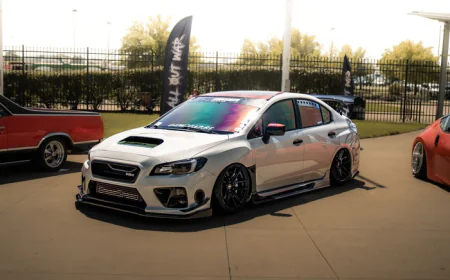
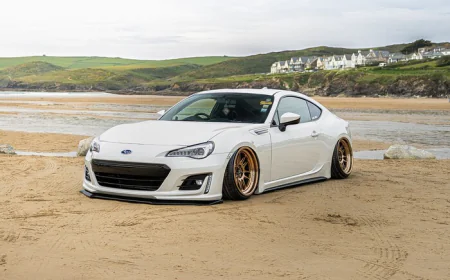

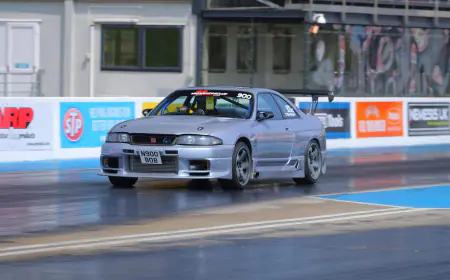
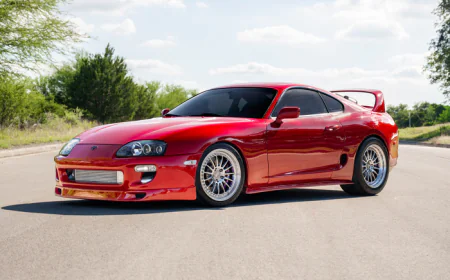




















.png)





![[HOONIGAN] Ken Block's GYMKHANA NINE](https://img.youtube.com/vi/_bkX5VkZg8U/maxresdefault.jpg)







































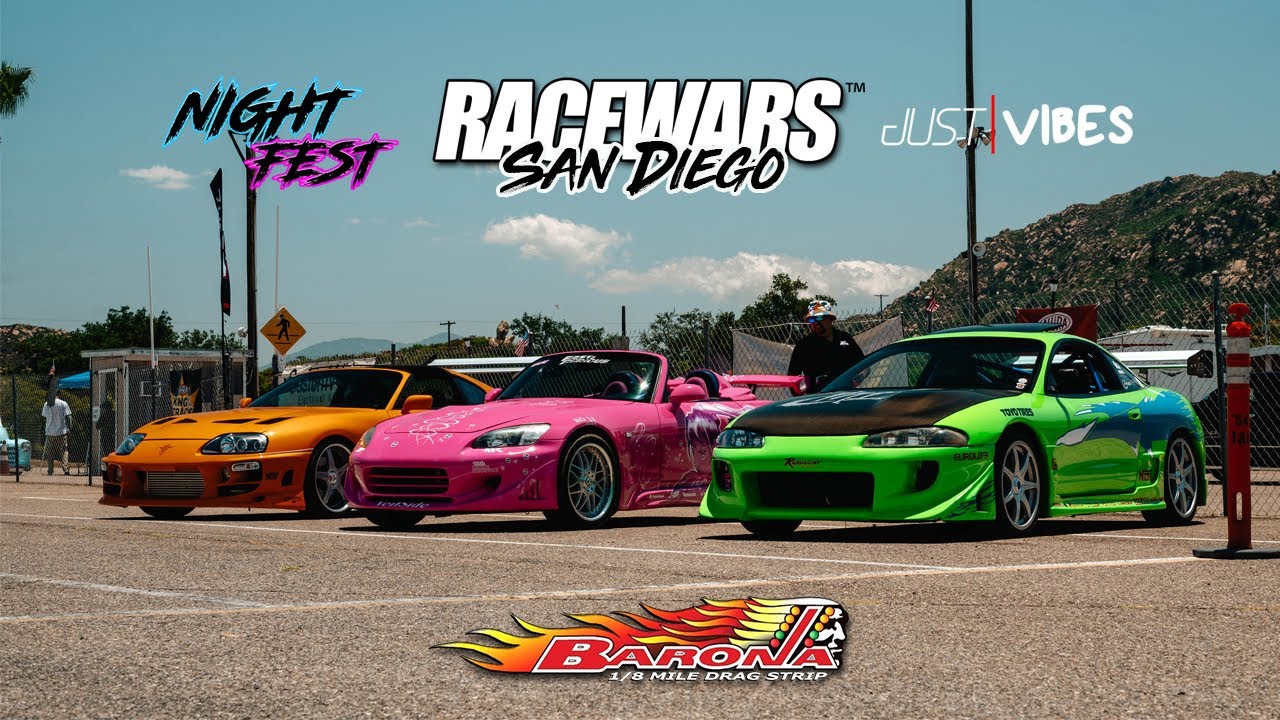
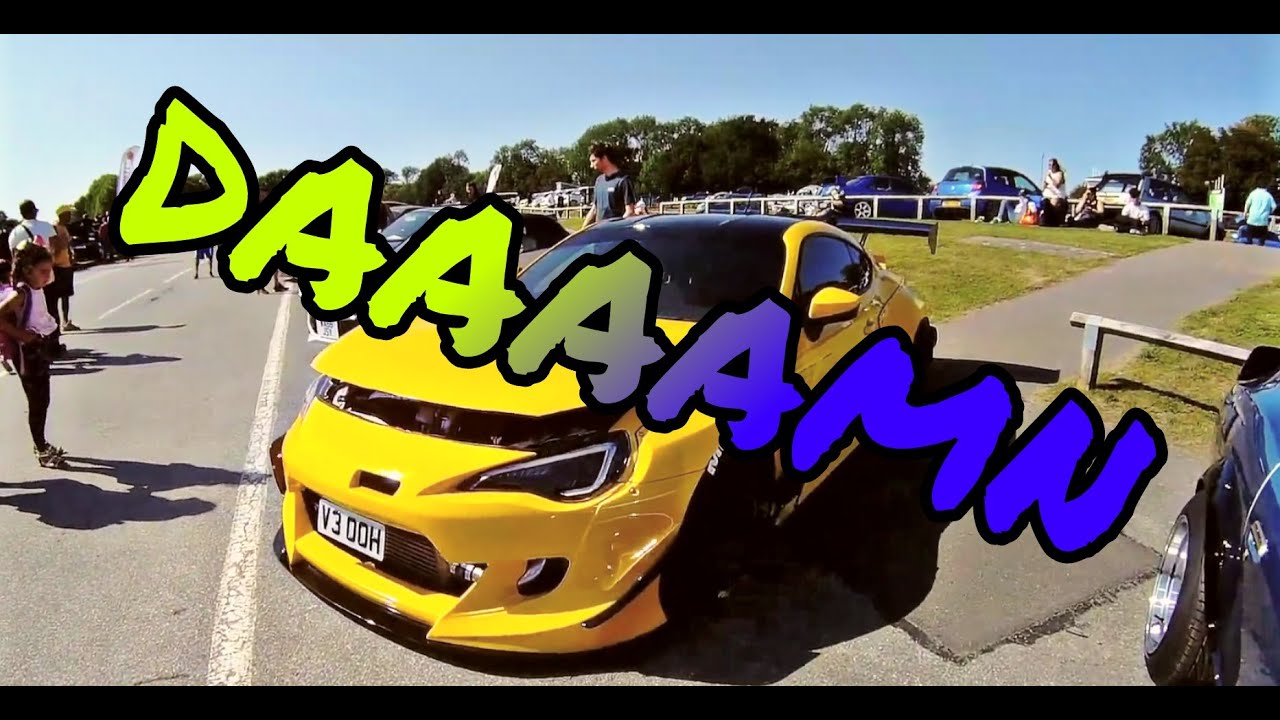




![[HOONIGAN] KEN BLOCK'S GYMKHANA SEVEN: WILD IN THE STREETS OF LOS ANGELES](https://cdn.motor1.com/images/mgl/2KlO4/s1/ken-block-london-tour-directors-cut.jpg)



































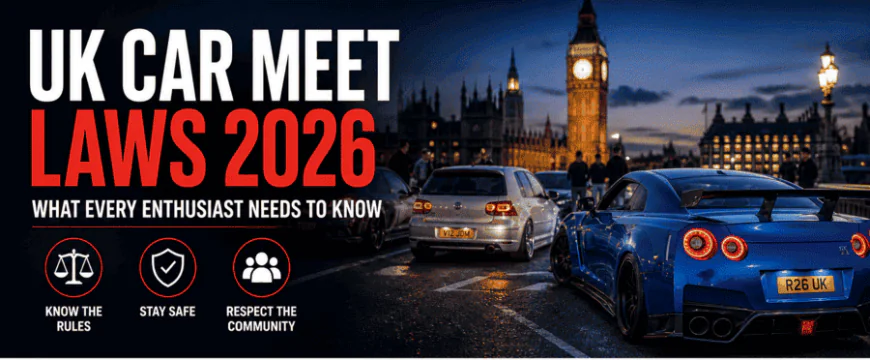
UK Car Meet Laws 2026 — What Every Enthusiast Needs to Know
UK car meets face a serious crackdown in 2026. From PSPOs to city-wide injunctions, here's what every car enthusiast needs to know to stay on the right side of the law.
What Every Enthusiast Needs to Know
If you're part of the UK car scene — whether you're rolling up to a Sunday morning show in a slammed hatch or just watching clips of cruise nights on Instagram — you've probably felt the shift in mood lately. The atmosphere around car meets and gatherings in the UK has changed. What was once a loosely policed grey area is rapidly becoming a landscape of injunctions, Public Spaces Protection Orders, fixed penalty notices, and the very real threat of a court summons. The crackdown is real, it's gathering momentum, and if you love cars, you need to understand exactly what's happening and why.
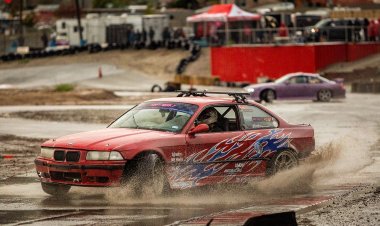
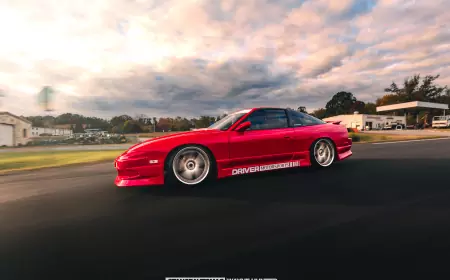
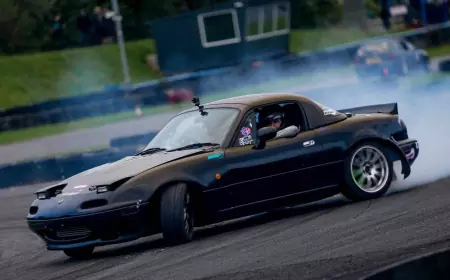
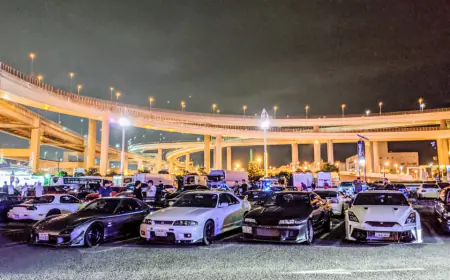
It's worth being absolutely clear from the start — and this matters — the legislation being rolled out across the UK is not targeting your local organised car show. It is not aimed at well-run static displays, charity fundraisers in supermarket car parks, or weekend meets where enthusiasts gather to talk suspension setups. The heat is firmly directed at the other side of the scene: illegal street cruises, burnouts in retail parks at midnight, drifting on public roads, and ghost-plated cars treating residential streets like race tracks. Understanding that distinction is crucial, because the way these new rules are written and enforced will affect everyone who attends any kind of automotive gathering in the UK — whether they're the problem or not.
The Scale of the Problem Driving New UK Car Meet Laws
To understand why local councils and police forces have started reaching for new legal tools, you have to look at the numbers. In the year to October 2024, police recorded 484 car meets or cruise events that required attendance and dispersal. That's nearly ten a week across the country. Nottinghamshire Police alone logged 134 incidents in a single year. Gwent Police in Wales recorded 130, up sharply from 96 the year before and 52 the year before that. The trajectory is clear, and it's not heading in a comfortable direction for anyone who wants the car community left to get on with things in peace.
The AA has been vocal about the problem, describing the rise of antisocial driving at unauthorised meets as deeply concerning. Their research found that one in ten members had personally witnessed a car meet in their neighbourhood in the past year. Eight out of ten AA members reported excess noise as the main issue, and 71% said they had seen vehicles racing nearby. A quarter reported physical damage to their local area — broken streetlights, damaged signposts, scarred road surfaces. These aren't small numbers, and they represent exactly the kind of public pressure that forces politicians and councils to act. What makes it particularly frustrating from a legitimate enthusiast's perspective is how these events are typically organised — through private social media groups, keeping police in the dark until residents start calling in complaints. By the time officers arrive, the crowd disperses and reassembles elsewhere. It's this cat-and-mouse dynamic that has pushed authorities toward more permanent, structural solutions rather than relying purely on reactive policing.
PSPOs — The New Weapon Councils Are Using Against Car Gatherings
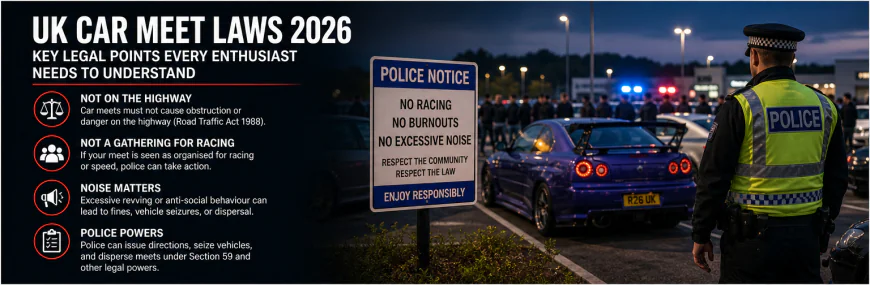
The most significant legal tool being deployed against antisocial driving at car meets is the Public Spaces Protection Order, or PSPO. These are statutory powers that allow local councils to impose conditions on behaviour within a defined geographic area, and they apply to absolutely everyone within that zone — no exceptions. Breach a PSPO and you're looking at an on-the-spot fixed penalty notice, or potentially a fine of up to £1,000 if it goes to court. Crucially, these orders can be enforced using ANPR cameras and existing CCTV infrastructure, meaning councils don't need an enforcement officer physically present to catch you.
Cambridge and South Cambridgeshire councils have recently proposed a PSPO at Babraham Road Park and Ride following 22 separate recorded incidents between April 2024 and January 2026. The documented activity included organised vehicle gatherings, drifting, burnouts, wheel spins, excessive revving, horn sounding, and loud music from cars — mostly happening late at night and continuing past midnight. Vehicles returned to the site even after police had attended and dispersed the crowd, which is exactly why councils are now reaching beyond standard policing powers. Down in Surrey, Mole Valley District Council is pushing for a PSPO along the A24 and the famous Zig Zag Road leading up to Box Hill — a location any UK car enthusiast will immediately recognise. The proposal has support from Surrey Police, and following a public consultation of nearly 1,000 responses, 62% of respondents backed it. The specific offences that would trigger a fixed penalty notice include revving engines, racing, performing stunts, and engine idling. For anyone who has ever been to Box Hill on a Sunday morning, that list will feel very close to home.
Birmingham's Street Cruise Injunction — A Sign of Things to Come
While PSPOs are being rolled out locally, Birmingham City Council has gone further than most, securing a full court injunction against street cruising that covers the entire city. Originally granted in 2022 and strengthened in 2025, the injunction runs until February 2027 and flatly prohibits participation in street cruises anywhere within Birmingham's boundaries — whether you're driving, organising, or even spectating. This isn't a council bylaw. It's a court order, and breaching it can be treated as contempt of court.
The Birmingham injunction is significant not just for what it does in that city, but for what it signals nationally. It demonstrates that local authorities have the appetite and the legal tools to go well beyond PSPO-level enforcement when they feel the situation demands it. Other councils watching Birmingham's approach will be taking notes, and it's entirely plausible that similar citywide injunctions will appear in other major UK urban areas over the next few years — particularly in the Midlands and South East where the growth in incidents has been most pronounced.
Ghost Plates, ANPR and the Government's National Strategy
The crackdown on illegal car meets and street racing isn't just happening at council level. The UK Government's Road Safety Strategy, published in January 2026, specifically addresses the use of illegal number plates — so-called ghost plates — as a tool used by antisocial drivers to evade identification cameras. The strategy commits to consulting on new police powers to crack down on drivers using these plates, with tougher checks to ensure number plates can be reliably read by cameras.
Alongside this, ANPR camera coverage is being significantly expanded across the UK. Police and enforcement agencies are rolling out more systems specifically to catch untaxed, uninsured, and unregistered vehicles — the exact profile of many cars that turn up at illegal meets. The message from government is straightforward: if you think you can hide behind a ghost plate or an unregistered car at a street cruise, the net is tightening fast. The government has also called for 1,000 additional traffic officers as part of a broader road safety push, something the AA has actively lobbied for. More dedicated traffic officers means more capacity to properly deal with illegal street racing events rather than leaving it to already-stretched response teams.
What This Means for Legitimate Car Shows and Organised Meets
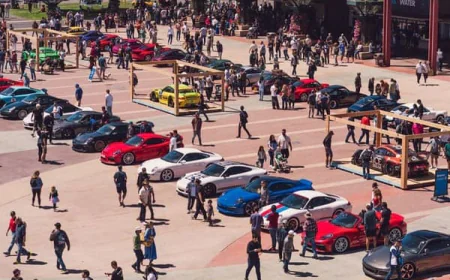
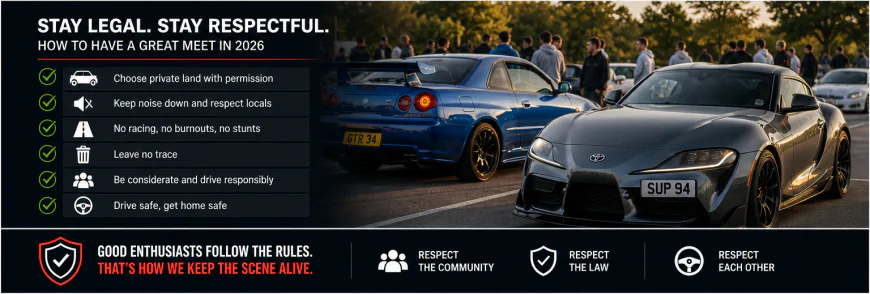
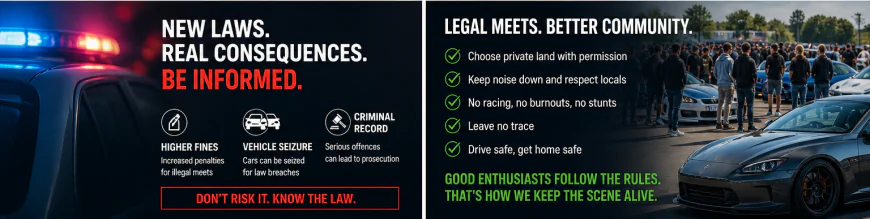
So where does all of this leave the legitimate end of the UK car scene? The honest answer is that organised, properly permitted car shows and static displays are not the target here, and there is nothing in the current legislation that threatens events run responsibly on private land with landowner permission. If you're organising a show through a venue, managing noise levels, and ensuring cars aren't performing driving exhibitions on the surrounding public roads, you are operating in a completely different legal and moral space to the events driving this crackdown.
That said, the broader tightening of enforcement does create collateral pressure. Expanded ANPR coverage means any car travelling to and from a meet is more visible than ever. If your car has a defective MOT, lapsed tax, or non-compliant modifications affecting its road legality, the journey to a meet is now a higher-risk proposition than it was two years ago. The increased camera coverage isn't selective — it catches everything and everyone. For those who are part of the show and cruise culture and want to keep it alive, the message is consistent: distance yourselves clearly from the antisocial element, support venue-based events with proper organisation, and make it impossible for lawmakers to lump enthusiasts and street racers into the same category. The car scene has always policed itself better than it gets credit for, and that self-regulation has never mattered more than it does right now. For more on how UK law is shaping the modified car scene, head over to Stance Auto Magazine, where we cover the culture, the builds, and the news that matters to enthusiasts. For the government's official position, you can read the full UK Road Safety Strategy 2026 directly.
The Bottom Line — Know Your Rights, Know the Rules
The UK car meet scene in 2026 is at a crossroads. The legislation being put in place is largely a response to a genuine problem caused by a minority, but the powers being created are broad enough to affect everyone. PSPOs don't distinguish between a crowd of well-behaved enthusiasts and a group of drivers doing burnouts — the geographic zone is what matters, and if you're in it doing something on the prohibited list, you're liable. Stay informed, support the legitimate end of the scene, and keep your car legal and road-ready. The community is stronger, louder, and more credible when it turns up properly — and that's the best possible defence against laws that could, if applied carelessly, make things harder for every single one of us.
Call to Action
Do you have a build story like this one? Got a build on a budget? We want to see it. Submit your story to Stance Auto Magazine, and you could be the next featured owner showing the world how to do it right—without breaking the bank.
 Like
0
Like
0
 Dislike
0
Dislike
0
 Love
0
Love
0
 Funny
0
Funny
0
 Angry
0
Angry
0
 Sad
0
Sad
0
 Wow
0
Wow
0