












































.png)






![[HOONIGAN] Ken Block's GYMKHANA NINE](https://img.youtube.com/vi/_bkX5VkZg8U/maxresdefault.jpg)






















































![[HOONIGAN] KEN BLOCK'S GYMKHANA SEVEN: WILD IN THE STREETS OF LOS ANGELES](https://cdn.motor1.com/images/mgl/2KlO4/s1/ken-block-london-tour-directors-cut.jpg)

































Exhaust Noise Cameras Are Coming for Modified Cars — Here's What's Actually Legal in 2026
Noise cameras are ticketing loud exhausts automatically in California and New York. Here's what the SLEEP Act and SB 1079 actually mean for modified cars.
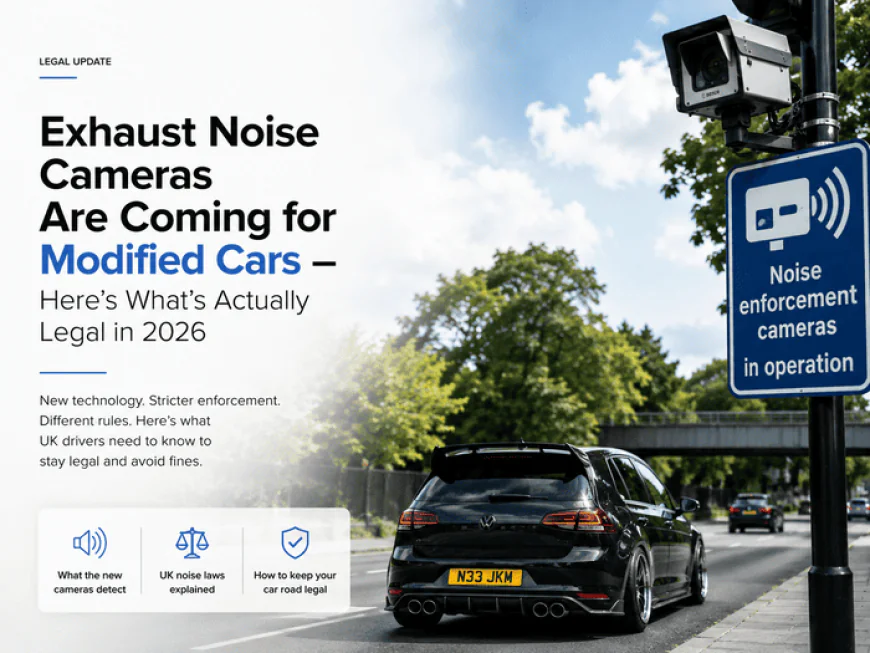
Exhaust Noise Cameras Are Coming
Exhaust noise cameras are automated roadside devices that measure a passing vehicle's decibel level and issue a citation without an officer present, and they're no longer a pilot-program curiosity — they're operational, they're getting funded, and they're starting to hit modified car owners where it hurts: registration renewal.
In plain English: if your exhaust is loud enough to trip a sensor, a camera photographs your plate, cross-references the noise reading, and mails you a fine — the same way a speed camera works, just for sound instead of speed.
What's Actually in New York's SLEEP Act
New York's Stop Loud and Excessive Exhaust Pollution Act — the SLEEP Act — was signed by Governor Kathy Hochul in October 2021 and took effect in April 2022. It raised the maximum fine for a modified muffler or exhaust from $150 to $1,000, and critically, it doesn't stop at the driver: shops that sell or install illegal cut-out or bypass devices face the same exposure, and inspection stations caught certifying illegal exhausts three times within 18 months can lose their certification entirely. The bill text itself sets a measurable ceiling — 95 decibels for motorcycles, 60 decibels for other vehicles — specifically so officers no longer have to rely on the old "excessive or unusual" standard, which was too subjective to enforce consistently.
California's Approach Is Slower, but It's Coming
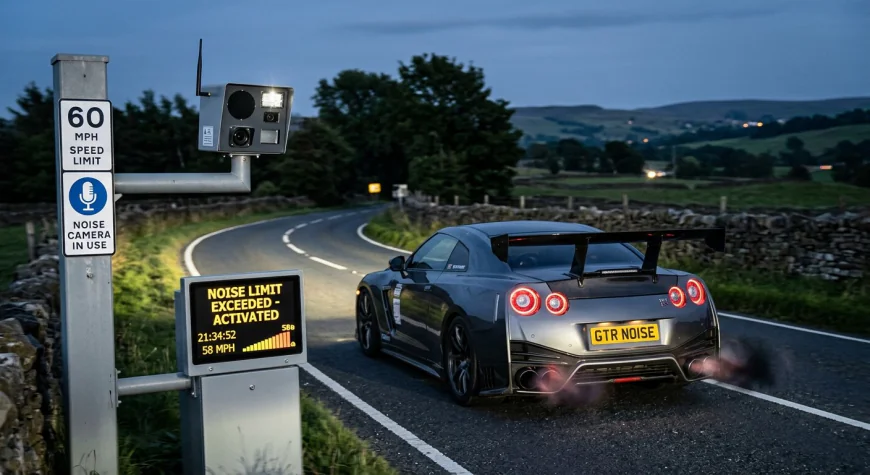
California hasn't deployed ticket-issuing noise cameras yet — that's the part worth being precise about. SB 1079, signed in 2022, didn't authorize six cities to start fining drivers; SEMA successfully lobbied to amend the bill so that the California Highway Patrol had to evaluate sound-activated devices from at least three manufacturers first and report findings to the legislature. That CHP evaluation report landed in January 2025, and it's the evidence base any future citation-issuing legislation will be built on. The underlying decibel limit itself is old law, not new: 95 dBA for vehicles under 6,000 lbs, 80 dBA for post-1985 motorcycles.
The part that actually will sting financially is AB 2496, which ties unresolved noise citations to your DMV registration — miss the three-month window to get a compliance certificate and the DMV puts a hold on your renewal until it's fixed. It's not live yet: the law becomes operative January 1, 2027, which gives California modified-car owners a genuine runway to sort out compliant setups before it bites.
Why This Matters Beyond These Two States
New York and California are the two states furthest along, but they're not outliers — they're the template. Noise complaints have risen steadily as modified exhausts have become more common, and lawmakers in other states are watching how the automated approach performs before writing their own versions. Colorado has already raised commercial vehicle noise fines. If SoundVue-style systems prove cost-effective in California's pilot cities, expect other state legislatures to introduce similar bills within a couple of budget cycles.
Is Automated Noise Enforcement Fair to the Car Community?
This is the actual debate, and it splits pretty cleanly along expected lines. Residents living along routes popular with modified cars point to real, measurable quality-of-life harm — interrupted sleep, and researchers have linked chronic noise exposure to elevated stress and cardiovascular risk. Local police in noise-affected towns report a meaningful jump in complaint-driven enforcement once cameras are trained and deployed.
On the other side, car owners argue that a camera can't distinguish between a straight-piped street racer doing 3 a.m. pulls and a well-built cat-back system on a track-day car that happens to be a few decibels over spec during a cold start. There's also a due-process wrinkle: unlike a radar gun operated by a trained officer who can testify in court, a noise camera's reading depends on calibration, wind conditions, and proximity — all of which are harder to challenge after the fact, especially in states like New York where there's no fixed decibel threshold to argue against.
Whichever side you land on, the practical takeaway for anyone running an aftermarket exhaust in New York, California, or a state likely to follow their lead is simple: know your local noise ordinance before you buy, because "it sounded fine at the shop" isn't a legal defense anymore. It's the same automated-enforcement pattern we've covered on the UK side with police powers targeting illegal car meets — tech doing the job officers used to do by eye and ear.
If you're weighing a new exhaust setup and want to keep your build both loud in the right ways and legal, it's worth flagging your local decibel cap before you buy anything from a performance-parts retailer — the Mag store on Amazon has a solid range of car culture reads if you want to go deeper on where this enforcement trend is headed next.
Sources: NY Senate Bill S784B, CA SB 1079 chaptered text, CHP SB 1079 evaluation report, Jan 2025, CA AB 2496 chaptered text, SEMA legislative tracking.
 Like
0
Like
0
 Dislike
0
Dislike
0
 Love
0
Love
0
 Funny
0
Funny
0
 Angry
0
Angry
0
 Sad
0
Sad
0
 Wow
0
Wow
0