




















































.png)










![[HOONIGAN] Ken Block's GYMKHANA NINE](https://img.youtube.com/vi/_bkX5VkZg8U/maxresdefault.jpg)
































































![[HOONIGAN] KEN BLOCK'S GYMKHANA SEVEN: WILD IN THE STREETS OF LOS ANGELES](https://cdn.motor1.com/images/mgl/2KlO4/s1/ken-block-london-tour-directors-cut.jpg)


































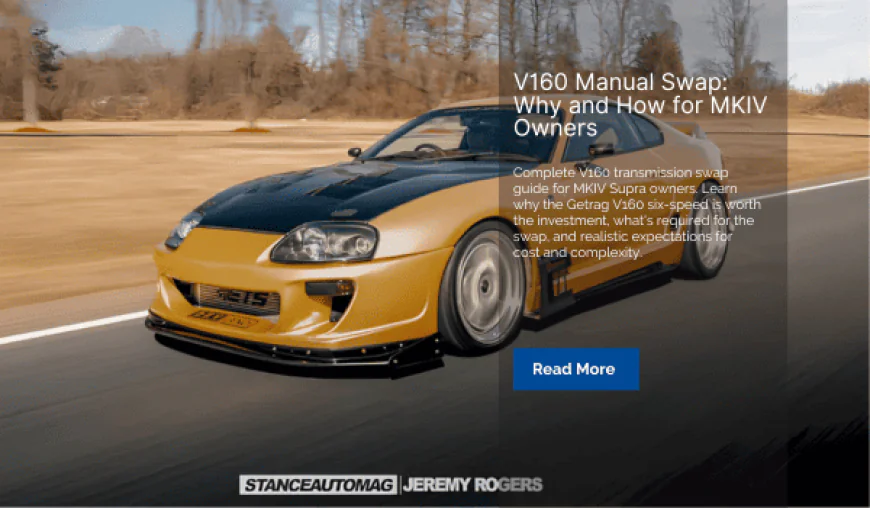
V160 Manual Swap: Why and How for MKIV Owners
Complete V160 transmission swap guide for MKIV Supra owners. Learn why the Getrag V160 six-speed is worth the investment, what's required for the swap, and realistic expectations for cost and complexity.
V160 Manual Swap
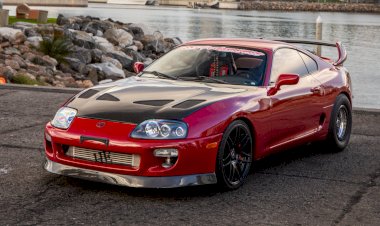
The Getrag V160 six-speed manual transmission represents the holy grail for serious MKIV Supra builders. This German-engineered gearbox was designed specifically to handle the 2JZGTE's power and torque, featuring triple-cone synchronizers, close-ratio gearing, and construction robust enough to survive abuse that destroys lesser transmissions. But swapping one into your Supra—especially if you're converting from an automatic—requires significant investment in both money and effort.
Understanding what the V160 offers, what the swap actually entails, and whether it makes sense for your specific situation separates successful builds from expensive regrets. This isn't a weekend project with parts from the local auto store. It's a comprehensive conversion that touches every aspect of how your Supra drives and performs.
Why the V160 Matters
Toyota didn't offer the V160 in every Supra. The turbo six-speed models came with it, but naturally aspirated cars received the weaker W58 five-speed, and many Supras were sold with the A340E automatic transmission. If you're building serious power or simply want the driving experience Toyota intended for the turbo six-speed cars, the V160 swap makes sense.
The V160 uses a cast aluminum three-section housing with fully synchronized helical gears that mesh constantly. First and second gears feature triple-cone synchronizers for quick, smooth shifts even under hard acceleration. Third and fourth use dual-cone units, while fifth, sixth, and reverse have single-cone synchronizers. This level of engineering shows in how the transmission behaves—shifts are precise and mechanical without being notchy, and the gearbox maintains its feel even after years of hard use.
Getrag conservatively rated the V160 at around 500 Newton-meters of torque, which translates to roughly 370 lb-ft. But like Toyota's habit of understating engine power, this rating includes massive safety margins. Real-world experience shows properly maintained V160 transmissions reliably handling 600-800 wheel horsepower for extended periods. Some have survived beyond 1,000 wheel horsepower with careful driving and appropriate clutch selection, though at those power levels, you're pushing the transmission into territory where catastrophic failures become genuine risks.

V160 vs V161: Understanding the Versions
Toyota produced two versions of the Getrag six-speed for the MKIV Supra. The V160 was used from May 1993 through May 1996, while the updated V161 replaced it from June 1996 until production ended in 2002. Both transmissions share the same basic design and overall strength, but the differences matter for swaps and performance.
The gear ratios differ slightly between the two. The V160 features closer ratios with first gear at 3.827:1, second at 2.360:1, third at 1.685:1, fourth at 1.312:1, fifth at 1.000:1, and sixth at 0.793:1. The V161 uses slightly taller gearing with first at 3.724:1, second at 2.246:1, third at 1.541:1, fourth at 1.205:1, fifth at 1.000:1, and sixth at 0.818:1.
For street driving and drag racing, many builders prefer the V160's closer ratios because they keep the engine in its power band better during hard acceleration. The taller V161 gears work well for road racing and highway driving where maintaining speed matters more than acceleration from a dig. Both transmissions use a 3.266:1 final drive ratio that pairs with the turbo Supra's differential.
The V161 received minor case strengthening and improved cooling compared to the V160, though these changes don't dramatically affect reliability at normal power levels. Both transmissions are now discontinued from Toyota, making used units the only option unless you find new old stock—which commands premium prices when available.
What's Actually Required for the Swap
Converting an automatic Supra to V160 manual requires more than just bolting in a transmission. You're essentially rebuilding the entire drivetrain and control system. Here's what needs to happen.
The Core Components
The transmission itself is obvious, but you'll also need the complete clutch assembly including a 250mm clutch disc with 14 splines, pressure plate, flywheel, and pilot bearing. The manual transmission driveshaft is shorter and balanced differently than the automatic version, so the automatic driveshaft won't work. You'll need the manual pedal assembly including clutch pedal, brake pedal, clutch master cylinder, and all associated hydraulics.
The transmission tunnel cover and carpet differ between automatic and manual cars. The center console is different. The shifter assembly, shift boot, and surrounding trim pieces all need to come from a manual car. You'll need the manual transmission crossmember since the mounting points differ from the automatic.
ECU and Wiring Modifications
This is where complexity escalates. The automatic ECU controls transmission operation and expects specific sensor inputs that won't exist after the swap. You have several options, none of them particularly simple.
The most straightforward approach uses a standalone ECU like AEM Infinity or Haltech that eliminates all automatic transmission control and allows full tuning capability for your engine modifications. This solves multiple problems at once—you get proper engine management for your modified 2JZ while eliminating automatic transmission complications.
Alternatively, you can modify the factory ECU wiring to work with manual transmission operation. This requires identifying and disabling automatic transmission control circuits, adding manual transmission sensors where needed, and ensuring the ECU doesn't throw error codes that affect engine operation. Some builders use manual transmission ECUs from turbo six-speed cars, but this requires extensive wiring work and may still need modifications for your specific configuration.
Differential and Rear End Considerations
The automatic Supra differential uses different gearing than the turbo manual cars. The automatic typically came with a 3.76:1 or 4.30:1 ratio depending on configuration, while the turbo manual uses 3.266:1. If you're swapping in a V160, you really need to also swap to the manual differential to maintain proper gearing. Otherwise, your gear ratios will be too short—you'll be shifting constantly, fuel economy will suffer, and highway driving becomes annoying with the engine revving higher than necessary.
Finding a manual turbo differential can be challenging since they're becoming scarce as more Supras get parted out or wrecked. Budget several hundred to over a thousand dollars depending on condition and availability.
Labour and Fabrication
Even if you're mechanically skilled, this swap requires significant time. Plan on several full weekends if you're working efficiently with all parts assembled beforehand. If you're paying shop labor, expect 30-50 hours of work depending on complications and whether you're converting from automatic or swapping from a W58 five-speed.
The physical transmission removal and installation is straightforward if you have proper tools and equipment. But the wiring modifications, pedal assembly installation, brake system work, and troubleshooting takes time. Many swaps encounter unexpected issues—stripped bolts, missing brackets, incompatible parts—that extend timelines and add frustration.
Realistic Budget Expectations
This is not a cheap swap, and costs escalate quickly if you're not finding good deals on used parts or doing substantial labor yourself.
Parts Costs
A used V160 or V161 in good condition typically runs $3,000-$5,000, though prices continue climbing as these transmissions become scarcer. Plan on the higher end for lower mileage units or those with documented maintenance history. A quality clutch setup from Exedy, Competition Clutch, or similar manufacturers costs $600-$1,200, depending on power handling requirements. The driveshaft, if you can find a good used unit, runs $200-$400. New driveshafts start around $500.
The pedal assembly, if sourced from a parts car, might cost $300-$600 depending on condition. Expect another $200-$300 for the shifter assembly and related trim pieces. The manual differential runs $500-$1,500 depending on availability and condition. Miscellaneous hardware, fluids, gaskets, and small parts add several hundred more.
If you're converting from automatic and need standalone engine management, add another $1,500-$2,500 for a quality ECU. Professional wiring modification services charge $500-$1,500, depending on complexity.
Total Investment
For a DIY swap with good used parts sourcing, budget $8,000-$10,000 minimum. This assumes you already have tools, garage space, and mechanical knowledge to handle the work. Shop-installed swaps with quality parts easily exceed $12,000-$15,000, and high-end conversions with all new components, upgraded clutches, and comprehensive engine management can approach $20,000.
These numbers make some people question whether buying a car that already has a V160 makes more financial sense than swapping one into an automatic or W58 car. That's a valid consideration, though clean turbo six-speed Supras command significant premiums over automatic versions.
Common Challenges and Solutions
Clutch Pedal Feel and Adjustment
Many first-time manual swap builders struggle with proper clutch pedal adjustment and bleeding. The hydraulic clutch system needs complete bleeding with fresh fluid, and the pedal should have specific free play before engaging. Too much free play makes shifts difficult, while too little causes constant clutch slip and premature wear.
Quality braided stainless steel clutch lines improve pedal feel compared to old rubber lines. Take time to properly adjust and bleed the system—this single issue causes more post-swap frustration than almost anything else.
Wiring Issues and ECU Problems
The electrical side trips up many builders. Test everything methodically, document your wiring changes, and don't assume anything works until you've verified it. Common issues include incorrect reverse light wiring, non-functional neutral safety circuits, and check engine lights from disconnected automatic transmission sensors.
Having access to factory service manual wiring diagrams makes troubleshooting dramatically easier. Online forums can help, but every swap encounters unique challenges depending on your starting configuration and chosen solutions.
Driveline Vibrations
Improper driveshaft installation or using incorrect driveshaft length creates vibrations that make the car unpleasant to drive. The manual transmission driveshaft is specific to that application—you can't just shorten an automatic driveshaft and expect it to work properly. Center bearing placement and driveshaft angles matter enormously for vibration-free operation.
If you experience vibrations after the swap, verify you're using the correct driveshaft and that all mounting points and angles are factory specification.
Is the V160 Swap Worth It?
The honest answer depends entirely on your situation and goals. If you're building a high-power Supra targeting 600+ wheel horsepower and plan to keep the car long-term, the V160 swap makes perfect sense. You're creating a transmission foundation that can handle your power goals while providing the driving experience Toyota intended for turbo six-speed cars.
If you have an automatic Supra with low mileage and good condition but want manual transmission driving engagement, the swap can be justified even at moderate power levels. The driving experience difference between automatic and manual is significant enough that many enthusiasts find the investment worthwhile purely for enjoyment rather than necessity.
However, if you're on a tight budget, not building serious power, or questioning whether you'll keep the car long-term, consider whether finding a car that already has a manual transmission might be smarter. The swap investment rarely returns dollar-for-dollar when selling the car, though it may help sell faster to the right buyer.
For builders who already have W58 five-speed cars, the V160 swap calculation changes. The W58 is marginal beyond 400 horsepower, so if you're planning significant power upgrades, the V160 becomes necessary rather than optional. In this case, you're already set up for manual transmission operation, dramatically reducing swap complexity since you're only changing the transmission itself rather than converting from automatic.
Alternatives to Consider
The V160 isn't the only transmission option for high-power Supras, though it's the most direct path to a proper six-speed manual. Some builders use the Nissan CD009 six-speed from 350Zs paired with adapter plates. This transmission handles similar power levels, costs less than a V160, and is more readily available. However, it requires adapter fabrication and may have slightly different shift feel.
The Tremec T56 Magnum represents another option with excellent torque capacity and aftermarket support, though it requires significant adaptation work and costs more than a V160 when you include all necessary components. For dedicated drag racing applications, some builders use Powerglide two-speeds or other automatic transmission options that can handle extreme power while maintaining consistency.
Each alternative has trade-offs in cost, availability, drivability, and complexity. For most street-driven Supras, the V160 remains the best overall option because it's what Toyota designed the car around and maintains proper gearing and feel.
Living With a V160
After the swap is complete and sorted, the V160 delivers exactly what it promises—precise shifts, strong construction, and the ability to handle serious power without constant worry. The close-ratio gearing keeps you in the power band, and the mechanical feel provides excellent feedback about what the transmission is doing.
Maintenance is straightforward. Use quality transmission fluid—either Toyota's specified fluid or Castrol Transmax Z as an alternative. Change fluid every 30,000-40,000 miles for street use, more frequently for track or drag racing. Monitor for leaks, unusual noises, or shift quality changes that might indicate developing problems.
With proper maintenance and reasonable driving habits, a V160 should last 100,000+ miles even at elevated power levels. Yes, they can break—no transmission is invincible—but they're among the most durable manual transmissions ever fitted to a Japanese sports car.
The V160 swap transforms how a Supra drives and performs. It's a significant investment that requires realistic expectations about cost and complexity, but for serious builders creating cars they plan to keep and enjoy, it's one of the best modifications you can make.
This transmission swap guide is brought to you by Stance Auto Magazine - your source for real-world build advice and automotive culture.
Related Articles
- 2JZGTE Build Guide: Parts, Tuning, and Reliability - Engine upgrades to match your transmission
- How to Choose the Right Turbo for a Street Supra - Power delivery that works with manual transmission
- MKIV Supra Brake & Wheel Upgrades That Work - Stopping power for increased performance
- Street vs Track: Tuning a Supra for Daily Use - Making your swapped car enjoyable daily
- Supra Generations: From A40 to A90
- Toyota Supra Mk4 Buying & Tuning Guide
- Toyota Supra Mk4 Reviewed
- The 2JZ-GTE: Japan’s Most Legendary Engine
 Like
0
Like
0
 Dislike
0
Dislike
0
 Love
0
Love
0
 Funny
0
Funny
0
 Angry
0
Angry
0
 Sad
0
Sad
0
 Wow
0
Wow
0