


























































































.png)











![[HOONIGAN] Ken Block's GYMKHANA NINE](https://img.youtube.com/vi/_bkX5VkZg8U/maxresdefault.jpg)












































































![[HOONIGAN] KEN BLOCK'S GYMKHANA SEVEN: WILD IN THE STREETS OF LOS ANGELES](https://cdn.motor1.com/images/mgl/2KlO4/s1/ken-block-london-tour-directors-cut.jpg)



































Are 4D Number Plates Actually Being Banned in the UK? Here's What's Real and What's Rumour
4D and gel number plates are still legal in the UK in 2026, but a BSI proposal could ban raised plates entirely. Here's exactly where the law stands.

Are 4D Number Plates Actually Being Banned in the UK?
BS AU 145e is the current British Standard that governs what makes a UK number plate legal — covering font, spacing, reflectivity, and supplier markings — and it's the single document that decides whether your 4D or gel plate is road-legal or an MOT failure waiting to happen. Every driver runs into this standard whether they know it or not, since it applies to every plate on every car, not just personalised or styled ones.
In plain English: 4D and gel plates are legal right now, as long as they're made properly to the current standard — but a genuine proposal is sitting with the British Standards Institution that could ban raised plates outright, and it's worth understanding the difference between what's true today and what might change.
What's Actually Legal Right Now
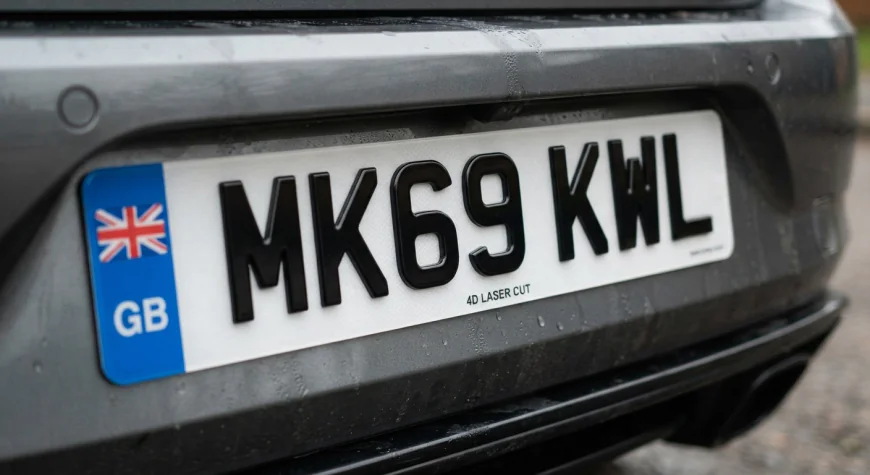
As of 2026, both 3D gel and 4D laser-cut plates are fully road-legal, provided they're manufactured to BS AU 145e: solid black characters (no colour, tint, or "highlighting" effects), the mandatory Charles Wright 2001 font at the correct dimensions, a reflective background, and permanent supplier markings showing the BS AU 145e mark plus the registered supplier's business name and postcode. Get any of that wrong and you're looking at an MOT failure, a fine of up to £1,000, and in serious cases the registration itself being withdrawn — but that penalty applies equally to a flat printed plate that's non-compliant. The standard doesn't care whether your plate is flat, gel, or 4D; it cares whether it meets the spec.
The genuinely illegal category is different from "raised" or "gel" entirely: tinted or coloured character fills (sometimes marketed as "Krystal" or "neon" 4D plates), reflective sprays or ghost coatings that beat ANPR cameras, squeezed or non-standard character spacing, and plates missing the required supplier markings. These are the plates driving most enforcement action, not compliant 4D or gel plates from a registered supplier.
The Proposal That's Actually on the Table
Here's what's genuinely new and worth watching closely. The British Standards Institution ran a public consultation on a draft amendment to BS AU 145e that would require all outward-facing plate surfaces to be completely flat — character height capped at 2mm above the surface, no attached materials that create a raised appearance, and no stickers or overlays that alter surface flatness. If adopted as written, this would remove the legal basis for 4D and gel plates entirely, not just the illegal tinted or coated versions. Trade estimates suggest as many as one in four drivers who've bought replacement plates since 2021 could be affected if the flat-surface rule goes through.
It's important to be precise about where this stands: the consultation has closed, but no formal decision or implementation date has been confirmed. Further announcements were expected in early 2026, and as of now this remains a proposal under review, not enacted law.
Why the Industry Itself Is Split on This
The case for the flat-surface rule is about enforcement consistency and fraud reduction: raised or layered plate designs are harder for cameras and officers to verify quickly and consistently than a flat printed plate, and a blanket flat-surface requirement removes the ambiguity around which specific gel or 4D products are compliant versus illegal on any given day.
The pushback, notably from established plate suppliers themselves, isn't really a defence of styled plates for their own sake — it's a concern about where the actual fraud is happening. Established, registered suppliers argue that illegally cloned, unreadable, and untraceable plates overwhelmingly come from unregulated online sellers operating outside the registered supplier system altogether, not from legitimate 4D and gel manufacturers already producing to spec. A blanket ban on raised plates, in this view, punishes compliant suppliers and their customers while doing little to touch the actual unregulated sellers driving plate fraud, who were never following BS AU 145e in the first place.
What to Actually Do Right Now
If you're buying a 4D or gel plate today, the practical checklist hasn't changed: confirm the supplier is RNPS-registered, check for the BS AU 145e mark and the supplier's business name and postcode permanently on the plate, and make sure characters are solid black with no tint or colour fill. If the flat-surface amendment does get adopted, existing compliant 4D and gel plates would likely need replacing — but that's a "when it happens" problem, not a today problem.
Curious what else is changing in UK road law this year? Our piece on new UK pavement parking laws for 2026 covers another rule change worth knowing about.
Sources: BSI BS AU 145e consultation coverage, Honest John, British Number Plate Manufacturers Association FAQs, Plates4Less industry briefing via London Loves Business, NomPlates and Moonstone Plates supplier guidance on current BS AU 145e requirements.
 Like
0
Like
0
 Dislike
0
Dislike
0
 Love
0
Love
0
 Funny
0
Funny
0
 Angry
0
Angry
0
 Sad
0
Sad
0
 Wow
0
Wow
0