






























































































.png)












![[HOONIGAN] Ken Block's GYMKHANA NINE](https://img.youtube.com/vi/_bkX5VkZg8U/maxresdefault.jpg)















































































![[HOONIGAN] KEN BLOCK'S GYMKHANA SEVEN: WILD IN THE STREETS OF LOS ANGELES](https://cdn.motor1.com/images/mgl/2KlO4/s1/ken-block-london-tour-directors-cut.jpg)








































New UK Pavement Parking Laws 2026: What Car Owners Need to Know
New UK pavement parking laws are coming in 2026. Here's what the English Devolution Act actually changes, when fines start, and what drivers need to know.
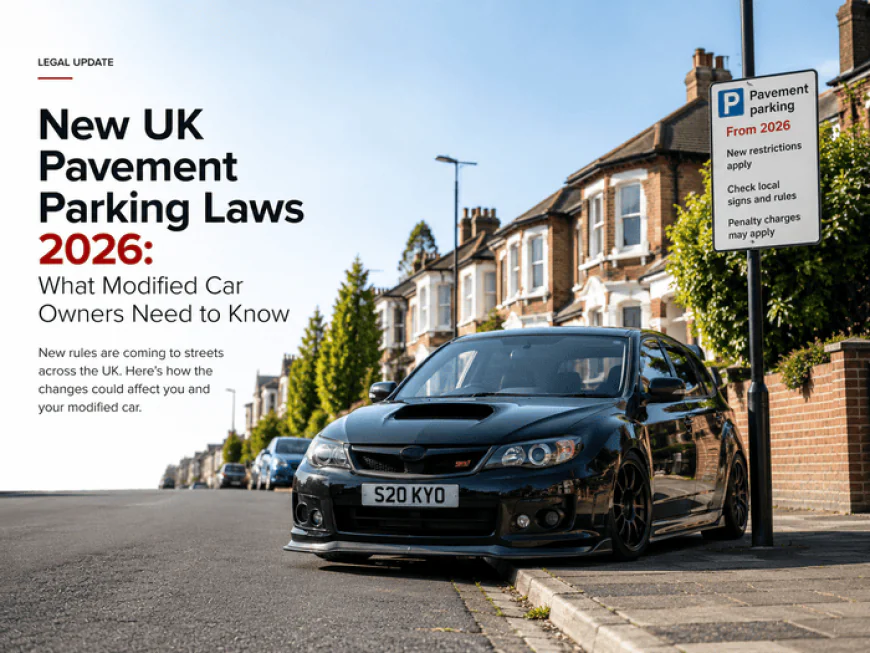
What Modified Car Owners Need to Know
If you've ever nudged two wheels up onto the kerb outside your own house because the road's too narrow for two cars to pass otherwise, you're about to want to pay attention. England is getting proper pavement parking enforcement for the first time, and while it's not the overnight nationwide ban some headlines are making it sound like, the direction of travel is unmistakable — and it's coming for streets that have quietly tolerated two-wheels-up parking for decades.
In plain English: pavement parking, meaning parking with one or more wheels on the footway rather than fully on the carriageway, is currently only banned outright in London and Scotland. Everywhere else in England, it's technically legal unless it causes an "unnecessary obstruction," a fairly loose test that's mostly been enforced by police rather than councils, and inconsistently at that. New legislation is about to change who can act on it, and how quickly.
What Actually Changed
The piece of legislation doing all the work here is the English Devolution and Community Empowerment Act, which received Royal Assent on 29 April 2026. Buried inside it is Schedule 32, which hands local transport authorities across England a power they've never had before: the ability to prohibit vehicles from parking on footways and verges, with regulations also covering exemptions, signage and enforcement.
The important nuance, and the bit that's getting lost in a lot of the panic-driven coverage doing the rounds on social media, is that this is genuinely a devolved power rather than a blanket ban. Councils will only be able to use it in areas that are already designated civil enforcement areas for parking, and each authority has to actively decide to switch it on for their own streets. Nothing changes automatically the moment the ink dries.
Once a council does flip that switch on a given street, though, the enforcement mechanism is a big upgrade from what exists now. Rather than obstruction cases sitting with the police, who've historically had bigger priorities than a Corsa half up a kerb, a designated prohibition becomes a civil parking contravention that a council enforcement officer can act on directly — the same people who already patrol yellow lines and residents' bays.
Key Facts
- Legislation: English Devolution and Community Empowerment Act 2026 (Royal Assent 29 April 2026)
- Who enforces it: Council civil enforcement officers, not police, once a street is designated
- Where it applies first: Only existing civil parking enforcement areas — not every road automatically
- Expected fines: Roughly £60–£130, broadly in line with London's existing penalty structure
- Timeline: Secondary legislation targeted for late 2026, with real street-level enforcement more realistically landing through late 2026 into 2027 and beyond
- Already banned outright: London and Scotland, under separate, older legislation
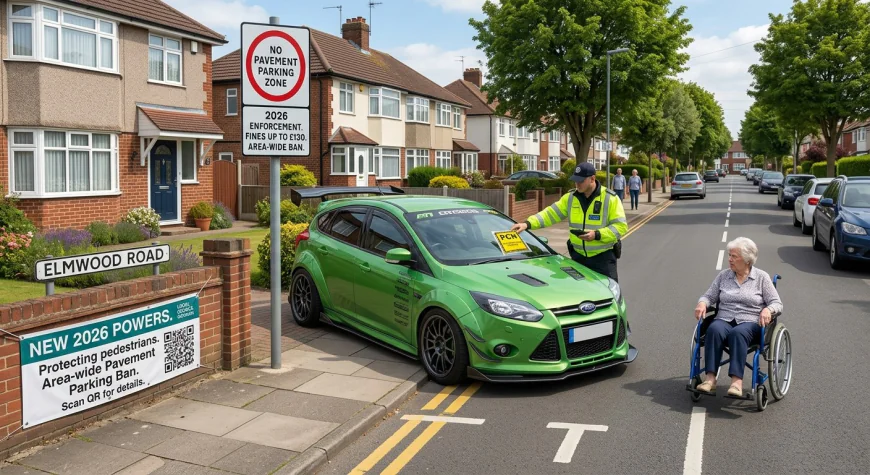
Why It's Taken This Long
This isn't a law that appeared out of nowhere. The government ran a full public consultation on pavement parking back in 2020, and the response was about as one-sided as consultations get — the overwhelming majority of people who replied wanted action, and separate RAC research has consistently found most UK drivers support a ban too, provided sensible exemptions are built in for narrow streets. Ministers didn't go for the simplest option, though. Instead of a single England-wide prohibition matching Scotland's approach, they landed on a devolved model that leaves the actual decision, and the local political heat that comes with it, sitting with individual councils. It's a compromise that satisfies almost nobody completely: campaigners for pedestrian and disability access wanted a full ban, while some councils and drivers' groups pushed back on anything that would make already-tight residential streets even harder to park on.
What Happens to Streets Where There's No Alternative?
This is genuinely the sticking point, and it's worth being upfront about it rather than pretending the new law is a clean win for everyone. On a lot of older terraced streets, particularly the kind you'll find modified car owners living on given how many of us are drawn to characterful older housing over identikit new-builds, parking fully on the carriageway on both sides simply isn't physically possible — a fire engine or a bin lorry wouldn't get through. That's exactly why the legislation includes provision for exemptions rather than a blunt one-size-fits-all rule. Councils will be expected to identify and mark genuinely necessary pavement parking before enforcement kicks in on a given street, and the secondary legislation due later in the year is meant to set out how that process actually works. Whether every council does that consultation properly before reaching for a camera van is, realistically, going to vary a lot by area.
What This Means If You Own a Modified Car
There's a practical angle here that's specific to this scene and worth spelling out. A lot of stanced and widebody builds already run tighter clearances and wider fitments than the car came with from the factory, which makes kerbs, drop-offs and pavement edges a genuinely bigger risk to bodywork and wheels than they are for a standard hatchback. If your council designates your street and you've been relying on a partial pavement park to protect your arches from an awkward camber, it's worth checking your local authority's plans well before enforcement starts rather than finding out from a PCN on your windscreen. It's also one more small factor to weigh up alongside the wider tightening around DVLA data access and vehicle checks that's already reshaping how the UK car meet scene operates in 2026 — none of it aimed at enthusiasts specifically, but all of it adding up to a stricter environment for anyone driving something that stands out.
If you're planning an organised meet or show and attendee parking spills onto residential pavements nearby, it's also worth building this into your planning alongside the usual permissions — our guide on how to organise a legal car meet in the UK covers the wider permissions and notification process that's becoming increasingly important either way.
How Does This Compare to London and Scotland?
London has run a pavement parking ban since the 1970s under different, older legislation, and it's the model everyone keeps referencing because the fine structure — that £60 to £130 range — is expected to carry over into the rest of England. Scotland's ban is more recent and considerably more aggressive in how it's being rolled out: since the Transport (Scotland) Act 2019, pavement parking, double parking and parking across dropped kerbs have all been prohibited nationwide, with councils issuing PCNs starting at £100 (reduced to £50 for prompt payment) as local authorities activate enforcement area by area. England's approach is deliberately more cautious and patchwork by comparison, leaning on local discretion rather than a single date everyone has to be ready for.
When Should You Actually Expect Fines?
Realistically, not this year in most places. The secondary legislation that actually switches these powers on is targeted for late 2026, and even once that's in force, individual councils still need to designate which streets are covered, get proper signage up, and train enforcement teams before a single ticket goes out. The honest expectation, based on how similar rollouts have gone elsewhere, is staggered enforcement beginning in some areas by very late 2026 or early 2027, spreading more widely through 2027 and beyond. If you want an early signal for your own area, your local council's transport or highways pages are the place to watch — they'll be the ones announcing designated streets locally, well ahead of any enforcement actually starting.
For now, the sensible move is the same as it's always been: don't obstruct a pavement to the point someone with a wheelchair, a pushchair or a guide dog can't get past, because that's already enforceable today regardless of what happens with the new powers. Beyond that, keep an eye on your council's announcements over the next year, because "it's always been fine to park like this" is about to stop being a safe assumption on an increasing number of English streets.
For more deep dives like this — the changing legal landscape, build features and everything in between — grab a copy of Stance Auto Magazine on Amazon and keep it on hand for the next read.
 Like
0
Like
0
 Dislike
0
Dislike
0
 Love
0
Love
0
 Funny
0
Funny
0
 Angry
0
Angry
0
 Sad
0
Sad
0
 Wow
0
Wow
0