

























































































.png)












![[HOONIGAN] Ken Block's GYMKHANA NINE](https://img.youtube.com/vi/_bkX5VkZg8U/maxresdefault.jpg)










































































![[HOONIGAN] KEN BLOCK'S GYMKHANA SEVEN: WILD IN THE STREETS OF LOS ANGELES](https://cdn.motor1.com/images/mgl/2KlO4/s1/ken-block-london-tour-directors-cut.jpg)



































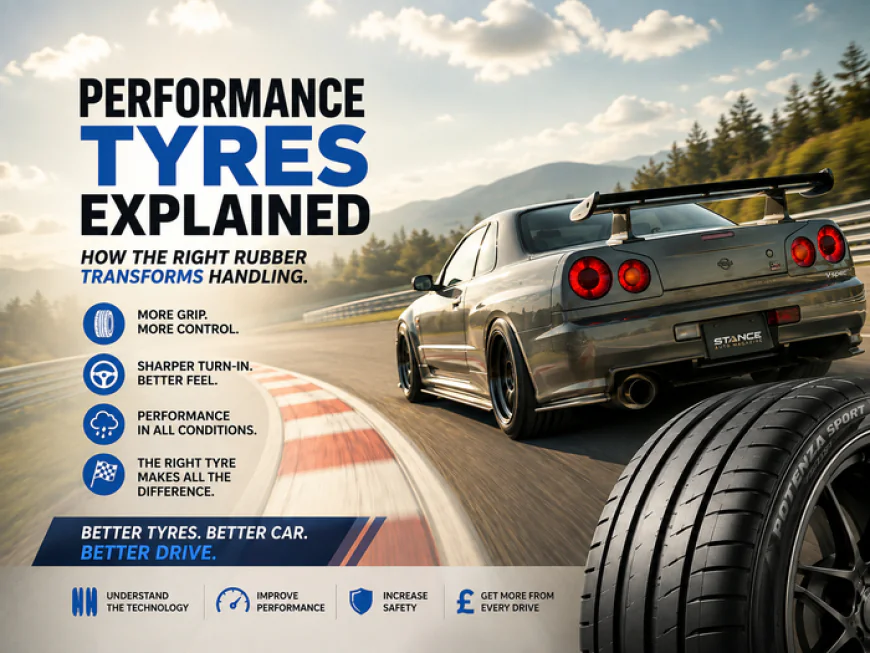
Performance Tyres Explained: How the Right Rubber Transforms Handling.
Performance tyres explained: how rubber compound, contact patch shape and pressure combine to transform grip, braking and handling on a modified car.
How the Right Rubber Transforms Handling, Braking and Grip
Ask most enthusiasts what "performance" means on their car, and you'll get roughly the same list every time. Turbo upgrades. A remap. Coilovers. Bigger brakes, lighter wheels, a limited-slip diff if they're properly serious about it. Almost nobody mentions the one component every single one of those upgrades has to pass through before any of it actually means anything.
Performance tyres explained simply: they're rubber compounds and constructions built to maximise the grip going through the contact patch — the bit where the car actually touches the road — usually at the expense of the tread life and comfort a normal touring tyre gets built around instead. Everything the engine makes. Everything the suspension's doing. Every ounce of stopping power the brakes are asked for. It all has to go through four contact patches roughly the size of a postcard, and that's it, there's no way round it. Spend three grand on an engine build and leave ten-year-old budget rubber on the car and you've basically paid a lot of money to spin the wheels a bit more enthusiastically.
It's a strange habit in this scene, honestly. Loads of money on power and looks, and the tyres get whatever was cheapest at the last MOT. Results are predictable enough — no amount of extra horsepower fixes a lack of grip; it just makes the lack of grip more obvious, faster.
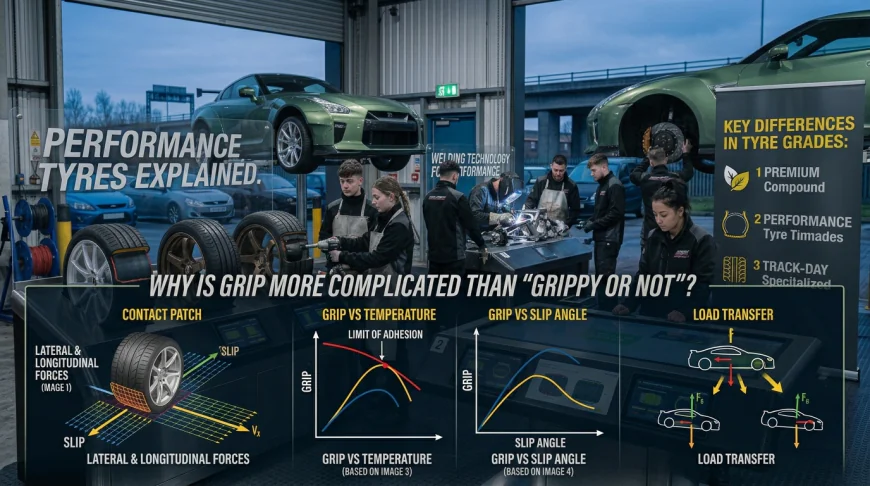
Why Is Grip More Complicated Than "Grippy or Not"?
Grip isn't really one number, even though most of us talk about it like it is one. It's a handful of different forces working together, and they don't always pull the same way.
Part of it's mechanical — the tread physically keying into the tiny imperfections in the road surface. The rest is chemistry. As the tyre rolls, the compound forms microscopic bonds with the asphalt, and that adhesive effect does more of the actual work than people give it credit for. Engineers spend their careers trading these things off against each other, because push grip too hard and the tyre's gone in a few thousand miles; chase longevity instead and the compound firms up, taking outright pace with it; get the dry-weather grip dialled in and wet performance can quietly suffer as a result. No tyre wins on every front at once. That's why there are so many different lines on the market rather than one "best" tyre everyone should just buy.
Worth a read if you haven't already — our piece on whether Kwik Fit is actually worth it for modified car tyres covers just how complicated even fitting the right rubber gets once your setup's a bit unusual. Choosing the compound in the first place is where all of that starts.
Does a Wider Tyre Actually Mean More Grip?
Not automatically. This one trips up a lot of people building their first proper setup, because the instinct is that wider equals grippier, full stop. The total contact patch doesn't grow anywhere near as much as most drivers assume it does.
Vehicle weight and tyre pressure largely dictate the overall size of that contact area — width mostly reshapes the footprint rather than enlarging it. A wider tyre tends to produce a shorter, broader patch on the road. Go narrower and that same patch stretches out longer and slimmer instead. Two very different shapes, and they behave completely differently under load: steering response, heat build-up, how well the tyre shifts standing water, braking behaviour, cornering stability- all of it shifts depending on which shape you're running. Which is exactly why fitting the widest tyre that'll physically clear the arch doesn't guarantee anything. Manufacturers spend years working out the correct width for a given chassis, because geometry, steering feel, weight distribution and even aero all interact with whatever's wrapped around the wheel.
Why Does Rubber Compound Matter More Than Anything Else?
The single biggest difference between a budget touring tyre and a proper performance tyre lives somewhere you can't see. It's buried in the chemistry, not the tread pattern people obsess over on Instagram.
Modern performance compounds blend natural rubber, synthetic polymers, silica, carbon black, specialist oils and resins, plus a long list of proprietary additives that the big tyre manufacturers have spent decades quietly refining. Softer compounds deform more readily over the microscopic texture of the road — that's the extra adhesion you actually feel through the wheel, and it's not subtle once you've felt a decent set on the right compound. Shorter braking distances. Sharper steering precision. More lateral grip through a corner, better traction off the line. Honestly, that feeling of confidence is probably the biggest selling point for most people, even if they'd just call it "feeling planted" rather than get into the chemistry of it. There's a trade-off though. Softer, grippier compounds don't last as long as a harder touring tyre, and most people building a proper car accept that without much thought once they've felt what they're missing on the old rubber.
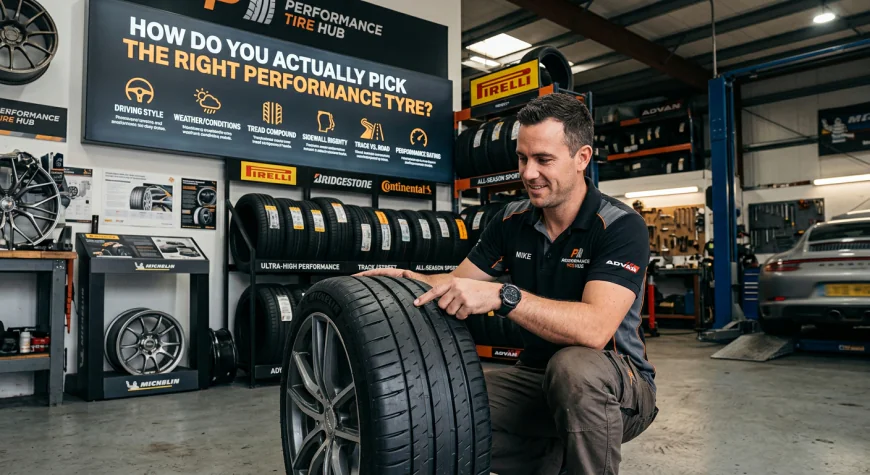
How Do You Actually Pick the Right Performance Tyre?
Match the tyre's priorities to how the car actually gets used. Don't just chase the biggest name on the sidewall — performance tyres aren't one category; they're several, and treating them as interchangeable is where a lot of people go wrong before they've even fitted them.
Some are built purely for maximum dry-weather grip on a car that mostly sees spirited road driving and nothing more serious than that. Others balance real wet-weather ability with everyday usability, because not everyone can get away with running a semi-slick as a daily driver. Certain lines lean hard toward occasional track days. Others prioritise ride comfort without giving up too much responsive handling in the process. Sites like Tyres.co.uk let you compare options by registration and actually see the technical differences between categories instead of just comparing prices, which helps a lot if you're trying to work out whether you need something dedicated to track days or a tyre that'll cope with a daily commute and still be up for a Sunday blast. A hot hatch driven every day and a weekend-only track car want completely different tyres — even if both owners would tell you they're chasing "performance tyres."
Why Does Temperature Change Everything About a Tyre's Grip?
Rubber behaves differently depending on how warm it is, and this catches out a lot of drivers who treat grip like a fixed quantity. A performance tyre running below its designed temperature window can actually offer less grip than an ordinary road tyre in the same conditions — genuinely worse, not just "not as good as it could be." Once that compound gets into its proper operating range, though, grip climbs sharply and it's a completely different tyre underneath you.
Anyone who's done a track day knows this feeling. The opening lap or two always feels flat and a bit vague, before things wake up properly as heat builds through both tyres and brakes. Works the other way too — too much heat and the compound overheats, grip falls away again just as it seemed dialled in. Managing that window is a genuine skill for anyone driving quickly on a regular basis, and it's a big part of why manufacturers pour so much research into compound development in the first place rather than just chasing a bigger tread block.
How Much Difference Does Tyre Pressure Really Make?
Enough that even the best performance tyres money can buy won't do their job properly if the pressure's off. It's not just a comfort thing — pressure changes how the contact patch sits on the tarmac, how heat builds through the carcass, how evenly the shoulders wear, how the car responds mid-corner. All of it.
Run a tyre too hard and the contact patch shrinks, grip drops, and the steering starts feeling nervous and skittish the moment the tarmac isn't perfectly smooth. Underinflate it and you get the opposite problem — sidewall flex goes up, that generates extra heat, rolling resistance climbs, and the outer edges of the tread wear faster than they should. Anyone who's serious about how their car handles checks pressures with an actual gauge rather than trusting a dashboard light that's calibrated to flag a problem, not to optimise anything for you. Manufacturer figures are a fine baseline for road use, but they're built around assumptions about load and temperature that don't hold up on track, which is why regular track day drivers keep adjusting pressures after watching how the tyre's wearing and heating up through the day.
Does Unsprung Weight Really Affect How a Car Handles?
Yes, and it gets overlooked because the lightweight wheels conversation usually stops at the wheel itself, forgetting the tyre wrapped round it counts too. Everything sitting below the springs — wheels, tyres, brakes, hubs, the lot — makes up the car's unsprung mass. Reduce it and the suspension reacts faster to bumps and imperfections, which helps the tyre stay in proper contact with the road instead of skipping across the top of it.
Knock-on benefits everywhere once you do that. Steering precision, braking stability, ride quality, traction on rough surfaces, general suspension response, it all improves a bit. Part of why premium performance tyres use more advanced construction to shave weight without giving up structural strength. Improvement can look modest written down on paper, but paired with decent suspension and well-chosen wheels — the sort of set-up we cover in our JDM wheel fitment guide — it adds up to a genuinely sharper car.
Are Today's Performance Cars Asking Too Much of Their Tyres?
In a lot of cases, yes — and it's only getting more extreme. Modern performance cars generate acceleration and cornering forces that would've belonged to genuine racing machinery a couple of decades back. Bigger power outputs, clever all-wheel-drive systems, adaptive suspension, electronic diffs, all of it loading serious demands onto tyres that simply didn't need to exist when half the classics people still modify were rolling off the line.
Even a fairly ordinary hot hatch now makes enough torque to overwhelm a standard touring tyre the second you drive it with any enthusiasm at all. Manufacturers have responded with increasingly specialised products built to handle those loads while staying predictable at motorway speed and under hard cornering. It's a big reason anyone stepping up from an older performance car to a modern equivalent notices a jump in grip before they've even touched the chassis or the electronics.
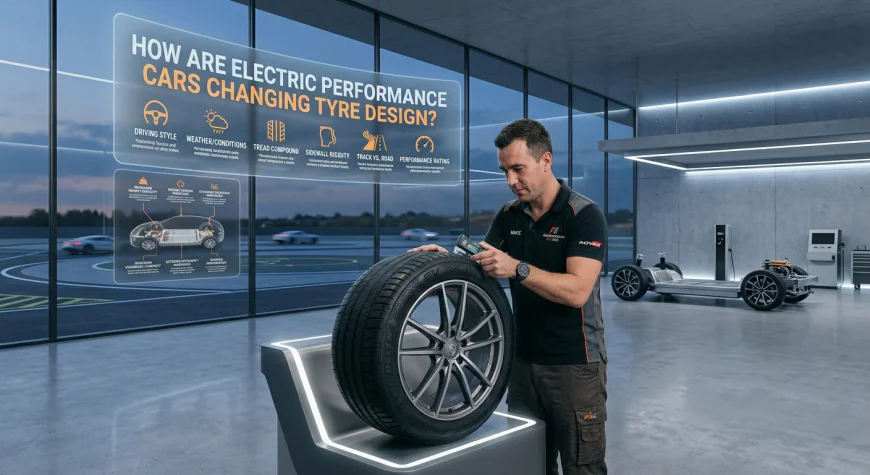
How Are Electric Performance Cars Changing Tyre Design?
They're forcing manufacturers to rethink construction from close to scratch. Near-instant torque from a standstill, combined with the extra weight of a big battery pack, creates demands a normal combustion car just doesn't put on a tyre, and that's pushed tyre engineering somewhere genuinely new.
EV-specific tyres now get built around reinforced internal construction, reduced rolling resistance, quieter road noise and proper high load capability — balancing all of that is nowhere near as simple as it sounds on paper. Push rolling resistance too low and grip can suffer for it. Chase durability too hard and flexibility drops off. Cut road noise, and you're usually doing extra engineering work in both the tread pattern and the carcass to get there. As EV performance cars get more common on UK roads, this side of tyre development isn't slowing down any time soon.
What Maintenance Actually Keeps Performance Tyres Performing?
Mostly the basics, done consistently. Nothing exotic about it. Even an excellent tyre loses its edge gradually if the rest of the car around it gets neglected — incorrect wheel alignment quietly raises rolling resistance while wearing the tread unevenly in a way that permanently costs you grip, and it's enough of an issue that we've gone through it properly in our wheel alignment after lowering guide. Worn bushes let unwanted movement creep in through corners. Tired dampers stop the tyre from keeping consistent contact with the road in the first place, no matter how good the rubber is.
Check pressures monthly. Look over the tread for uneven wear. Keep an eye on the sidewalls for cuts or bulges, rotate when it's due, get alignment checked after any decent impact — none of it's glamorous, but it's what actually preserves the handling you paid for. Suspension condition matters just as much here. A well-set-up coilover kit, the sort we break down in what are coilovers and how do they work, only delivers its full benefit when the tyres underneath it are in decent condition too.
The Simplest Upgrade Most Enthusiasts Overlook
Everyone loves modifying their car. More power grabs attention, a lower stance changes how it looks in every photo, big brakes look properly serious behind a lightweight set of wheels. None of it counts for much, though, unless the tyres can actually get that improvement down onto the road — which is the honest reason experienced drivers keep telling newer enthusiasts to sort their tyres out before chasing more power or another big-ticket mod.
A well-chosen set of performance tyres can transform steering accuracy, braking confidence, cornering stability, and just general driver confidence, in ways that genuinely catch out people who've been in the scene for years. They're not a consumable you swap when the tread's gone and forget about. They're one of the most heavily engineered parts on the whole car, and they decide how everything else you've fitted actually behaves once it hits the tarmac. Lightly modified daily, proper track weapon, or something in between — it always comes back to those four small contact patches doing the work.
For more builds, guides and everything else going on in the scene, head over to stanceauto.co.uk, and if you want the print side of things, our magazine is available through the Stance Auto Amazon store.
 Like
0
Like
0
 Dislike
0
Dislike
0
 Love
0
Love
0
 Funny
0
Funny
0
 Angry
0
Angry
0
 Sad
0
Sad
0
 Wow
0
Wow
0