

































































































.png)












![[HOONIGAN] Ken Block's GYMKHANA NINE](https://img.youtube.com/vi/_bkX5VkZg8U/maxresdefault.jpg)
















































































![[HOONIGAN] KEN BLOCK'S GYMKHANA SEVEN: WILD IN THE STREETS OF LOS ANGELES](https://cdn.motor1.com/images/mgl/2KlO4/s1/ken-block-london-tour-directors-cut.jpg)








































Relay Attack Car Theft: The New 2026 Law and How to Actually Protect Your Modified Car
Relay attack devices are now illegal to own in the UK under the Crime and Policing Act 2026. Here's what changed, why it matters, and how to protect your car.

Relay Attack Car Theft: The New 2026 Law
If you've ever glanced at your key fob sitting by the front door and wondered whether that's actually a security risk, the honest answer has been yes for years — and until very recently, the tools that made it a risk weren't even illegal to own. That's finally changed.
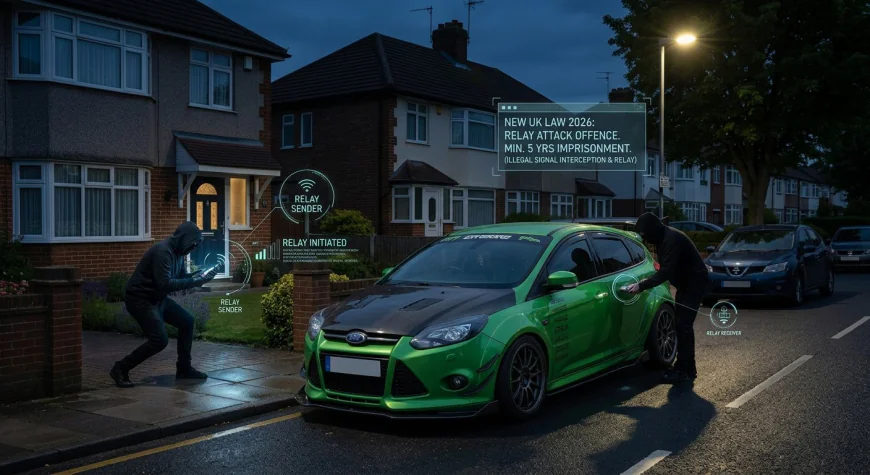
In plain English: relay attack is a method of car theft where thieves use a pair of electronic devices to capture the signal from your key fob, even through a wall, and relay it to your car parked outside. The car thinks the key is right next to it, unlocks, and in a lot of cases can be driven away without the key ever leaving your hallway. Until 29 April 2026, simply owning the kit that does this wasn't a crime in itself — only using it to actually steal something was. Now it is.
What Actually Changed
The relevant law here is the Crime and Policing Act 2026, a wide-ranging piece of legislation covering everything from knife crime to terrorism, but with a section that lands directly on anyone who owns a keyless car. It creates new offences covering the possession, importation, manufacture, adaptation, supply or offer to supply of an electronic device designed for vehicle theft — relay boxes, signal repeaters and amplifiers, signal jammers, and key emulators are all named specifically.
The genuinely significant part isn't just that these devices are now banned; it's who has to prove what. Previously, police needed to link a device to an actual theft to act on it, which made it almost impossible to touch the people stockpiling and supplying this kit. Under the new law, the burden flips: if you're found with one of these devices, it's on you to demonstrate a legitimate purpose, not on the prosecution to prove intent to steal. That single change is what's expected to actually disrupt the supply chain rather than just catching thieves after the fact.
Key Facts
- Legislation: Crime and Policing Act 2026 (Royal Assent 29 April 2026)
- What's now illegal: Possessing, making, importing, adapting or supplying relay attack tools, signal repeaters/amplifiers, signal jammers, and key emulators
- Burden of proof: Flipped — the person found with the device must prove legitimate use
- Penalty: Up to five years in prison, an unlimited fine, or both
- Scale of the problem: Electronic methods are used in around 40% of UK vehicle thefts nationally, rising to roughly 60% in London
- Police powers: Officers can now enter premises without a traditional warrant where a stolen vehicle has been tracked there
Why Modified Car Owners Should Care More Than Most
There's a reason this hits differently for this audience specifically. A build that's had real money and years put into it — coilovers, a widebody kit, forged wheels, an engine that's been properly gone through — isn't just replacing a lost commute vehicle if it disappears from your driveway overnight. A lot of that spend either isn't fully recoverable on a standard insurance valuation, or requires specialist modified car cover to even be accounted for properly in the first place. Thieves also aren't picking targets at random; a car that visibly stands out, sits somewhere it's easy to loiter near unnoticed, or gets photographed and geotagged at meets is, if anything, a more attractive target than an anonymous daily driver.
How Does a Relay Attack Actually Work?
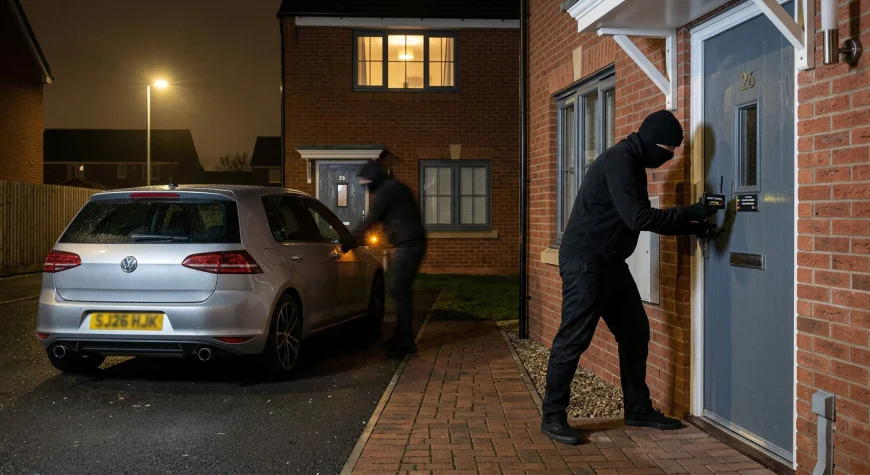
It's worth understanding the mechanics, because it explains why the fix isn't complicated. Every keyless fob is constantly emitting a low-power signal, and it's designed to only unlock the car when that signal is close enough to be trusted — inches, not metres. A relay attack uses two devices working as a pair: one held near your front door or window to pick up the fob's signal from inside the house, and a second held next to the car, which rebroadcasts that captured signal as if the key were sitting right there. The car can't tell the difference between the real signal and the relayed one, so it unlocks, and in cars where the ignition works the same way, it'll start too. None of it requires touching your key or breaking a window — which is exactly why it's grown into the dominant method of vehicle theft over the last decade, and exactly why criminalising the tools themselves, not just the act, was the gap this law closes.
What You Can Actually Do About It
The law targets supply, not the underlying vulnerability sitting in your key fob, so the practical advice for owners hasn't really changed — it's just more urgent now that the devices themselves carry criminal risk for anyone caught holding them. A Faraday pouch that blocks your fob's signal entirely is still the simplest and cheapest fix, and it's worth testing yours occasionally rather than assuming it still works — walk up to the car with the sealed fob in hand and check the doors genuinely don't respond. Keep both your main and spare fobs out of sightlines from doors and windows regardless, since some pouches degrade with age or a compromised seal.
Beyond that, it's worth checking whether your specific fob has a motion sensor that puts it to sleep after a period of stillness, which defeats a relay attack outright since a dormant fob has nothing to capture — your dealer or the manufacturer's technical line can usually confirm this. Newer platforms fitted with Ultra-Wide Band technology are considerably more resistant to relay attacks by design, since UWB can measure the actual distance to the key rather than just detecting a signal, so it's a genuine question worth asking if you're shopping for a donor car or a daily to pair with your project. None of this replaces good old-fashioned visible deterrents either — a steering lock or tracker doesn't stop the relay itself, but it does change the calculation for a thief who's just successfully unlocked a car they now can't easily drive away or keep.
Does This Overlap With the Wider Crackdown on Car Meets?
It's connected, if indirectly. This is one strand of a broader tightening around vehicle crime and car culture in the UK through 2026, alongside the expanded police powers and DVLA access affecting the car meet scene and the wider shift in how UK car meet law is being enforced. None of it is aimed at enthusiasts specifically — the Crime and Policing Act's vehicle theft provisions are squarely about organised crime, not car shows — but it's part of the same broader pattern of the modified car scene existing under sharper legal scrutiny than it did even a couple of years ago, for better and worse.
Is This Actually Going to Work?
The honest answer is: partly, and not immediately. Removing the tools from legitimate retail and reducing casual availability should meaningfully shrink the pool of people able to attempt relay theft opportunistically, and giving police the power to seize devices before a theft happens — rather than waiting for one to be reported — closes a real gap. What it doesn't do is fix the underlying vulnerability baked into how keyless entry works across most of the current UK car parc, which means determined, well-resourced organised gangs with existing stock of devices, or access to manufacturing routes outside the UK, aren't going to be stopped by this alone. Vehicle security researchers have been consistent on this point: legislation targeting supply is a genuinely useful lever, but it works best alongside manufacturers building in resistant technology like UWB as standard, rather than as a complete fix on its own.
For now, the practical takeaway for anyone with a keyless modified car is simple: the legal landscape around these devices has shifted in your favour, but the fob in your hallway is exactly as vulnerable today as it was in April. A £15 Faraday pouch is still doing more for your car's security this week than the new law will manage on its own.
For more on the changing legal landscape affecting modified car owners in the UK, along with the builds and features you're actually here for, grab a copy of Stance Auto Magazine on Amazon.
 Like
0
Like
0
 Dislike
0
Dislike
0
 Love
0
Love
0
 Funny
0
Funny
0
 Angry
0
Angry
0
 Sad
0
Sad
0
 Wow
0
Wow
0