






























































































.png)












![[HOONIGAN] Ken Block's GYMKHANA NINE](https://img.youtube.com/vi/_bkX5VkZg8U/maxresdefault.jpg)















































































![[HOONIGAN] KEN BLOCK'S GYMKHANA SEVEN: WILD IN THE STREETS OF LOS ANGELES](https://cdn.motor1.com/images/mgl/2KlO4/s1/ken-block-london-tour-directors-cut.jpg)








































AI Cameras Are Now Watching UK Drivers for Phones, Seatbelts, and Loud Exhausts — Here's What's Actually Live
AI cameras now catch UK drivers using phones, skipping seatbelts, and running loud exhausts. Here's exactly where they're live and how the tech works.
AI Cameras Are Now Watching UK Drivers
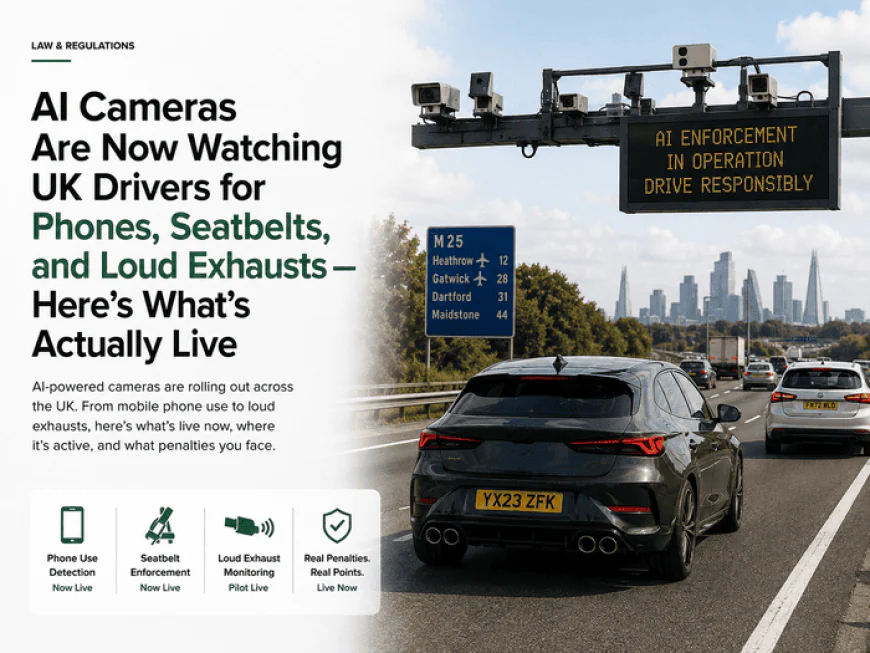
AI enforcement cameras, in the UK context, are two genuinely separate technologies that get lumped together in headlines: cameras that use artificial intelligence to spot phone use and unbuckled seatbelts through the windscreen, and acoustic cameras that measure exhaust noise against a legal limit — and both are already live, not theoretical, on UK roads right now. This applies to every driver, not just anyone running a modified exhaust.
In plain English: these cameras don't just clock your speed anymore — some can see inside your car to check if you're holding a phone or wearing a belt, and others listen for whether your exhaust is over the legal noise limit.
Phone and Seatbelt Detection Is Already a Multi-Force Rollout
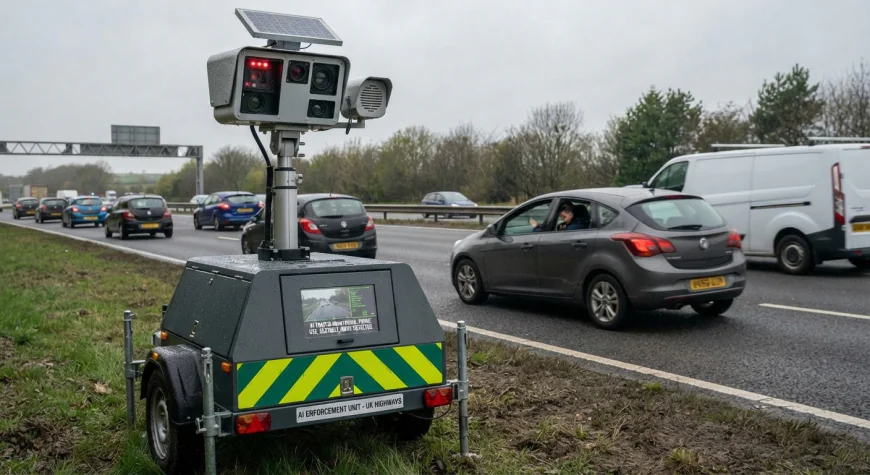
This started as a 2021 trial on a fixed camera on the M4 in Berkshire, which over six months flagged nearly 7,000 seatbelt offences and more than 25,000 instances of drivers holding phones. Off the back of that, National Highways partnered with engineering firm AECOM and, separately, camera maker Acusensus, to run mobile trailer- and van-mounted units through Devon and Cornwall from late 2022. It's since expanded to at least ten police forces, including Durham, Greater Manchester, Humberside, Staffordshire, West Mercia, Northamptonshire, Wiltshire, Norfolk, Thames Valley, and Sussex.
The mechanics matter here: the cameras use AI to flag a probable offence from footage, but a human reviewer checks every flagged image before it goes anywhere near an actual penalty — it's not a fully automated fine-by-algorithm system. When Sussex Police switched their cameras on in April 2026, the numbers from the prior year's trial gave a sense of scale: 458 offences detected across just seven days, split between seatbelt and phone use. Not wearing a seatbelt carries a fine of up to £500 plus penalty points; using a handheld phone while driving can mean a fine of up to £1,000 and six penalty points.
Exhaust Noise Cameras Are a Separate, Slower-Moving Trial
The acoustic camera side has a longer history and hasn't scaled anywhere near as fast. The Department for Transport backed a £300,000 trial that placed camera-and-microphone rigs in four locations — Bradford, Bristol (South Gloucestershire), Great Yarmouth, and Birmingham — running from late 2022 into 2023. The system pairs a video camera with multiple microphones to triangulate which vehicle in a group of traffic actually produced an over-limit noise reading, then automatically captures the plate.
The legal limit itself is already tightening on its own track, separate from the camera trial: vehicles manufactured from 2016 onward are capped at 72 decibels, dropping to 68 decibels for new vehicles from 2026. Public appetite for wider rollout looks strong — RAC research found 58% of drivers surveyed wanted noise cameras rolled out nationally, against just 22% opposed — but as of now, this remains a trial technology being evaluated for wider deployment, not a nationwide system.
Why This Isn't Just a "Modified Car" Story
It's worth being precise about scope here, because a lot of coverage frames both programs as being aimed at car culture specifically. The phone and seatbelt cameras aren't targeting modified cars at all — they catch any driver, in any car, doing either of two extremely common and largely unrelated things. The noise camera trial is more narrowly exhaust-focused, but even there, the DfT's own framing was about noise pollution and quality of life for residents on affected streets generally, not a car-culture crackdown specifically — modified exhausts are simply the most common cause of an over-limit reading.
Smarter Enforcement, or a Surveillance Creep Problem?
The safety case is straightforward and well-evidenced: National Highways cites research showing drivers using phones are four times more likely to be in a crash, and unbelted occupants are twice as likely to die in one — and unlike a stationary officer, these cameras run continuously and catch offences that would otherwise go completely unnoticed, since roadside enforcement of phone use has been notoriously hard to catch in the moment.
The pushback is less about any single camera and more about the trajectory: a network of cameras that can see inside your car, identify your vehicle's make and model, and — per National Highways documentation — retain footage for months with a commercial third party, is a genuinely different category of road policing than a radar gun. Privacy advocates have raised exactly this concern publicly, and it's a fair one to sit with even if you support the underlying safety goal: today's "detect phones and seatbelts" system is a data-processing pipeline that could, in principle, be pointed at other things in future without much additional hardware.
Either way, the practical reality for any driver on UK roads right now is that phone and seatbelt cameras are operating across ten-plus police force areas already, with more likely to follow the Sussex pattern through 2026, while the noise camera side is still trial-stage and narrower — but neither is going away.
For more on how UK road enforcement affects modified cars specifically, see our piece on UK car meet laws and new police powers.
Sources: National Highways Mobile Phone and Seatbelt Detection Trial privacy notice, Sussex Police AI camera announcement, RAC noise camera research, Institute of Acoustics briefing note on noise cameras, AtkinsRéalis/DfT noise camera trial announcement.
Content
 Like
0
Like
0
 Dislike
0
Dislike
0
 Love
0
Love
0
 Funny
0
Funny
0
 Angry
0
Angry
0
 Sad
0
Sad
0
 Wow
0
Wow
0