














































































.png)












![[HOONIGAN] Ken Block's GYMKHANA NINE](https://img.youtube.com/vi/_bkX5VkZg8U/maxresdefault.jpg)









































































![[HOONIGAN] KEN BLOCK'S GYMKHANA SEVEN: WILD IN THE STREETS OF LOS ANGELES](https://cdn.motor1.com/images/mgl/2KlO4/s1/ken-block-london-tour-directors-cut.jpg)




































How to Properly Select Oil for Your Vehicle
How to choose the right engine oil for your car — expert Juri Sudheimer explains OEM approvals, viscosity, and common mistakes to avoid.
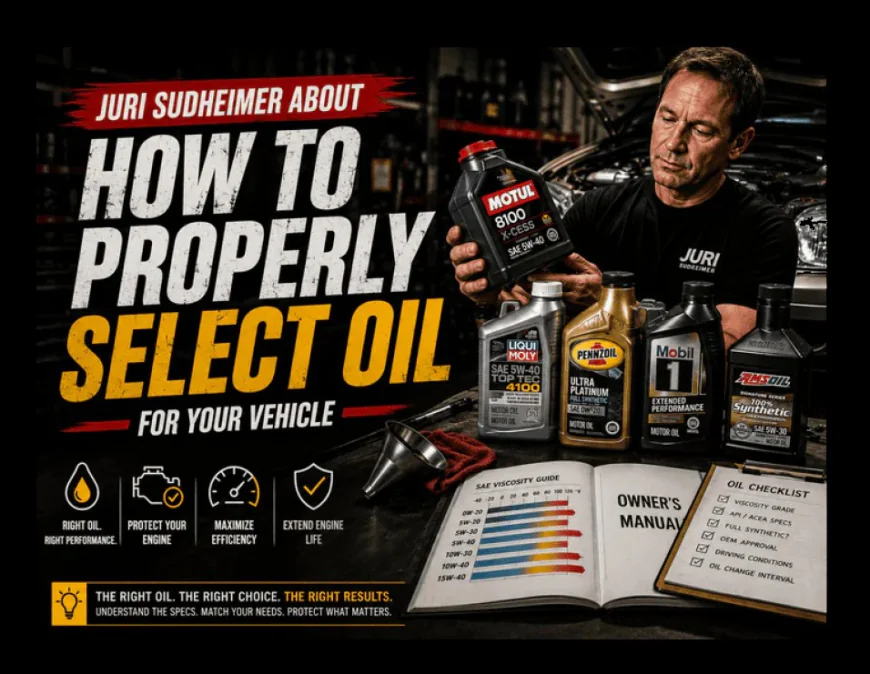
Juri Sudheimer About How to Properly Select Oil for Your Vehicle
The final requirements for motor oil are determined by the vehicle manufacturer or the component manufacturer, specifying approvals and specifications—for example, for an automatic transmission. First, design engineers select the oil according to the parameters of the engine or component, then the oil receives approval from the vehicle manufacturer (approval), and only after that does the vehicle owner choose the oil, guided by these recommendations for their vehicle, which are set out in the Owner's Manual or in the service book. Therefore, there is one simple golden rule -- always follow the recommendations set out in the owner's manual for your vehicle!
Expert Opinion: Juri Sudheimer
Juri Sudheimer, founder of Mannol and a specialist with more than 30 years of practical experience in the field of lubricants, notes that the overwhelming majority of engine problems arise not because of "bad oil," but because of deviations from the vehicle manufacturer's requirements.
According to Juri's observations, vehicle owners often perceive the recommendations in the manual as advice rather than as an engineering limitation. Meanwhile, approvals, viscosity, and oil requirements are part of the engine design, incorporated at the design stage. Ignoring these parameters, especially in modern engines, almost always leads to accelerated wear, even if the oil is formally considered "high quality."
The oil manufacturer does not assign specific fluids to individual vehicles; its task is to produce products that meet the established specifications and approvals of both vehicle manufacturers and automotive component manufacturers. It also cannot do this because it does not know all the design features of the engine or component, does not know which materials are used in them, and other significant design details that may affect the choice of oil.

Why Is It Also Important to First Refer to the Owner's Manual?
Because quite often the owner's manual specifies oils adapted to specific regions both in terms of fuel quality in that region and in terms of the climate of that region. That is, for different countries, the vehicle manufacturer may recommend oils of different viscosity for the same engine. For example, for a hot climate the manufacturer may recommend oil with a viscosity of 10W-40, and for a severe northern climate 0W-40.
In a number of cases, the vehicle manufacturer directly specifies oils and specifications whose use is not permitted for a particular engine. This particularly concerns energy-saving oils of the type A5/B5 or C5, C6, C7 with low HTHS, since these oils can only be used in engines adapted for this.
Is Deviation Allowed?
In a number of cases, the use of oil with better low-temperature characteristics is permissible, provided that the required specification and the vehicle manufacturer's approval are maintained. For example, in a hot climate, instead of oil 10W-40, using 5W-40 or 0W-40. Only why? Most likely, oils with better low-temperature properties will be more expensive.
But it is better to leave the operating viscosity---the second number---as it is. Of course, if you have a simple engine, for example a naturally aspirated gasoline engine, then changing the operating viscosity by +/- one grade will most likely not lead to anything serious, but for modern turbocharged engines with direct injection, equipped with numerous additional units, this may lead to serious consequences for engine life.
In general, there is another simple rule -- engines that are simpler in design are less sensitive to minor deviations in oil characteristics.
About the Turbocharger
It is necessary to understand one simple thing: the turbocharger places increased demands on the thermal stability and resistance of motor oil to coking. But then the vehicle manufacturer would have to equip the engine with a second oil circuit, and fill the engine with two oils: one engine oil, the other -- ultra-thermally stable specifically for the hot turbocharger. But this is expensive and technically difficult to implement, so motor oil manufacturers have to develop formulations capable of simultaneously meeting the requirements both for engine lubrication and for turbocharger operation.
A Serious Mistake
There is another serious mistake -- many believe that increased oil consumption (oil burning) can be neutralized by increasing the viscosity of the oil (at 100°C). That is, instead of oil 0W-20, pour oil 0W-30. This is far from always the case.
An increase in viscosity sometimes reduces oil consumption (if the cause is clearances/wear/leaks through guides/rings), sometimes does not affect it (if the cause is stuck rings, crankcase ventilation, turbocharger, etc.), and sometimes may worsen certain operating modes (for example, oil removal from the piston ring zone).
What Else Should a Vehicle Owner Consider When Choosing Oil?
For example, choosing between semi-synthetic and synthetic oil of the same viscosity, if such an option exists. It is also possible to choose between oil that has official approval from the vehicle manufacturer and oil that does not. But in any case, it is necessary to follow the recommendations of the owner's manual.
Internet Myths
On the internet, one can often encounter opinions from various bloggers that vehicle manufacturers deliberately prescribe in their manuals oils that will ensure engine life only within the warranty period. Particularly heated debates occur around low-viscosity oils such as 0W-20 and 5W-20 -- allegedly these will definitely destroy the engine!
However, there is no evidence of any mass failure of engines in any automotive brand immediately after the expiration of the warranty period. And the very fact of mass failure of vehicles after the warranty period would inevitably affect the image of any vehicle manufacturer. Therefore, all these speculations resemble conspiracy theories.
Practical View of Juri Sudheimer on "Universal Solutions"
Juri Sudheimer emphasizes that attempts to "universally improve" engine performance by changing viscosity are one of the most common and dangerous mistakes. Over years of working with failures of engines and transmissions, he has repeatedly encountered situations where switching to a more viscous oil only worsened the problem, accelerating coking of rings and the growth of deposits.
According to Juri, in modern engines oil has long ceased to be just a lubricant -- it performs the functions of a hydraulic fluid, a cooling element, and a medium for the operation of complex systems. Therefore, any deviation from the calculated parameters of the vehicle manufacturer disrupts the balance, for which the engine "pays" with its service life.
What to Do After You Have Found Oil Information in the Manual?
There may be several options here:
Option 1. The manual specifies viscosity and specification.
For example: in the RENAULT service book for vehicles with a diesel engine with a particulate filter (DPF), the following requirements for motor oil at T > -20°C are specified:
-
Specification RN 0720
-
Viscosity 5W-30 or 5W-40
To correctly select oil for your vehicle, oil manufacturers create resources on which, based on the required specification and viscosity, you can independently select the oil you need. For example, Mannol provides the website: https://www.mannol.de/product-selector
Option 2. The manual specifies a specific oil.
For example, in the manual for NISSAN Qashqai: NISSAN Motor Oil Synthetic Technology 5W-40 A3/B4, and in the manual for Toyota RAV4: Toyota Genuine Motor Oil 5W-30 Premium Fuel Economy for 2WW engine. In this case, you already know exactly which oil you need.
What to Do If There Is No Owner's Manual?
Option 1. Use any selection tool.
By vehicle model, year of manufacture, etc., you can select oil for your vehicle. Most selection tools use OEM manufacturer data, however their databases may differ in volume and relevance of information.
Olyslager
Olyslager is a leading global supplier of lubricant data for the industry. This information is obtained directly from more than 2,700 OEM manufacturers, which guarantees its accuracy and reliability. Olyslager states that it does not publish and will not publish data not confirmed by documentation from OEM manufacturers.
Mannol
Among oil manufacturers, Mannol offers a convenient service where you can select the required oil using the resource https://www.mannol.de/product-selector. Nevertheless, it should be understood that no selection tool contains as detailed information as that contained in the manual. This can be considered a backup option.
Option 2. Contact an authorized service center.
There they can help you find the manual for your vehicle, and if they do not have it either, then based on their practice and on the basis of information from the vehicle manufacturer, they will recommend the most suitable oil in their opinion. Most likely, it will be either OEM or not the cheapest. But having this information, you will be able to select oil at your own discretion.
Selection of Oil for Manual Transmissions
For them, the selection methodology is the same as for motor oil. Knowing the viscosity and required specifications, you can use any selection tool, such as https://www.mannol.de/product-selector, and select the required oil.
Selection of Fluid for Automatic Transmissions
Here everything is not so simple. There is no single universal global standard for automatic transmissions, since requirements are formed by specific OEMs. This can be done for Japanese and many Asian vehicles, since all ATF fluids for them must comply with one or another category of the Japanese standard JASO M315.
In all other cases, this can only be done by selecting a fluid with the required specification. The manufacturer of the additive package for ATF fluid usually provides a long list of specifications. Such lists may include both official specifications and references to OEM numbers, names of fluids, and internal designations of transmissions. In addition to specifications, this list may contain: OEM part number, name of OEM oil, gearbox number, transmission number, etc.
 Like
0
Like
0
 Dislike
0
Dislike
0
 Love
0
Love
0
 Funny
0
Funny
0
 Angry
0
Angry
0
 Sad
0
Sad
0
 Wow
0
Wow
0