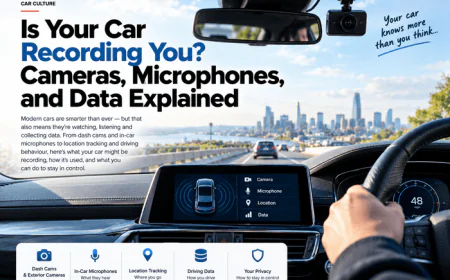






























































































































































































































Is Your Car Recording You? Cameras, Microphones, and Data Explained
Is your car recording you? Learn what data cameras, microphones and connected systems collect, who can access it, and how to take control of your privacy.
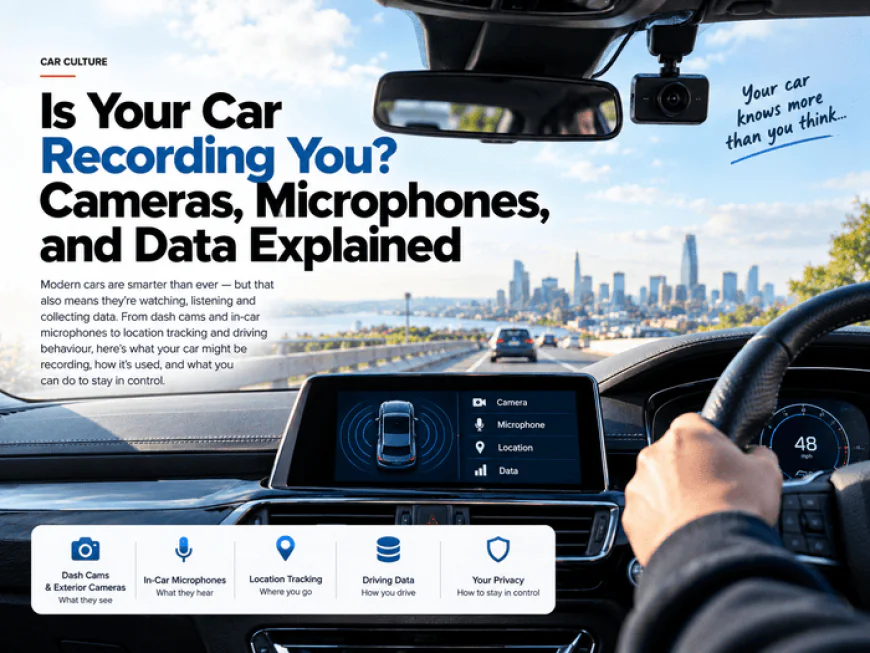
Think about the last time you got into your car. You might have connected your phone via Bluetooth to play your favourite playlist, adjusted the climate control, or switched on your dashcam before setting off. It all seems pretty routine, until you consider how much technology is working behind the scenes.
Modern cars are more than just four wheels and an engine. They contain sensors and connected systems that can collect information about your journeys and how you use your vehicle. From dashcams and microphones that pick up voice commands to GPS systems that track your location, your car may be gathering more data than you realise.
Understanding how these systems work can help you make informed decisions about your car's settings and protect your personal information. Here's what you need to know about car cameras, microphones, and connected data.
What Can Your Car Actually Record
What your car collects depends on its make, model, equipment, and connected services. However, the amount of data gathered may be greater than you expect. According to the BBC, some carmakers collect precise location data, passenger details, seatbelt use, and driving habits, including speeding and harsh braking. Some may even gather personal details such as age, weight, and facial expressions.
Darrell West of the Brookings Institution highlights the implications, warning that this information could allow a person’s life to be “recreated almost on a second-by-second basis”.
Here are some of the main types of data your car may collect:
- Cameras: Dashcams, reversing cameras, and driver-monitoring systems may capture road conditions, occupants, or incidents.
- Microphones: Voice assistants and hands-free calling systems use microphones to process voice commands and speech.
- Location data: Navigation systems may store destinations, recent journeys, and saved locations.
- Performance data: Sensors monitor speed, braking, and vehicle faults, while event data recorders capture limited technical information around a collision.
- Phone connections: Pairing your phone may allow the infotainment system to access contacts, call histories, and messages, depending on the permissions you grant.
Who Can Access Your Vehicle's Data
Vehicle data may be stored in the car itself, on a paired phone, or on a manufacturer’s servers, depending on the technology and services you use. Manufacturers and connected-service providers process this information to support features such as navigation, remote locking, diagnostics, and software updates. Insurance telematics schemes may also collect driving data under their own terms.
Whether insurers, repair providers, or law enforcement can access this information depends on the circumstances, applicable laws, and any required permissions. Camera footage is not automatically available to every third party.
Beyond privacy, connected vehicles also raise security concerns. The Guardian reports that the Dutch intelligence service AIVD has called for “awareness of espionage risks around modern vehicles”, including the possibility of microphones being activated remotely. Although the warning did not name a specific country, it comes amid growing Chinese car imports to the UK.
The Society of Motor Manufacturers and Traders (SMMT) reports that Chinese-owned brands account for 15% of new car registrations. Earlier reports also revealed that British defence firms had cautioned staff against pairing their phones with Chinese-made electric cars over data security concerns.
What Privacy Risks Should Drivers Consider
Connected features can be useful, but they may reveal more about your daily life than you realise.
Location histories can expose commuting routes, home addresses, and frequently visited places, while saved destinations in shared vehicles may remain visible to other users. Dashcams can capture pedestrians and number plates, and cabin-facing cameras may record passengers or conversations.
If you sell, rent, or lend your car without disconnecting your phone or signing out of personal accounts, you could expose contacts, saved addresses, and other private information. Weak passwords and outdated software create additional security risks.
These concerns are reflected in real-world cases. According to Infosecurity Magazine, Volkswagen received a €1.1 million fine in 2022 for failing to adequately inform test drivers about in-car camera recordings. The following year, more than 100GB of Tesla data, reportedly including sensitive customer and employee information, was leaked by insiders.
As connected vehicles become more common, protecting personal data is increasingly important.
When Vehicle Data Becomes Relevant to Personal Safety
Vehicle recordings and connected data can sometimes help clarify what happened during an incident. Dashcam footage, location histories, messages, and journey records may provide useful context, depending on what they capture.
If an incident occurs, prioritise your safety, report it to the appropriate authorities when necessary, and preserve any relevant original files. Avoid editing recordings or sharing sensitive material publicly without considering the privacy implications.
These records may also be relevant in cases involving personal safety, not just road accidents. For example, someone who experiences alleged sexual assault during an Uber journey may need to consider legal options beyond filing a complaint with the platform. TorHoerman Law notes that Uber Technologies, Inc. faces lawsuits from individuals who allege they were sexually assaulted by Uber drivers.
In the United States, an Uber sexual assault lawyer can help affected individuals understand their legal options and assess what evidence may support a claim. The appropriate course of action depends on the circumstances and jurisdiction. However, while digital records may assist an investigation, they do not automatically prove what happened or establish liability.
How Can You Control What Your Car Records
You can take several practical steps to reduce unnecessary data collection without giving up useful vehicle features.
- Review privacy settings: Explore the infotainment system and manufacturer's app to identify optional data-sharing, location, and recording settings.
- Check microphone settings: Find out when voice assistants are active and whether voice data is processed locally or through an online service.
- Manage connected accounts: Remove old phone pairings, sign out of personal accounts before selling or returning a vehicle, and delete saved destinations where appropriate.
- Review camera settings: Check whether your dashcam records audio, how long it retains footage, and whether automatic uploads are enabled.
- Secure your accounts: Use strong, unique passwords and enable additional account security where available.
- Read the privacy policy: Check what information is collected, why it is needed, how long it is retained, and whether optional data collection can be disabled.
In the UK, the UK GDPR and Data Protection Act 2018 give individuals rights over their personal data, including, in certain circumstances, the right to erasure. When selling or returning a vehicle, ask the relevant dealer or provider to remove personal data stored in the vehicle and associated accounts.
Finally, remember that recordings may capture other people, so consider their privacy when using or sharing footage.
Frequently Asked Questions
Do all modern cars record audio and video?
No. Recording capabilities vary by make, model, equipment, and software. Some vehicles have recording-enabled cameras or microphones, while others use cameras only for live assistance or have microphones that respond to voice commands. Check your vehicle manual and settings to understand its specific capabilities.
Can someone access my car's location history?
Potentially, depending on the vehicle's connected services, account permissions, and security settings. Manufacturers or service providers may process location data to deliver particular features. Someone with access to your connected-car account may also be able to view certain information. Review account access and privacy settings regularly.
Can dashcam footage be used as evidence after an incident?
Yes, dashcam footage may be submitted to the police or used in legal proceedings, depending on the circumstances. Its usefulness depends on factors such as image quality, context, and what the recording shows. Preserve the original file and seek guidance from the relevant authorities or a qualified legal professional when necessary.
Statistics and Key Insights Mentioned in the Article
|
Share of new UK car registrations accounted for by Chinese-owned brands |
15% |
|
Fine imposed on Volkswagen in 2022 over data protection failures |
€1.1 million |
|
Volume of Tesla data reportedly leaked by insiders in 2023 |
More than 100GB |
|
Types of data some carmakers may collect |
Multiple categories including location, driving habits, and passenger details |
|
Laws give individuals rights over their personal data, including the right to erasure in certain circumstances. |
UK GDPR and Data Protection Act 2018 |
Modern vehicles can collect information through cameras, microphones, navigation systems, and connected services. While these technologies can improve convenience and safety, they also make privacy settings and responsible data management increasingly important.
Take time to review your vehicle's recording features, check connected accounts, and understand how information is stored or shared. If you use a dashcam, manage its footage carefully and consider the privacy of others who may be recorded. A little awareness can help you enjoy the benefits of connected-car technology while maintaining greater control over your personal information.
 Like
0
 Dislike
0
 Love
0
 Funny
0
 Angry
0
 Sad
0
 Wow
0