










































.png)








![[HOONIGAN] Ken Block's GYMKHANA NINE](https://img.youtube.com/vi/_bkX5VkZg8U/maxresdefault.jpg)
























































![[HOONIGAN] KEN BLOCK'S GYMKHANA SEVEN: WILD IN THE STREETS OF LOS ANGELES](https://cdn.motor1.com/images/mgl/2KlO4/s1/ken-block-london-tour-directors-cut.jpg)






























K20 vs K24: Honda's Two Legendary Engines Compared
K20 vs K24: we compare Honda's two legendary K-series engines on displacement, power, torque and swap cost to help you pick the right build.
Honda's Two Legendary Engines Compared
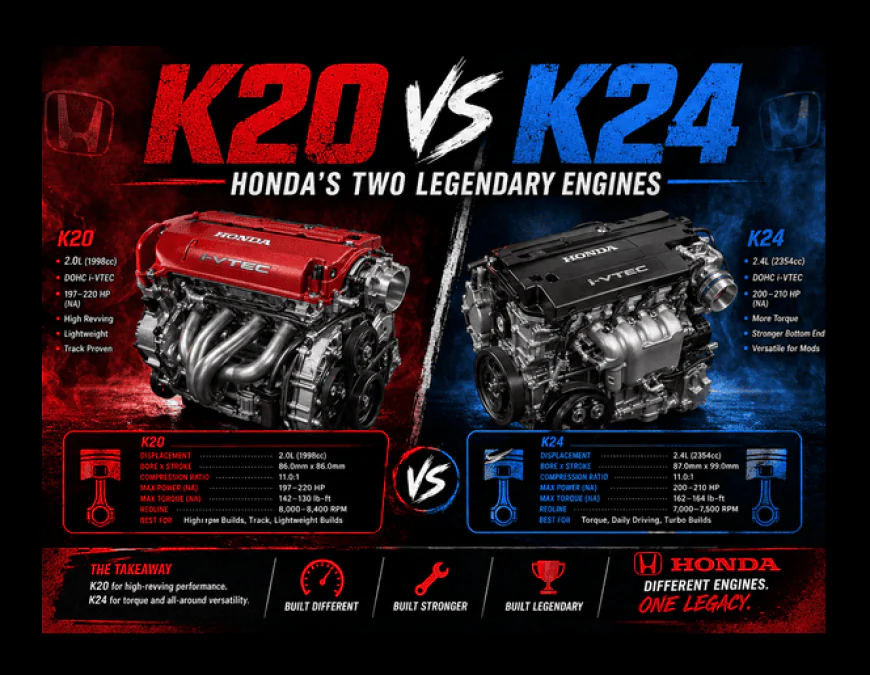
Few engine families split opinion in the Honda scene quite like the K-series does, and the K20 vs K24 debate has been running since both engines were still under warranty. They share the same basic architecture, the same VTEC philosophy, and a lot of cross-compatible parts, but they were built with genuinely different priorities, and knowing which one actually fits your build brief matters more than picking whichever one sounds more famous.
| K20 | K24 | |
|---|---|---|
| Displacement | 2.0L | 2.4L |
| Character | High-revving, VTEC-focused | Torque-focused, broader powerband |
| Famous variant | K20A (Civic/Integra Type R) | K24A2/K24Z (Accord, CR-V, Civic Si later years) |
| Stock power range | 200-220hp | 160-200hp depending on variant |
| Typical swap use | Track/drift builds, high-rev enthusiasts | Stroker builds, torque-focused street builds |
Displacement, Power and Character
The K20 is the engine most Honda enthusiasts picture when they hear "K-series," largely thanks to the K20A that powered the Civic and Integra Type R models, an engine that made its case entirely through high-revving VTEC theatrics and a genuinely thrilling top-end. The K24 trades some of that top-end drama for a broader, torquier powerband from the factory, thanks to its larger displacement, which made it the natural choice for heavier applications like the Accord and CR-V where low-down grunt mattered more than a screaming 8,000rpm redline.
The K24 Stroker Trick That Changed Everything
Here's where the comparison gets genuinely interesting rather than just being two spec sheets side by side. The K-series' shared bore spacing means a K24 block can be built up with a K20 head, known as the "K20/K24" or "Frankenstein" build, combining the K24's larger displacement and torque with the K20's higher-revving head and VTEC character. This hybrid approach has become one of the most popular routes in the whole K-series scene precisely because it sidesteps the K20-vs-K24 choice entirely, giving you displacement and top-end in the same package.
Reliability and Bottom End Strength
Both engines share Honda's reputation for genuinely robust factory engineering, and neither has a significant reliability black mark against it in stock form. The K24's larger displacement does mean slightly different thermal and mechanical loads than the K20, but nothing that translates into a meaningful reliability gap between the two in day-to-day driving. Where things diverge is under serious boost or high-rev abuse, where factory rods on either engine become the limiting factor, and forged internals become the sensible upgrade path on both once you're chasing real power numbers.
Weight and Swap Difficulty
Both engines share close enough dimensions that swap kits and mounting solutions largely overlap, making the choice between them less about install difficulty and more about which output characteristic actually suits your build. Neither is meaningfully heavier or lighter in a way that changes handling balance noticeably, unlike the bigger weight gaps you see comparing something like a 1JZ to a 2JZ.
K20 Pros and Cons
- Pros: Thrilling high-rev VTEC character, proven Type R pedigree, strong aftermarket support
- Cons: Less low-down torque than the K24, needs revs to make the most of it
K24 Pros and Cons
- Pros: Broader, more usable torque from lower in the rev range, strong stroker/hybrid build platform
- Cons: Less dramatic top-end character in stock form, slightly less iconic than the K20A specifically
K20 vs K24 in Real-World Chassis
The K20 has historically found its most natural home in lighter Civic and Integra chassis, where its high-revving character and lower weight suit a nimble, track-focused build brief. The K24, particularly in hybrid form, has become a favourite for builders wanting a genuinely quick street car without needing to live at 7,000rpm to access the fun, making it a common choice for daily-driven project cars where broader torque is simply more practical than outright top-end drama.
Final Verdict
There's no wrong answer here, only the wrong engine for a build brief it wasn't suited to. Pick the K20 if the high-rev VTEC experience is the whole point of the build. Pick the K24, or better yet a K20/K24 hybrid, if broader torque and street usability matter more to you than chasing redline on every drive.
How Does This Compare to Other Engine Families?
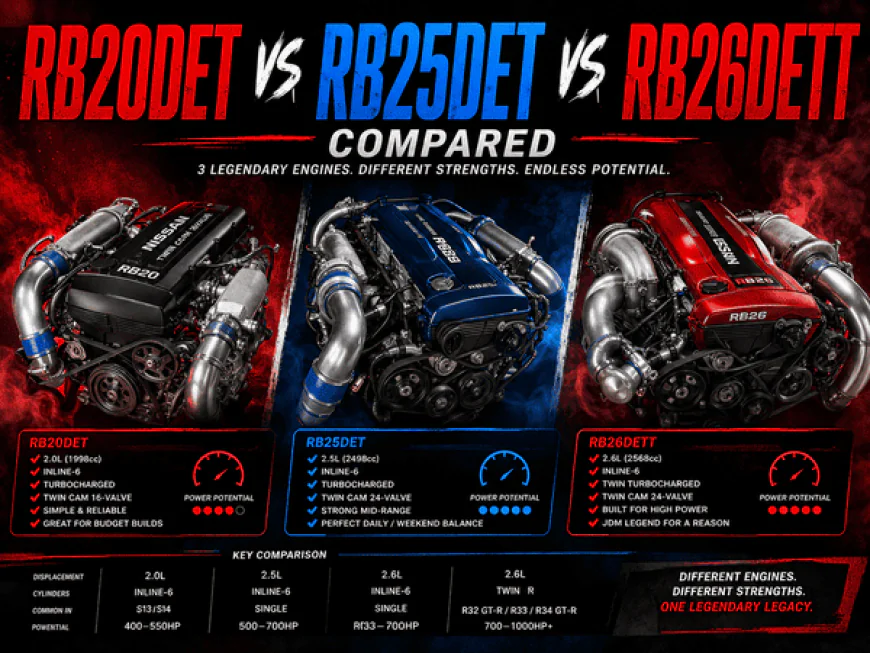
If you've read our breakdowns on the 1JZ vs 2JZ or RB20 vs RB25 vs RB26, you'll notice the K-series occupies a different niche entirely, four-cylinder, naturally aspirated by default, and built around VTEC's high-rev philosophy rather than factory turbocharging. That makes the K-series a genuinely different build philosophy from the big turbocharged inline-sixes, lighter, revvier, and generally cheaper to build to a comparable power figure before forced induction enters the picture.
Which Turbo and Supporting Mods Make Sense?
Both engines respond well to forced induction, and a single turbo from a brand like Garrett is the common route once you're past what naturally aspirated tuning can extract. Pairing that with a standalone ECU from Haltech gives you the tuning control to actually run boost safely on either block, and upgraded injectors from Injector Dynamics are a common companion purchase once you're pushing past stock fuelling limits on either engine.
Availability and Cost
The K24 is generally the easier and cheaper of the two to source, given how many Accords, CR-Vs and later Civics it powered across a long production run, making donor engines relatively plentiful in salvage yards. The K20, particularly the Type R-spec K20A, commands a genuine premium thanks to its performance pedigree and comparatively limited production run in the cars that made it famous. If budget is a major factor, sourcing a cheap K24 as the base for a hybrid build with a separately sourced K20 head is often more cost-effective than hunting down a complete, matching-numbers K20A setup.
Common Mistakes on K-Series Builds
The most common mistake on either engine is underestimating how much the factory ECU and wiring assumes about the exact engine and transmission combination it was paired with from the factory, which becomes a real headache on hybrid builds specifically. Getting the ECU, sensors and wiring harness properly matched to a mixed K20/K24 combination is where a lot of otherwise straightforward builds run into unexpected delays, and it's worth budgeting real time for this rather than assuming it'll be a simple plug-and-play swap.
So, Which K-Series Should You Actually Build?
If you want the classic high-revving Honda experience and don't mind working the rev range to get there, the K20 remains the emotional and cultural benchmark. If you want a broader, more flexible powerband, or you're planning a stroker build combining the best of both, the K24 (or a K20/K24 hybrid) is the more practical choice for most street-focused builds. Honestly, a lot of serious K-series builders end up at the hybrid combination anyway, which tells you plenty about how complementary these two engines actually are rather than being true rivals.
See K-Series Builds in Action
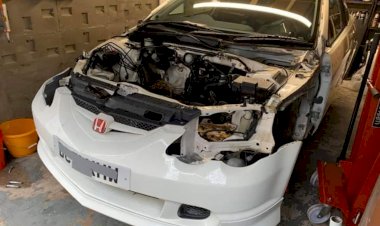
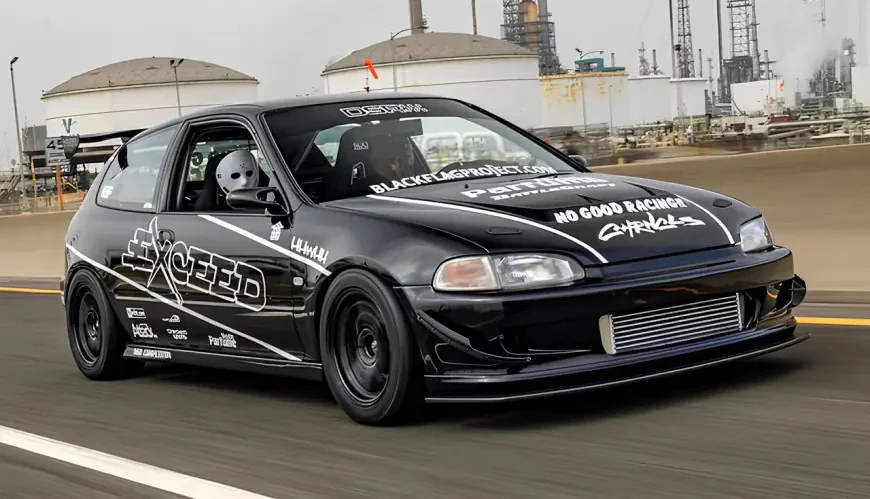
Our own budget 300bhp EP3 build guide walks through exactly what a well-executed K20 turbo build looks like on a realistic budget, and Dan Edwards' supercharged EP3 shows the same engine family pushed a different way, via forced induction from a Jackson Racing supercharger rather than a turbo.
For more Honda engine breakdowns and swap guides, and everything else modified car culture, head back over to Stance Auto Mag. You can also grab the latest print issue through our Amazon magazine store.
 Like
0
Like
0
 Dislike
0
Dislike
0
 Love
0
Love
0
 Funny
0
Funny
0
 Angry
0
Angry
0
 Sad
0
Sad
0
 Wow
0
Wow
0