



























































































.png)












![[HOONIGAN] Ken Block's GYMKHANA NINE](https://img.youtube.com/vi/_bkX5VkZg8U/maxresdefault.jpg)















































































![[HOONIGAN] KEN BLOCK'S GYMKHANA SEVEN: WILD IN THE STREETS OF LOS ANGELES](https://cdn.motor1.com/images/mgl/2KlO4/s1/ken-block-london-tour-directors-cut.jpg)



































Speed Limiters Are Already in Your New Car — Here's What UK Law Actually Requires
New cars sold in the UK now come with Intelligent Speed Assist as standard, even though it isn't UK law. Here's what ISA actually does and who it affects.

Speed Limiters Are Already in Your New Car
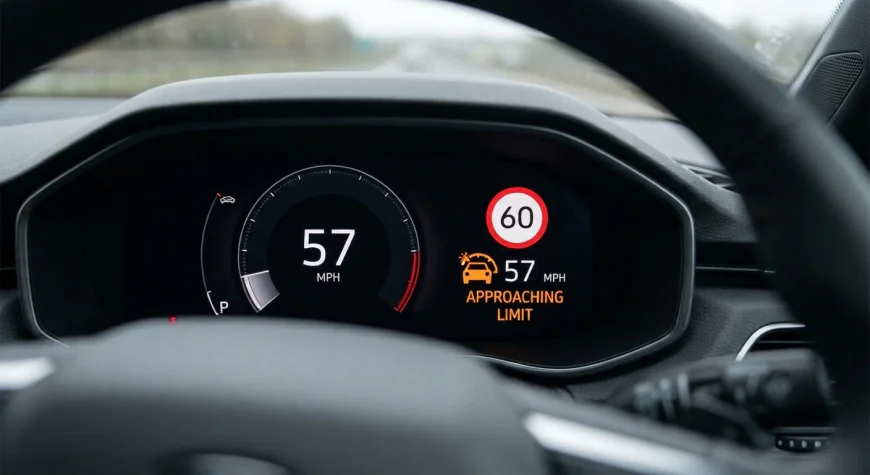
Intelligent Speed Assist, or ISA, is a driver-assistance system — using GPS positioning and camera-based sign recognition — that identifies the posted speed limit and warns, nudges, or gently resists the driver when they go over it, and it's already standard equipment in the vast majority of new cars sold in Britain, even though there's technically no UK law that requires it.
In plain English: the EU made this mandatory, Britain left the EU, and yet almost every new car sold here has it anyway — because manufacturers build one European specification and don't bother making a UK-only version without it.
The Law That Doesn't Actually Apply Here (But Might as Well)
The regulation itself is European: under EU Regulation 2019/2144 (the General Safety Regulation, or GSR2), ISA became mandatory for all newly-launched car models from July 2022, then extended to every new car sold — regardless of when that model was first launched — from 7 July 2024. Northern Ireland is legally bound by this, since it remains aligned with parts of EU single market law post-Brexit. Great Britain is not: the Department for Transport has confirmed the mandate doesn't apply in England, Scotland, or Wales.
In practice, that legal distinction barely matters to the average buyer. Because manufacturers engineer to a single EU-wide specification rather than build a stripped-down UK variant, ISA ships as standard in nearly every new car sold in Great Britain regardless of the legal technicality. If you've bought a new car in the last couple of years, you almost certainly already have it.
How It Actually Behaves Behind the Wheel
ISA isn't a hard speed cap in the way people often assume — the EU regulation specifically requires it to work with the driver rather than override them. Manufacturers can choose from four permitted feedback methods: audible tones, a vibration through the seat or wheel, gentle resistance through the accelerator pedal, or a more direct speed-control function. Whichever method a manufacturer picks, the system must be fully overridable by simply pressing harder on the accelerator, and it resets to active every time you restart the car — you can't permanently switch it off. It's worth being clear this sits alongside, not instead of, the UK's existing hard speed limiter law for heavy vehicles under the Road Vehicles (Construction and Use) Regulations, which is a completely separate, older requirement for lorries, buses, and coaches.
What This Means for Remapped and Older Cars
This is where a lot of the online concern doesn't quite match reality. ISA only applies to new cars as they're sold — it isn't being retrofitted to the existing UK fleet, so anything already registered before your car's specific launch or sale-date threshold is unaffected. For enthusiasts running a remap on a newer car that does have ISA, remapping the engine's power and fuel maps is legal in the UK and entirely separate from the ISA system, which operates through the car's driver-assistance software rather than the engine ECU tune itself — a Stage 1 or Stage 2 remap doesn't touch it either way. The genuine legal risk with any remap remains what it's always been: emissions compliance under the Road Vehicles (Construction and Use) Regulations 1986, not speed-limiter interference.
Does Factory-Fitted Speed Assistance Kill the Appeal of a Performance Car?
For a lot of drivers, the practical answer is: not really, since the system is designed to be trivially overridable at any moment and most people barely notice it beyond the occasional chime. For enthusiasts specifically, though, there's a longer-term unease worth taking seriously: today's advisory, easily-overridden ISA sets the software and hardware baseline that a future, stricter mandate could simply switch from "advisory" to "hard limit" with an over-the-air update, no new hardware required. That's not a hypothetical unique to cars, either — it's the same pattern seen with other assistance systems that started as suggestions and became harder to disable over successive model years.
The case for it is straightforward and well-supported: the European Commission attributes roughly 30% of fatal crashes to excessive speed, and ISA is one of the cheapest interventions available precisely because it just uses data the car already has (GPS and sign-recognition cameras most new cars already carry for other systems) rather than requiring new hardware. Whether that trade-off feels worth it probably depends on how much you trust the system to stay in "advisory" mode long-term — which is exactly the debate that's played out around similar tech in the US, where states have taken the more contained approach of mandating hard limiters only for court-ordered high-risk drivers rather than every new car.
If you're weighing how new safety tech interacts with a build you're planning, our piece on what you must legally disclose when selling a modified car in the UK is worth reading alongside this one.
Sources: EU Regulation 2019/2144 (GSR2), Department for Transport comments via Which? and Auto Express, RAC Drive GSR2 explainer, Road Vehicles (Construction and Use) Regulations 1986.
 Like
0
Like
0
 Dislike
0
Dislike
0
 Love
0
Love
0
 Funny
0
Funny
0
 Angry
0
Angry
0
 Sad
0
Sad
0
 Wow
0
Wow
0