

















.png)





![[HOONIGAN] Ken Block's GYMKHANA NINE](https://img.youtube.com/vi/_bkX5VkZg8U/maxresdefault.jpg)





























![[HOONIGAN] KEN BLOCK'S GYMKHANA SEVEN: WILD IN THE STREETS OF LOS ANGELES](https://cdn.motor1.com/images/mgl/2KlO4/s1/ken-block-london-tour-directors-cut.jpg)


















Best Skyline GT-R for a Modified Build: R32 vs R33 vs R34
The best Skyline GT-R for a modified build depends on your goals — here's how the R32, R33 and R34 compare for drift, track, show and daily builds.
Best Skyline GT-R for a Modified Build
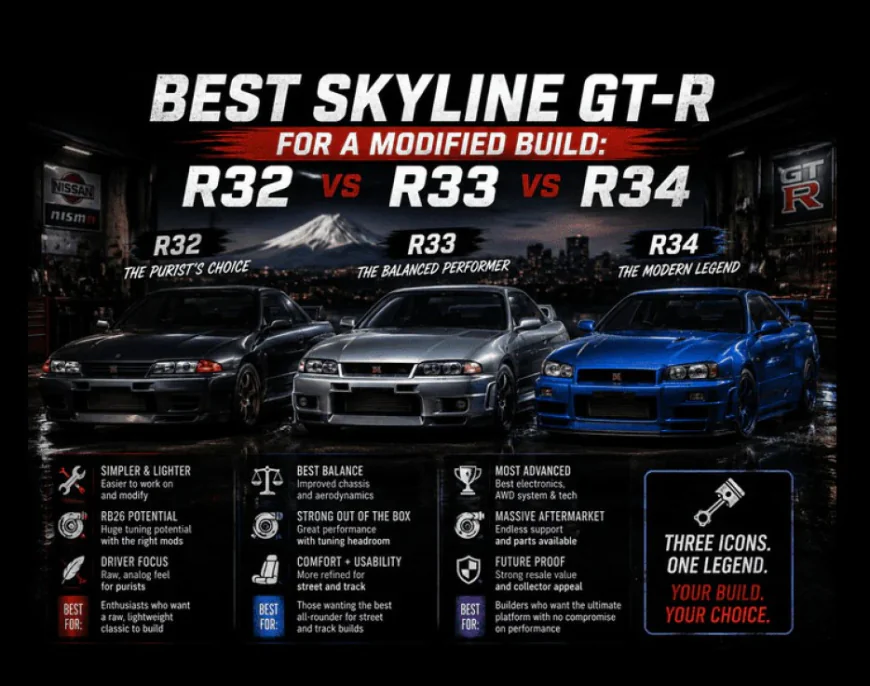
The Nissan Skyline GT-R is a turbocharged, four-wheel-drive performance car built across three main generations — R32, R33 and R34 — between 1989 and 2002, all powered by the same legendary RB26DETT straight-six. The best Skyline GT-R for a modified build genuinely depends on what you're building it for. There's no single right answer here — a drift car wants something completely different from a time attack weapon, and a weekend show build has different priorities again. All three generations share the same bones, the legendary RB26DETT twin-turbo six and ATTESA E-TS four-wheel-drive system that made the platform famous, but the weight, chassis stiffness and electronics shift enough between R32, R33 and R34 that the "best" one really is a moving target depending on your goals.
This isn't about crowning one generation king. It's about matching the car to the build, because buying the wrong Skyline for what you actually want to do with it is one of the most common regrets in this scene. So let's go through it by build type, not just by spec sheet.
What's the Best Skyline GT-R for a Modified Build?
For most people the answer comes down to weight versus refinement. If you want the lightest, most old-school platform to throw around, the R32 wins every time. If you want a stiffer chassis and more stability at serious speed, the R33 and R34 pull ahead, with the R34 commanding a serious premium for being the last car to run the RB26DETT before Nissan moved on. Budget, build goal and how much you're prepared to spend on an already-expensive platform all factor into which one actually makes sense for you.
Best Skyline GT-R for a Drift Build
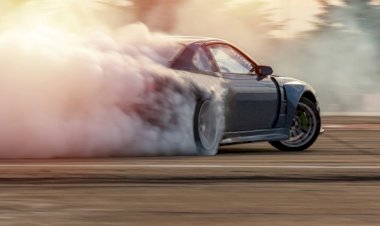
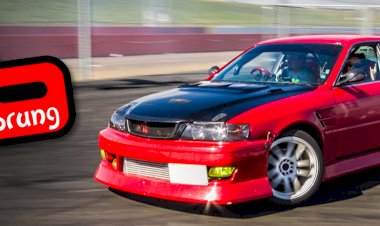
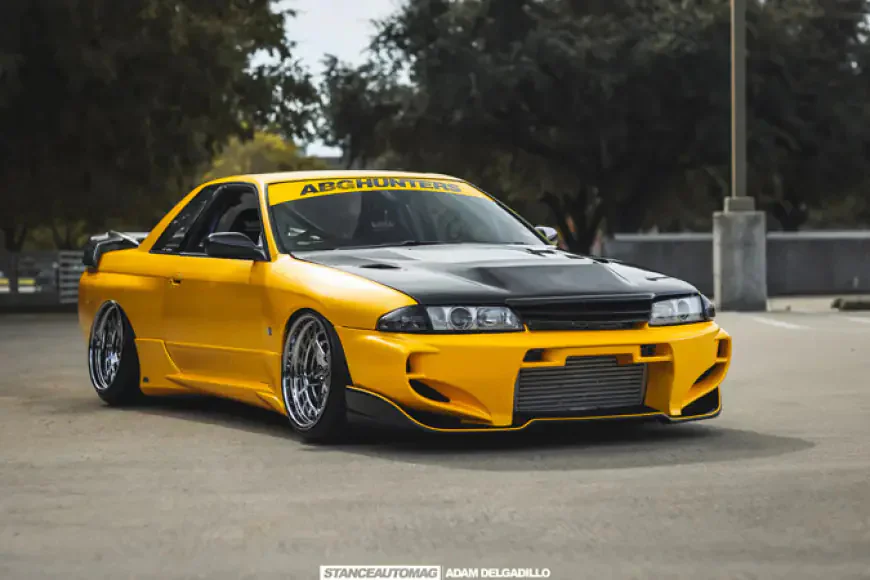
The R32 is the standard pick for drift builds, and it's not close. Its light weight, somewhere around 1,430kg, combined with the shortest wheelbase of the three generations, makes it the most responsive and easiest to rotate on turn-in. A huge amount of the drift scene's love for the RB26DETT platform started with R32s specifically, because the extra kilos the R33 and R34 pack on start working against you the moment you're trying to unstick the rear end on command. Parts availability for pure drift setups, aftermarket angle kits and suspension geometry mods is also deepest for the R32 simply because it's been the go-to for the longest.
If originality matters to you even in a drift build, the NISMO Heritage Parts programme is worth knowing about — Nissan's own remanufacturing effort has kept a lot of discontinued panels and trim pieces available for R32 owners who don't want to hunt secondhand for years.
There's also a practical side to this that doesn't get talked about enough: crash repairability. Drift cars get hit, that's just the nature of the sport, and the R32's popularity means body panels, subframes and suspension arms are still comparatively easy to source secondhand from breakers and specialists. Go looking for the same parts on an R34 and you'll pay considerably more, if you can find them at all, which is one more reason the R32 stays the default choice once a build moves from "show car with attitude" into genuinely competitive drift territory.
Best Skyline GT-R for Track and Time Attack
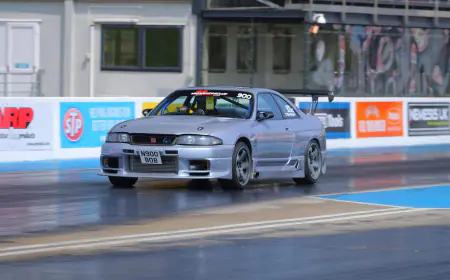
For anyone building toward serious track pace rather than sideways theatrics, the R33 is arguably the best Skyline GT-R for a modified build aimed at lap times, and it's the one to actually take seriously. It's the car that put Nissan on the map by becoming the first production car to break eight minutes around the Nürburgring, and that record didn't happen by accident — the R33's stiffer chassis, longer wheelbase and improved aero over the R32 make it a noticeably more planted, more confidence-inspiring car once you're carrying real speed into a corner. It's also, right now, the least expensive of the three to buy into, which matters a lot when your budget needs to stretch to a cage, brakes and suspension on top of the car itself.
The R34 will get you there too, and its shorter wheelbase versus the R33 gives it a slight edge in tighter, technical sections, but you're paying a significant premium for that last bit of sharpness. For most track builds, the R33 is the smarter spend, with the R34 reserved for buyers who've got the budget to treat "best" and "most expensive" as the same thing.
Weight distribution is another factor that gets overlooked here. The R33's longer wheelbase spreads load more evenly through fast direction changes, which is part of why it feels so settled once you're pushing on at a circuit like Silverstone or Donington. Add a proper set of coilovers, some decent brake cooling and a cage, and you've got a platform that can genuinely embarrass cars twice its price on a trackday, without needing anywhere near R34 money to get there.
Best Skyline GT-R for a Show Build or Daily Driver
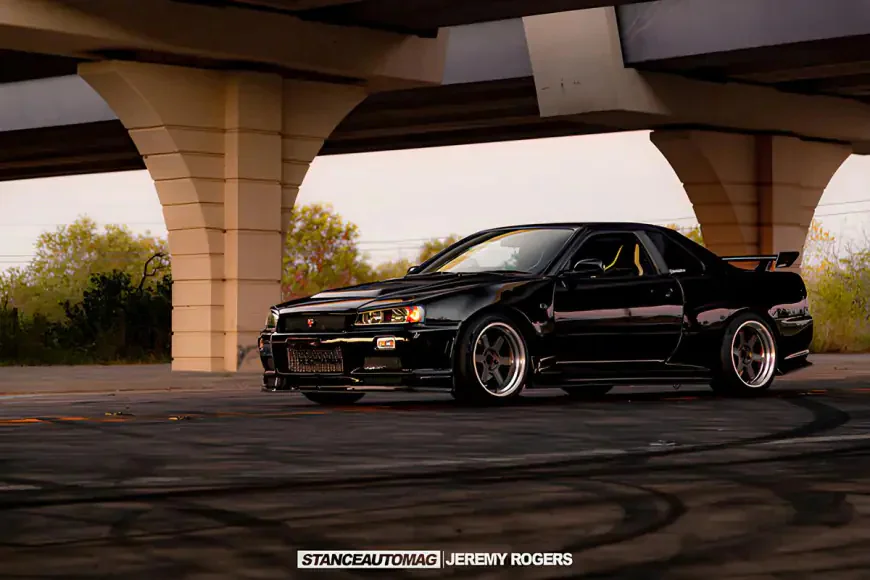
If your priority is presence and daily usability, the R34 is generally the best Skyline GT-R for a modified build with show or daily-driver goals, and this is where it earns its reputation. Its shortened wheelbase, tighter chassis and that now-iconic multi-function LCD display, which let owners monitor boost and oil temperature without a single aftermarket gauge in sight, make it the most complete package to live with day to day and the most striking thing to roll into a car meet. It's the car most people picture when they hear "Skyline," and that cultural weight is exactly why R34 values have climbed as hard as they have.
If you want that R34 presence without the R34 price tag, a well-specced R33 gets you most of the way there, particularly once you've fitted a set of wheels and coilovers that lean into the show side of the build. Plenty of builders go this route deliberately, banking the savings for the mod list instead of the badge.
Importing a Skyline GT-R for a Build
Sourcing the best Skyline GT-R for a modified build in the UK usually means either sourcing one already here or importing directly from Japan, and that choice affects all three generations differently. R32s and R33s are both well past the 25-year import threshold that applies in markets like the US, so availability out of Japan is still decent for both, though the good, unmolested examples get snapped up fast by specialist importers before they ever reach a public listing. R34s are a different story — Japanese owners are increasingly reluctant to let clean cars go, and the ones that do come up for export command a serious premium before you've even factored in shipping and compliance.
Whichever generation you're chasing, buying UK-spec versus importing isn't just a price question, it's a paperwork and provenance one too. A UK-registered car with a known history removes a lot of the guesswork that comes with an import, even if it costs more upfront, and that's worth weighing against the theoretical savings of going direct to a Japanese auction house.
Budget vs Ultimate: Which Skyline GT-R Should You Buy?
If you're building on a tighter budget and want the lightest, most rewarding platform to actually drive, the R32 remains the smart entry point into GT-R ownership. If you want the best all-round platform for track use without paying R34 money, the R33 is the one that deserves more respect than it usually gets. And if you've got the budget and want the last word on the RB26DETT era, the R34 is still worth every penny to the right buyer.
"I built my R33 knowing full well I could never afford an R34 doing the same job — and honestly, I don't think I'd swap now," is a sentiment you'll hear more and more as R33 prices start catching up to what the car's always deserved. There's no wrong answer among the three once you know your own build goals, which is really the whole point of thinking about the best Skyline GT-R for a modified build this way rather than by spec sheet alone. Whichever generation you land on, tuning specialists like HKS have supported all three platforms for decades, so power isn't the limiting factor here — knowing what you actually want the car to do is.
Quick Spec Comparison
- R32 GT-R (1989–1994): ~1,430kg, RB26DETT twin-turbo, shortest wheelbase, best for drift and old-school feel
- R33 GT-R (1995–1998): ~1,540kg, RB26DETT twin-turbo, stiffest chassis of the era, best value for track builds
- R34 GT-R (1999–2002): ~1,560kg (trim dependent), RB26DETT twin-turbo, shortened wheelbase, best for show and daily use
Whichever generation you're drawn to, the support network around the platform is one of the best in modified car culture — the GTROC has spent two decades building exactly the kind of knowledge base and parts network that makes long-term Skyline ownership far less daunting than tackling it alone.
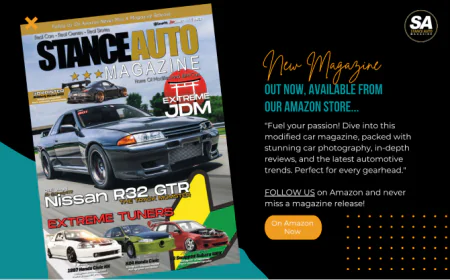
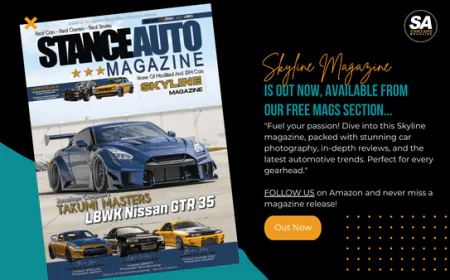
For a full spec-by-spec breakdown of how the three generations actually differ, check out our Skyline R32 vs R33 vs R34 comparison — and if you want to see some of these legends in print, our full magazine archive is available through our Amazon store.
 Like
0
Like
0
 Dislike
0
Dislike
0
 Love
0
Love
0
 Funny
0
Funny
0
 Angry
0
Angry
0
 Sad
0
Sad
0
 Wow
0
Wow
0